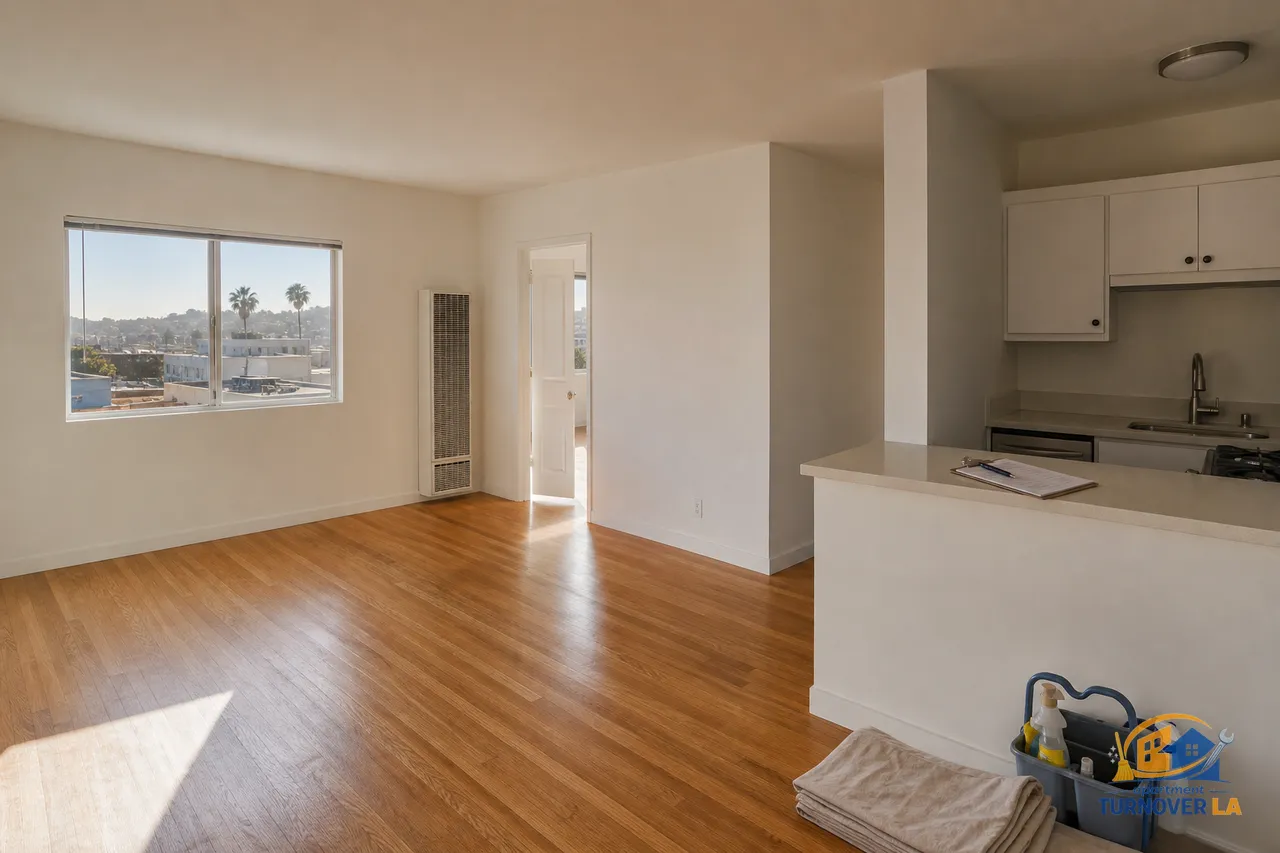
Quick answer: Across LA, the average apartment turnover typically costs $1,000 to $5,000, depending on condition and vacancy days. With TurnOver LA, a clean 1BR often pencils near $585 to $835 using catalog items like Make Ready at $255, paint touch-up at $200, rekey at $150, and a half-day handyman at $230. Turnaround is a flat 48 hours.
LA turnover averages are broad because they blend labor, supplies, and vacancy days. In practice, a light 1BR with routine cleaning and a few repairs can land well under the citywide average, while a repaint, wall repairs, and junk haul push the budget higher. If your goal is a tight turn with minimal days vacant, start by isolating the highest ROI tasks and schedule them back-to-back. Get instant quote in 30 seconds
How much does the average apartment turnover cost in LA?
Across Los Angeles, a typical turnover runs $1,000 to $5,000. That number mixes cleaning, paint, drywall work, hardware, locks, listing media, and vacancy loss that can be $80 to $200 per day depending on submarket. By line item, LA market pricing often looks like $250 to $450 for a 1BR deep clean, $400 to $900 per room for repainting, $175 to $300 per drywall patch, and $125 to $250 for rekey.
Against that backdrop, TurnOver LA’s catalog can hold a light 1BR closer to $585 to $835 in many clean cases: Make Ready at $255, paint touch-up at $200, full apartment rekey at $150, and a half-day handyman punch list at $230. Heavier scopes cost more, but every item is fixed price with a 48-hour turnaround. That clarity helps you trade budget against vacancy days with fewer surprises.
Which line items drive turnover cost the most in LA?
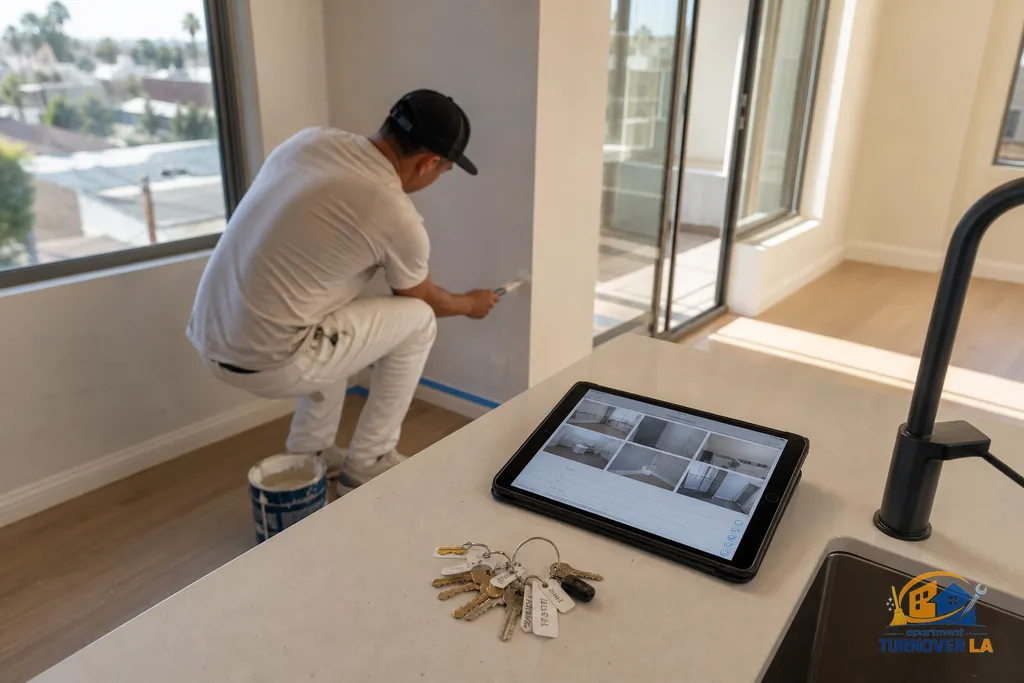
The big drivers are painting, drywall repair, and days vacant. Paint is usually the largest labor block. Market repainting often lands $400 to $900 per room, while TurnOver LA is $345 per room, with ceilings and trim at $125. Drywall adds up fast when there are multiple patches. Market is commonly $175 to $300 per patch. TurnOver LA is $150 per small patch and $240 per medium patch. Multiply either by five holes and you have a meaningful swing.
Vacancy loss adds real money. In West Hollywood or Santa Monica, two idle days can equal $300 to $500 in lost rent. A cleanout, rekey, and photo-ready clean done in two days helps offset that. Cleaning, locks, minor maintenance, and listing media are smaller but important. Make Ready is $255 for a 1BR, rekey is $150 for up to two locks, and the TLA Launch Pad Media Package is $399.
What does a realistic LA market vs TurnOver LA scope look like?
Here is a common light-to-moderate 1BR scope for context. Market numbers are general LA ranges sourced from vendor quotes and landlord experience. The TurnOver LA column is our catalog, all with 48-hour turnaround.
| Scope item | Typical LA market | TurnOver LA catalog |
|---|---|---|
| 1BR deep clean | $250 to $450 | Make Ready 1BR $255 |
| Paint touch-up | $200 to $500 | Paint touch-up only $200 |
| Repaint per room | $400 to $900 | Repainting per room $345 |
| Small drywall patch | $175 to $300 | Small drywall patch $150 |
| Half-day handyman | $250 to $450 | Half-day punch list $230 |
| Full apartment rekey | $125 to $250 | Full rekey up to 2 locks $150 |
| 1BR junk haul | $300 to $600 | Unit cleanout 1BR $310 |
| Listing media | $250 to $600 | TLA Launch Pad Media Package $399 |
If a unit only needs a Make Ready, paint touch-up, and rekey, you might land near $605. Add a half-day handyman and you are at $835. Add a full room repaint and a small drywall patch and you are at $1,330. Get instant quote in 30 seconds
How long does an apartment turnover take in Los Angeles?
Most light turns can be completed in 48 hours if you schedule tasks in the right order and keep the scope tight. That means cleanouts or trash first if needed, then paint touch-ups and drywall, then a Make Ready clean with a 12-point photo report, followed by rekey and final checks. TurnOver LA’s standard is a flat 48-hour turnaround on every job, no rush fee.
Heavier scopes, like full repainting of multiple rooms, cabinet refinishing, or several drywall repairs, can take 3 to 5 days in practice. The key is running trades in parallel where space allows and locking in media on day two so you can list as soon as the unit is safe and clean. That lowers vacancy loss in neighborhoods like Koreatown or North Hollywood where days-to-lease can swing with photos.
What is a good turnover rate for apartments?
For stabilized LA buildings, an annual turnover rate between 35 percent and 55 percent is common. Garden-style assets in the Valley may sit on the low end, while urban 1920s walk-ups near Downtown can run higher. A good turnover rate is the one that fits your rent growth plan without overpaying in vacancy loss and make-ready labor.
Three practical targets help: retain residents who are on-time payers, keep standard turns under $1,500 when possible, and replace residents who block NOI growth. Use renewal offers and minor upgrades that tenants value, like refreshed paint in bedrooms or working smart locks. A lower turnover rate is not always better if you are trading away reasonable rent steps or holding rough units that later cost more to make ready.
What is the 30 percent rule for apartments, and does it apply to turnover?
The 30 percent rule is a tenant affordability guideline that says households should spend no more than 30 percent of income on rent and utilities. It is not a property operations rule, and it does not govern turnover budgeting. For turnover, your better guardrails are vacancy math and payback periods on scoped work.
A simple framework is this: if the work does not help you rent in 2 to 4 days, or does not deliver a measurable rent lift within one leasing cycle, push it to a later capital plan. Focus your turnover budget on work buyers can see at first showing. Paint, clean, repair hazards, replace broken hardware, and publish professional photos quickly. The cost that does not help show the unit or pass habitability is usually a poor candidate for day-one spend.
Need the unit turned before the next tenant?
We do the move-out clean and send you a photo report you can attach to the deposit itemization.
Get an instant quoteCan a landlord charge you for flooring in California?
Yes, but only for damage beyond ordinary wear and tear. California Civil Code section 1950.5 allows deductions from a security deposit for cleaning, repair of damage, and restoring the unit to the same level of cleanliness, but not for normal aging. Heavy pet stains, burn marks, or unauthorized modifications can be charged. Routine traffic wear on carpet or minor finish wear on wood floors cannot be.
If you charge for flooring or other repairs, you must provide an itemized statement and receipts within 21 days of move-out. See California Civil Code §1950.5 and the California DCA Landlord-Tenant Guide for details on documentation and timelines. For deeper odor or stain problems, see our guide on pet odor removal and smoke smell removal, and budget for targeted cleanup rather than full replacement when salvageable.
- Reference: California Civil Code §1950.5
- Reference: California DCA Landlord-Tenant Guide
How do LA rent rules and deposits affect turnover charges?
LA rent stabilization rules do not change what you can deduct, but they influence strategy. Under the LAHD Rent Stabilization Ordinance, owners often plan paint and patch work that supports long-term habitability and controls future repair calls. For deposits, AB 12 (2023) security deposit cap generally limits residential security deposits to one month of rent for many landlords starting 2024 to 2025, with some exceptions for small owners and corporate rentals.
The cap tightens cash flow on heavy turns. That makes scope control more important. Document damage with a photo report, apply only allowable deductions, and avoid over-improving during turnover when you will not recoup in a single leasing cycle. TurnOver LA’s Make Ready includes a 12-point photo report that supports your deposit accounting and reduces disputes.
What are the fastest ways to cut turnover cost and days vacant in LA?
Five steps consistently lower both cost and vacancy days across LA submarkets:
- Pre-inspect and order parts before move-out. Door handles, angle stops, smoke and CO alarms are common fail points.
- Lock your schedule. Reserve cleaners, paint, and handyman in a 48-hour block, then rekey on exit.
- Limit paint to show walls and high-touch areas. Use touch-up unless a room fails at first glance.
- Publish listing media by day two. The TLA Launch Pad Media Package at $399 routinely shortens time to first showing.
- Price the unit correctly on day one. Missed pricing adds more vacancy cost than any single trade.
- Use a short punch list visit. Our half-day handyman at $230 clears 6 to 10 items most tenants notice.
- Close with a Make Ready photo report. It protects the deposit process and marketing.
Pair those steps with a realistic target for your submarket. In Highland Park and Echo Park, listings with fresh photos often book first tours within 24 to 48 hours in normal conditions.
What does a tight-budget 1BR turnover plan look like?
Here is a lean plan that keeps a clean 1BR near the low end of spend and still shows well:
- Make Ready clean with 12-point photo report: $255
- Paint touch-up only for scuffs and corners: $200
- Half-day handyman punch list for loose hinges, blinds, GFCI checks: $230
- Full apartment rekey up to two locks: $150
- Optional listing media if you do not have recent photos: $399
Without media, you are at $835. With media, you are at $1,234. Both deliver a presentable unit in 48 hours when scheduled correctly. If you inherit junk or bulky items, add a 1BR unit cleanout at $310 and still keep the total under many citywide averages. For detailed inclusions, see our Make Ready service page and book a slot now. Get instant quote in 30 seconds
How should you decide between touch-up and full repaint?
Use three checks. One, stand at the entry and scan the main walls in daylight. If mismatched tones or roller marks are obvious, repaint that room. Two, check kitchens and baths for moisture damage or semi-gloss mismatches. If touch-up flashes, repaint those walls as a set. Three, compare labor against vacancy math. If a full room repaint at $345 nets a faster lease by a day or two, it can pay for itself in Hollywood or Culver City.
If color drift is severe across rooms but budgets are tight, repaint the living room and primary bedroom first, then touch-up the rest. Add ceilings and trim at $125 only when discoloration is noticeable. This approach yields most of the visual gain for less labor and helps you publish photos by day two.
What TurnOver LA services cover the typical turnover scope?
- Cleaning and documentation: Make Ready includes deep clean and a 12-point photo report.
- Paint and wall repair: See interior painting and drywall for touch-ups, per-room repainting at $345, and patches.
- Repairs and safety: Use a half-day handyman punch list for common fixes and checks.
- Locks: A full apartment rekey is $150 for up to two locks.
- Junk removal: Unit cleanout at $310 for a 1BR.
- Marketing: The TLA Launch Pad Media Package is $399.
For broader planning, see our guides on apartment turnover cost in Los Angeles, the apartment turnover checklist, and what a Make Ready includes. If you are managing deposits, review normal wear and tear in California and the 21-day deposit return rule. To model downtime, see vacancy loss math for LA property managers.
Bottom line: what should you budget for your next LA turnover?
Set a base plan at $585 to $835 for a clean 1BR using Make Ready, touch-up, rekey, and a half-day handyman. Add $345 per room you choose to repaint, $150 to $240 per wall patch, and $310 if you need a 1BR cleanout. Consider $399 for media if you do not have current photos. Then weigh each addition against vacancy days for your submarket, which often costs $80 to $200 per day. Book early, scope tightly, and publish quickly. Get instant quote in 30 seconds