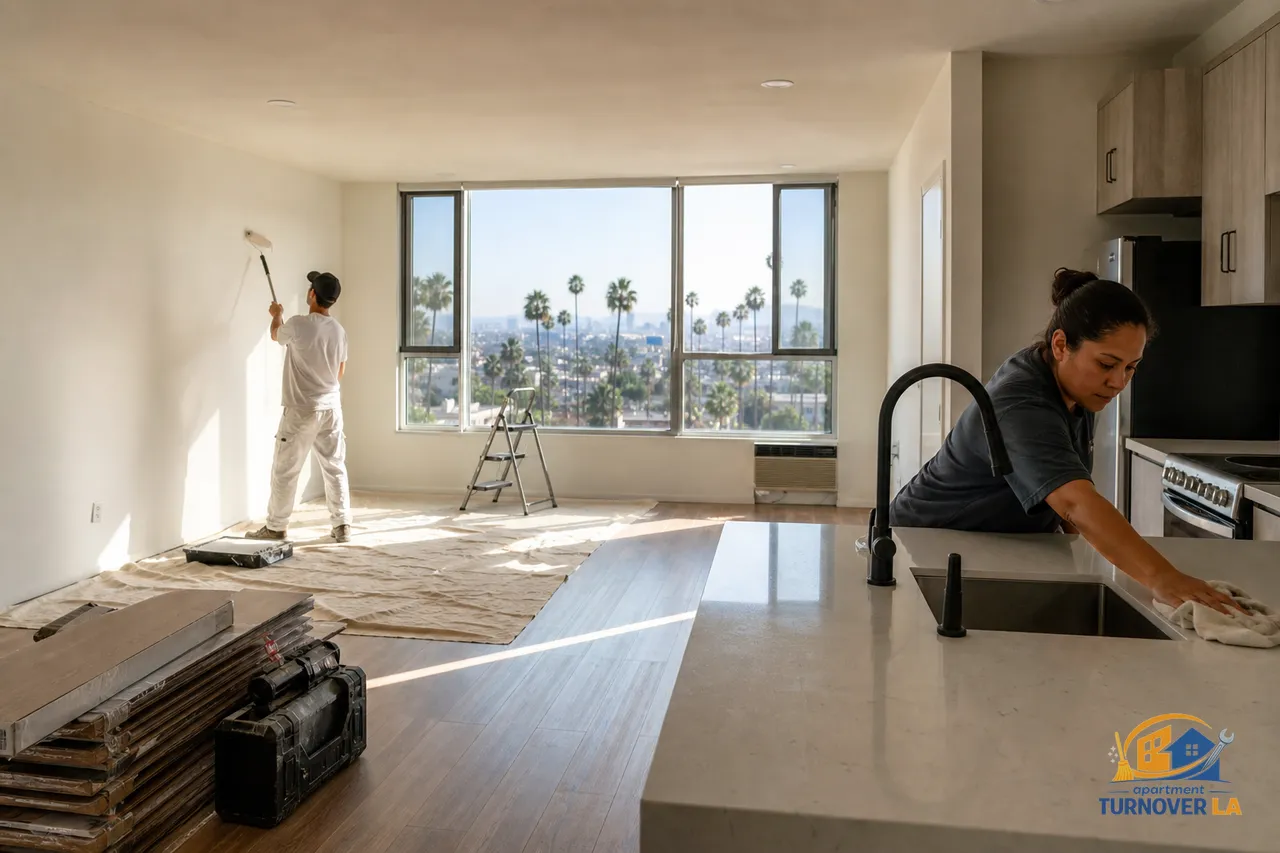
Quick answer: In Los Angeles, most apartments see a 35% to 45% annual turnover rate, with 25% to 35% considered good for stabilized buildings. Calculate it as move outs divided by total units over a defined period. Student and coastal submarkets can push 50% in peak months. Faster turns cut vacancy loss and improve NOI.
Across LA, annual apartment turnover typically lands between 35% and 45%. In stabilized properties with strong retention and predictable renewals, 25% to 35% is a realistic target. Your exact rate depends on submarket dynamics, lease expirations, price changes, and how efficiently you execute turns and re-leasing. Get instant quote in 30 seconds
What is apartment turnover rate and how do you calculate it?
Turnover rate is the share of units that move out and must be re-leased in a period. The basic formula is move outs divided by total units, measured monthly, quarterly, or annually. If a 40 unit building has 14 move outs in a year, the annual turnover rate is 14 divided by 40, which is 35%. If 4 units turn in June, the monthly rate for June is 4 divided by 40, which is 10%. Use the same denominator every time so comparisons hold. Include only completed move outs, not notices. For mixed asset portfolios, calculate rate by property, then weight by unit count to get a portfolio average. This isolates problem assets and seasonality.
What is a good tenant turnover rate in Los Angeles?
A good rate in LA is 25% to 35% for stabilized buildings with consistent renewals. Newer lease ups, heavy student concentration, or short-term job centers often land 35% to 50%. LA Rent Stabilization Ordinance buildings can show lower voluntary turnover in prime corridors because renewal increases are capped, which improves retention. Price sensitivity also matters. A 10% rent bump in Koreatown can nudge move outs more than the same change in Brentwood. Track rate by floor plan too, since studios often turn faster than 2BRs. The target is not zero. Some planned churn helps you reset rent and refresh condition without stacking multiple major rehabs at once.
How long does tenant turnover take in practice?
In LA, the operational window from keys returned to new keys handed over is often 5 to 10 days when vendors queue, showings lag, or repairs expand. The pure make ready window is usually 1 to 3 days for a typical unfurnished unit that is not a deep rehab. Every day vacant costs roughly 80 to 200 dollars depending on submarket. TurnOver LA runs a flat 48 hour turnaround on every job, no rush upcharge. That compresses a common 5 day vendor cycle to 2 days, which can save 240 to 600 dollars in vacancy loss while preserving listing momentum. Coordinate your lease expiration dates and prebook vendors to hit day zero starts. Get instant quote in 30 seconds
What does apartment turnover include and what does it cost in LA?
Across LA, a 1BR turn with cleaning, touch up paint, lock work, small repairs, and light haul often runs 650 to 1,400 dollars in the general market before vacancy loss. Here is how that maps to specific line items and our current catalog.
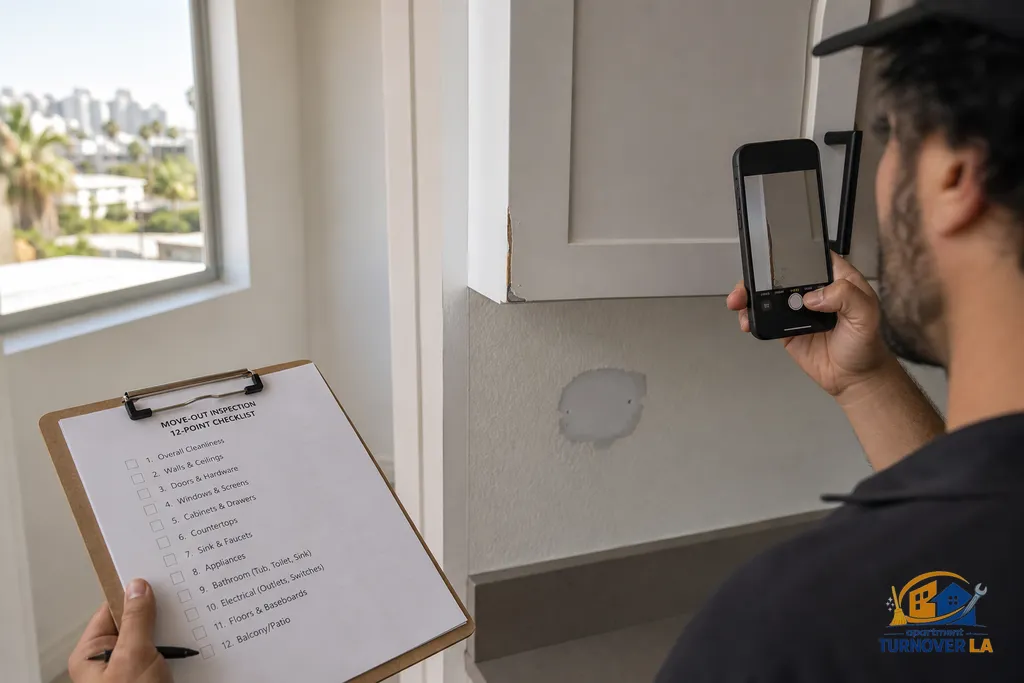
- Make ready cleaning and documentation: Market 1BR move out cleans often land 275 to 400 dollars. With TurnOver LA, Make Ready is flat Studio 225 dollars, 1 Bedroom 255 dollars, 2 Bedroom 335 dollars, 3BR or larger 425 dollars, and it includes a 12 point photo report. See our service details at our Make Ready package.
- Painting: Market per room repaint 300 to 600 dollars. TurnOver LA is 395 dollars per room. Paint touch up only is 200 dollars. Ceilings and baseboard or trim is 125 dollars. Sand and repaint cabinets or shelving is 135 dollars.
- Drywall: Market small patch 150 to 300 dollars. TurnOver LA small drywall patch plus texture is 150 dollars per patch. Medium drywall repair is 240 dollars per patch.
- Handyman and punch: Market half day 250 to 400 dollars, full day 450 to 700 dollars. TurnOver LA half day handyman punch list is 230 dollars. Full day is 425 dollars. A general maintenance and safety visit is 125 dollars. See task coverage on our handyman and maintenance service.
- Cleanout and haul: Market 1BR junk haul 300 to 500 dollars. TurnOver LA unit cleanout is Studio 200 dollars, 1 Bedroom 310 dollars, 2 Bedroom 420 dollars, 3BR or larger 420 dollars. Additional junk load is 200 dollars per load.
- Locks and security: Market single rekey 120 to 180 dollars. TurnOver LA rekey first lock is 100 dollars. Additional lock rekey is 50 dollars per lock. A full apartment rekey, up to two locks, is 150 dollars. Front plus deadbolt rekey is 110 dollars. Door knob or handle replacement is 100 dollars per knob. Smart lock install is 210 dollars.
- Listing media: Market for a proper media set is commonly 250 to 600 dollars across LA. TurnOver LA TLA Launch Pad Media Package is 399 dollars. Good media often shortens days on market, which reduces vacancy loss.
Combine only the items you need and book them back to back. We hold a 48 hour completion standard on every job, which protects your rent roll during busy seasons. Get instant quote in 30 seconds
How do LA laws affect turnover and retention?
Local and state rules influence both resident decisions and your timing. LAHD’s LAHD Rent Stabilization Ordinance caps annual increases for covered units, which can lower voluntary turnover and extend tenancy length. California’s California Civil Code §1950.5 governs deposits, deductions, and timelines. You must account for the 21 day return rule and proper itemization, or you risk disputes that delay possession and re-leasing. See our guide to the 21 day deposit return and what qualifies as normal wear and tear. The state also adopted an updated cap on deposits under AB 12 (2023) security deposit cap, which shapes upfront cost strategy. For broader context, the California DCA Landlord-Tenant Guide remains a reliable reference.
What is a turnover tenancy?
In everyday operations, managers say turnover tenancy to describe a move out that triggers work to return the unit to rent ready condition, followed by a new lease. It is not a legal status. It bundles the resident’s surrender of possession, your inspection and security deposit handling, and the make ready scope. Some turns are ordinary cleaning and paint. Others include punch list repairs, drywall patches, lock changes, and a cleanout if items are abandoned. The turnover tenancy ends when the unit is re-leased and occupied.
Need the unit turned before the next tenant?
We do the move-out clean and send you a photo report you can attach to the deposit itemization.
From $225 · 48-hour turnaround
Get an instant quoteWhat is apartment turnover cleaning?
Turnover cleaning is the detailed, post move out service that resets the unit to rent ready. It includes appliance degrease, bath descaling, interior cabinet wipeout, floor detailing, wall spot clean, and a final polish. In LA, it often pairs with paint touch ups and a handyman punch. Our Make Ready package includes a deep clean and a 12 point photo report so you can itemize deductions accurately and share before or after photos with ownership. For more scope detail, see our guide to what is make ready and our move out cleaning in Los Angeles.
How long does tenant turnover take to re-lease, not just clean?
From keys in to new keys out, a well run LA turn targets 7 to 12 calendar days including marketing and screening. The work window is 1 to 3 days for cleaning, paint, and punch. Photography and listing can land on day 1 or 2. Showings can begin as soon as lock work is complete. Approval and move in typically add 3 to 7 days depending on applicant readiness. High demand pockets like West Hollywood and Santa Monica compress the back end if pricing is clean. Use pre-leasing and a same day media upload to gain 2 to 3 days.
Tenant turnover formula and a quick calculator you can use
Use the standard fraction and keep periods consistent. For a monthly view, sum the year for annualized insight too.
- Monthly rate equals move outs in month divided by total units.
- Annual rate equals total move outs in 12 months divided by total units.
- Portfolio rate equals sum of each property’s move outs divided by sum of units, or a weighted average of property rates.
- For example, 3 move outs in a 30 unit building this month equals 10%. If 34 move outs happened this year, annual is 34 divided by 30 equals 113%, which signals heavy churn or many short tenancies and deserves a reset on renewals and pricing.
- Track by floor plan and by cause code, like transfer, non renewal, non payment, or rent increase.
For a downloadable workflow, see our apartment turnover checklist.
How can you reduce turnover rate and vacancy days in LA operations?
These are the practical levers you can pull immediately.
- Stagger expirations. Avoid stacked end dates in June and July in student corridors like Westwood. Balance across quarters.
- Pre-inspect 30 days out. Create a small pre-move punch list so the final turn is quick.
- Hold renewal pricing steady for long-term RSO residents where a modest increase avoids a move out risk that blows a month of rent.
- Prebook vendors. A 48 hour make ready beats a 5 day queue. That alone saves 160 to 400 dollars in vacancy loss.
- Use fast media. Order the 399 dollar TLA Launch Pad Media Package on day zero so you can list within 24 hours.
- Fix small annoyances. A 230 dollar half day handyman visit to resolve cabinet hinges, sticking sliders, and drippy faucets can save a non renewal.
- Clean communication. Send renewal offers 60 to 75 days out with options and reminders. Avoid surprised notices that bunch up at month end.
For the math on carry costs, see our note on vacancy loss in Los Angeles.
When does turnover spike in LA and by how much?
Expect elevated move outs from mid May through September. In student heavy Westwood and North Hollywood, 55% to 65% of annual turnovers can cluster in that window. Coastal leases in Venice and Santa Monica also cycle in late summer as renters time moves for daylight and beach proximity. In Downtown LA, winter is less volatile, but January moves still rise with job changes. Plan paint and vendor capacity to follow this curve and set expiration mix to soften the peak. Clear renewal offers in April can pull some summer churn forward.
How does turnover rate relate to cost and NOI in LA?
Turnover rate sets how often you incur turn costs and vacancy loss. Even a lean 1BR turn may carry 700 to 1,100 dollars of work in the general market before lost rent. If your rent is 2,400 dollars in Culver City and you lose 5 days during peak season, that is roughly 400 dollars to 1,000 dollars in vacancy loss based on the 80 to 200 dollars per day range. Tight execution helps. With TurnOver LA, Make Ready is 255 dollars for a 1BR, touch up paint is 200 dollars, a half day handyman is 230 dollars, and front plus deadbolt rekey is 110 dollars. That full example scope totals 795 dollars from our live catalog, with a 48 hour turnaround standard to protect income.
Bottom line
For most LA portfolios, a 35% to 45% annual turnover rate is normal. Well run stabilized assets can hold 25% to 35%. You control more of that outcome than it may feel like. Track by cause, pre-inspect, prebook, and compress work to 48 hours. The savings lands in reduced vacancy loss and steadier renewals. Get instant quote in 30 seconds