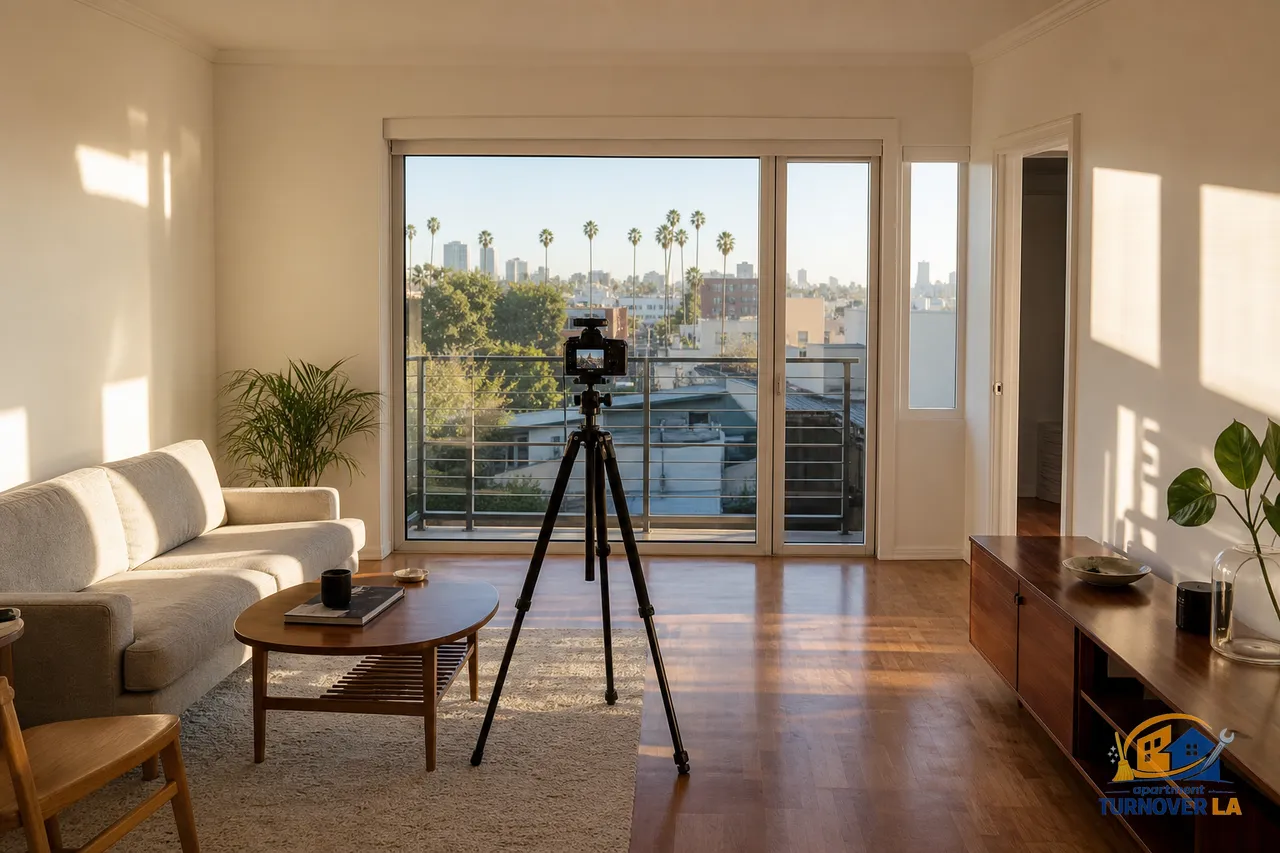
Quick answer: Across California, a standard apartment listing shoot typically runs $200 to $600, with add-ons pushing some jobs near $800. TurnOver LA runs a flat TLA Launch Pad Media Package at $399 with a 48-hour turnaround. For most LA rentals, $399 is recovered in 1 to 3 vacancy days based on an $80 to $200 per day loss baseline.
California real estate photography for rentals means fast, accurate images that sell a unit online, plus documentation that supports deposit accounting. In Los Angeles, the operational win is simple: clean and prep the unit, capture market-ready visuals, and publish the listing within 48 hours. TurnOver LA handles that sequence end to end, then hands you ready-to-post media. Get instant quote in 30 seconds
How much does California real estate photography cost in LA today?
Across LA, small residential shoots for rentals generally price between $200 and $600 for stills, with twilight or drone add-ons often adding $100 to $300 each. The range reflects travel, license terms, and deliverable count. TurnOver LA simplifies this with a single line item, the TLA Launch Pad Media Package at $399, delivered in 48 hours. No rush fee, no menu of upcharges to pick through. For many owners, clarity beats a la carte. You can slot the shoot exactly where it belongs, after cleaning and minor fixes, and have media in hand to list before the weekend.
If your unit is truly move-in ready and you only need listing media, book the package directly. If you still have turnover work to do, pair media scheduling with Make Ready so the space photographs the way it shows.
What does a rental-focused shoot include and how is it different from sales photography?
Rental photography prioritizes speed to market, neutral color accuracy, and angles that clarify layout and storage. Where luxury sales sets add stylized lighting or twilight, rentals often win with daytime exposures that show actual light and condition. You want to answer the top five tenant questions in three seconds: natural light, floor plan logic, kitchen condition, bathroom condition, and closet capacity.
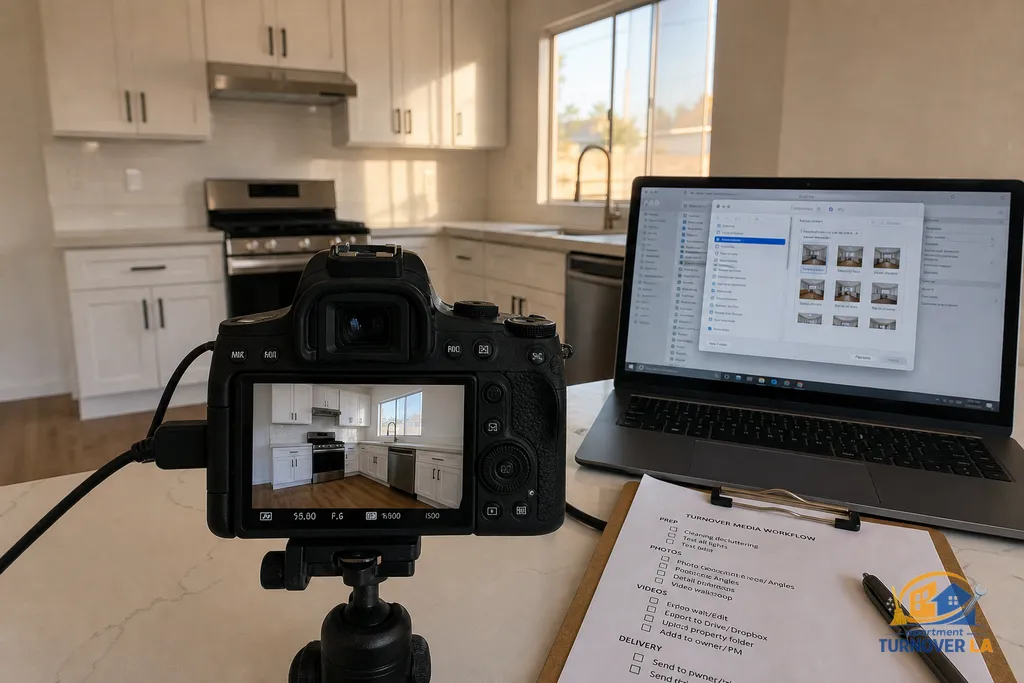
Operationally, that means a tight on-site plan: walk the unit, clear counters, confirm bulbs and blinds, then work room order to avoid footprints and smudges. Keep verticals straight, avoid distorted corners, and show at least two practical views of kitchens and baths. If you pair media with TurnOver LA’s Make Ready, the cleaning phase wipes out dust, streaks, and floor residue that would otherwise read as wear. Then media happens while the unit is pristine.
Why pair Make Ready and media in one 48-hour window?
You make money by compressing downtime. In LA, vacancy losses run about $80 to $200 per day depending on submarket and price point. A clean unit photographs better, and fresh media lets you publish fast, which fills calendars and reduces the days empty. TurnOver LA’s Make Ready pricing is flat by size, then you add the listing media package:
- Day 0 afternoon: keys in hand, basic assessment, schedule crew.
- Day 1 morning: Make Ready deep clean plus 12-point photo report for condition documentation. Studio $225, 1 Bedroom $255, 2 Bedroom $335, 3BR or larger $425.
- Day 1 midday: light paint touch-up if needed, Paint touch-up only $200, or Repainting per room $395 if walls are beyond touch-up.
- Day 1 late day: handyman punch list for safety or quick fixes, Half-day $230 or Full-day $425 as needed.
- Day 2 morning: TLA Launch Pad Media Package $399.
- Day 2 afternoon: publish listing and start showings.
This sequence is simple, predictable, and keeps you inside a 48-hour posting target. Get instant quote in 30 seconds
How do I calculate ROI on listing media using LA vacancy loss?
Tie spend to days saved. A $399 media package is breakeven if it cuts vacancy by 2 to 5 days depending on your submarket. Example: a Koreatown one-bedroom at $2,200 rent carries roughly $110 to $140 per day in vacancy loss depending on your pipeline and concessions. If better photos pull qualified leads faster and you sign one day sooner, that is $110 to $140 back. Two days saved, $220 to $280. For a Santa Monica studio at $2,600, vacancy loss is often higher because demand is spiky by week. Three days saved likely clears the entire media cost plus your Make Ready margin. The math does not need to be perfect, it needs to be consistent. Compare apples to apples, then repeat the process on each turnover.
For a full review of downtime math, see our guide on vacancy drag and scheduling in LA: property managers often underestimate the carry cost until they quantify it. See: Property managers and vacancy loss in Los Angeles.
Does California law change how I should document a unit with photos?
Yes, because photos do double duty. First they market the unit, second they memorialize condition for deposit accounting. California Civil Code §1950.5 sets the rules for security deposit use, itemization, and return. Good photo documentation at move-out and before new move-in supports your written file if there is a dispute. The state’s California Civil Code §1950.5 and the California DCA Landlord-Tenant Guide outline timelines and allowable deductions. AB 12 updated deposit caps statewide, which increases scrutiny on what you can charge, so clarity matters. See also our process notes on the 21-day return window here: California 21-day deposit return and where wear and tear lines are drawn: Normal wear and tear in California.
What is the 80 20 rule in photography, and does it help rentals?
In practice, 20 percent of the frames usually drive 80 percent of inquiries. For rentals, allocate most of your effort to the rooms that rent the unit. Kitchens, bathrooms, the main living area, and the best natural light angle usually carry the listing. Capture clean, clear establishing shots first, then supporting details that show storage, outlets, and appliance condition. If time gets tight, you already have the hero frames. This is different from luxury sales where the feature set is broader and more stylized. Rentals benefit from clarity, speed, and a small set of decisive images that lead the carousel.
Need the unit turned before the next tenant?
We do the move-out clean and send you a photo report you can attach to the deposit itemization.
From $225 · 48-hour turnaround
Get an instant quoteIs 100 an hour good for a photographer in California?
It depends on scope and deliverables. Across the state, many real estate shooters charge between $100 and $250 per hour, with minimums and travel, or package rates from $200 to $600 for basic interiors. Day rates often run $800 to $2,000 for larger properties. TurnOver LA avoids hourly billing for rentals and uses a flat package, the TLA Launch Pad Media Package at $399, which keeps your turnover budget predictable and aligns with a 48-hour listing timeline. If you prefer hourly, expect to pay setup and edit time in addition to on-site shooting.
Can I rent an Airbnb for a photoshoot of my rental?
Short answer: ask the host, and check platform rules. Many hosts prohibit commercial use without written permission, and noise or crew size limits can apply. Insurance and COI requests are common. For landlords, it rarely pencils. You want authentic photos of the actual unit you are leasing, taken when it is clean and empty. That is also when your Make Ready is complete and the space is at its best. Better to invest in a tight turnover plan than a temporary set.
Which pre-photo fixes move the needle most for LA rentals?
Small, targeted work shows up in photos and in person. Focus on touch points and lines that read on camera. In our experience across DTLA, West Hollywood, and the Valley, these small items often return more than they cost:
- Paint touch-up only $200 to even out scuffs and patch marks.
- Repainting per room $395 for spaces with heavy wear or mismatched colors.
- General maintenance and safety visit $125 for bulbs, lids, GFCI, and trip hazards.
- Half-day handyman punch list $230 for a cluster of quick wins before photos.
- Unit cleanout and junk haul, 1 Bedroom $310 or Studio $200, so photos show empty rooms.
Schedule these alongside Make Ready so the cleaning run leaves surfaces photo-ready.
What images convert best for LA apartments in 2026?
Data points are consistent across our bookings. Lead with the main living room wide, then kitchen, bath, primary bedroom, and the unique asset that matters for your submarket. In Koreatown and Mid-City, in-unit laundry or a secure parking spot may be the hero. In Santa Monica and Venice, a balcony with light and a tree canopy can anchor the set. Keep verticals straight, show window context, and include one honest shot of the building entry. Skip heavy filters. Daylight accuracy wins because it reduces no-show risk.
If you need a complete media set for a rental, book our apartment photography service. The TLA Launch Pad Media Package is a flat $399 with a 48-hour turnaround.
How does scheduling work across LA neighborhoods with different light and traffic?
Plan for sun and access. West-facing units in Palms or Mar Vista photograph better late morning or early afternoon before harsh contrast. East-facing units in Echo Park or Silver Lake benefit from late morning once hills stop casting shadows. If the unit is in a permit-heavy area like West Hollywood, buffer 15 minutes for parking. In dense corridors like Koreatown, key transfer and elevator timing can make or break a 30-minute window. Build your schedule around the building, not just the photographer’s clock, and you will hit the 48-hour listing target more consistently. Get instant quote in 30 seconds
What should a landlord expect on delivery and file handling?
Keep it simple and consistent. File names should reference address, unit, and room so future teams can find them for deposit references or repairs. Store a marketing set and a condition set separately. If you use TurnOver LA’s Make Ready, you will already have a 12-point condition photo report in your turnover file. The listing media set is then your marketing folder for the next lease cycle. That separation reduces risk if you ever need to share images tied to a California Tenants Guide dispute while keeping your marketing assets consistent year over year.
Bottom line: when does photography pay off for a rental?
If you can publish within 48 hours of move-out and your market loss is $80 to $200 per day, a $399 media spend pays for itself quickly. The bigger savings often come from the process it enforces: a real schedule, a clean unit, and clear documentation. If that helps you avoid even one week of slippage on a busy month, the math is obvious. Book the sequence, hold the timeline, and keep your process the same every time. Get instant quote in 30 seconds