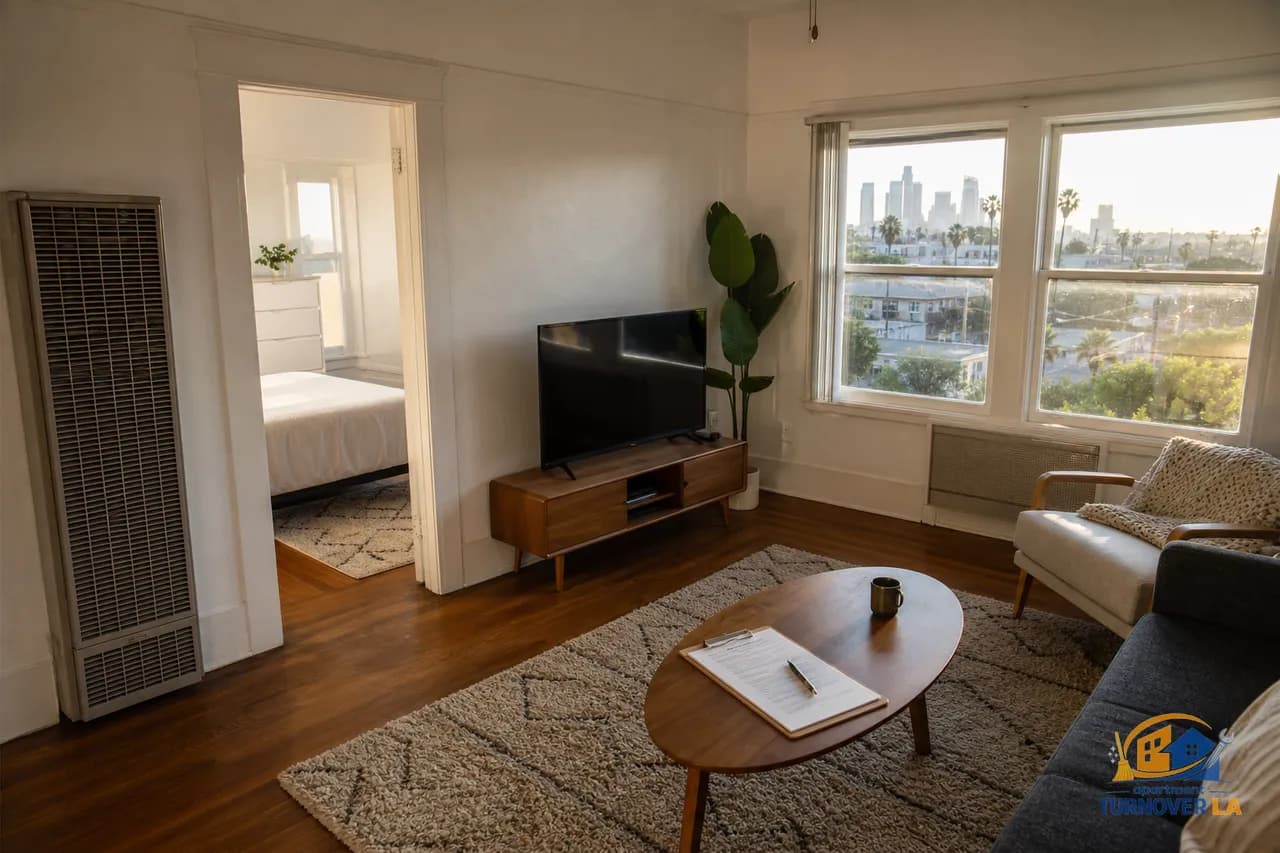
Quick answer: In Los Angeles, tenants cannot change permanent flooring without written landlord consent. Most leases treat flooring as a fixture and a housing service. You can usually add rugs and removable mats, but installing or removing carpet or hard surface without approval risks deposit deductions under California Civil Code §1950.5 and possible violations in rent controlled units.
Tenants need the owner’s written approval to replace or remove carpet, install laminate or vinyl plank, or refinish hardwood. Minor, reversible coverings like area rugs are usually allowed unless your lease says otherwise. If you change flooring without consent, the owner can require restoration and charge for excess damage beyond normal wear. Get instant quote in 30 seconds
What do your lease and LA rules actually say about changing flooring?
Your lease controls first. Most LA leases bar alterations to fixtures and finishes without written consent, and flooring qualifies as a fixture. Under California Civil Code §1950.5, owners can charge for repair or replacement of damage beyond ordinary wear at move out, but not for normal aging. That sets the framework for any flooring dispute.
If the unit is under the LAHD Rent Stabilization Ordinance, flooring is a housing service. Removing carpet or switching to hard flooring in an upstairs unit can be treated as a reduction in housing services, which can trigger complaints and rent decrease petitions. Building rules or HOA rules sometimes require carpet coverage in upper units to control noise. When in doubt, get permission in writing and include the product, underlayment, and who pays.
For Santa Monica and West Hollywood, similar rent control service concepts apply. Ask for written approval before any change, and keep all receipts and photos. You can review the LAHD summary of rent stabilization rules here: LAHD Rent Stabilization Ordinance. The state overview is here: California DCA Landlord-Tenant Guide.
When will a landlord replace worn flooring, and how often?
There is no statute that forces a set replacement cycle. Industry practice in LA is common sense and prorated value. Carpet often lasts 5 to 7 years in rentals with standard traffic. Sheet vinyl and decent LVP can run 10 to 15 years, sometimes longer in low-traffic bedrooms. Hardwood can be screened or refinished instead of replaced.
Owners weigh safety and habitability first. Trip hazards, rips at transitions, exposed tack strips, and water-damaged or moldy materials get priority. Cosmetic wear usually does not force replacement. If a tenant has lived many years and carpet is threadbare, a replacement request has a better chance, especially in rent controlled buildings where services must be maintained. The state guidance on wear and tear vs damage is summarized in the California Tenants Guide. For practical turnover planning, many LA managers tie flooring updates to vacancy to avoid disturbing neighbors and to control noise issues.
How much does flooring replacement cost in Los Angeles right now?
Across LA, basic installed LVP in a rental often falls in the $4 to $7 per square foot range for value product, and $7 to $12 per square foot for thicker plank or higher-end vinyl. Carpet with pad and base install can land around $3 to $6 per square foot. Stairs, subfloor leveling, transitions, and furniture moving all add cost. Pre-1981 vinyl and adhesive can involve asbestos, which means professional handling and schedule risk.
TurnOver LA does not install new flooring. We support the surrounding work that keeps your timeline tight. Market cleaners charge about $250 to $400 for a 1 bedroom deep clean in Los Angeles, while our Make Ready is a flat $255 for a 1 bedroom, $225 for a studio, $335 for a 2 bedroom, and $425 for a 3 bedroom or larger. Painting prices across LA often run $450 to $700 per room; our repainting per room is $395, paint touch-up only is $200, and ceilings and baseboard or trim is $125. We hold a 48 hour turnaround so vacancy loss stays contained. Get instant quote in 30 seconds
Can a landlord charge you for flooring damage in California?
Yes, for damage that exceeds ordinary wear. California Civil Code §1950.5 allows owners to use the security deposit for necessary cleaning, repair, and replacement to return a unit to its prior condition, minus reasonable depreciation. For example, pet urine saturation, burn marks, or plank gouges are chargeable. Typical scuffs, traffic patterns, and minor fraying usually are not.
The owner must provide an itemized deposit accounting within 21 days. You can read our step-by-step on that here: California 21 day deposit return and see definitions in Normal wear and tear in California. Also note the 2024 deposit cap change. Under AB 12 (2023) security deposit cap, most residential deposits are capped at one month’s rent, with limited small-owner exemptions. That cap makes avoiding preventable flooring charges more important.
What flooring can a tenant add without permission?
Check your lease first. In many LA apartments, tenants can do these low-impact steps without special approval:
- Add area rugs with a sound-absorbing pad to reduce noise in upstairs units.
- Use removable entry mats in kitchens and at sliders to control tracking and wear.
- Place floor protectors under furniture legs to prevent dents or gouges.
- Use temporary runner rugs in halls to protect high-traffic lanes.
- Seal pet areas with machine-washable pads and regularly clean to prevent urine intrusion.
Avoid peel-and-stick tile or floating plank unless you have written consent, since both change the assembly and can trap moisture. Avoid removing carpet without approval. If you do get consent, make sure the agreement says who owns the material at move out and whether you must restore to the prior finish.
Need a turnover quote?
Send the unit address and your target date. We quote in 15 minutes.
Get an instant quoteUpstairs units: what about noise and hard flooring?
Noise drives many flooring disputes. In upstairs apartments, switching to hard surface can increase footfall noise to the unit below. Many buildings, and most HOAs, require a minimum underlayment rating such as IIC 50 and STC 50 on multifamily assemblies, and some require carpet over 80 percent of the floor area in bedrooms and living rooms. While not a statewide law, your lease or house rules may incorporate similar standards.
In LA neighborhoods with older framing like Koreatown and Hancock Park, underlayment choice matters more because there is less mass between floors. If your owner approves a change to hard surface, plan for premium underlayment, perimeter caulking, and door threshold adjustments. Without that planning, noise complaints can force a costly do-over.
Need drywall, paint, or punch work after a flooring change or leak?
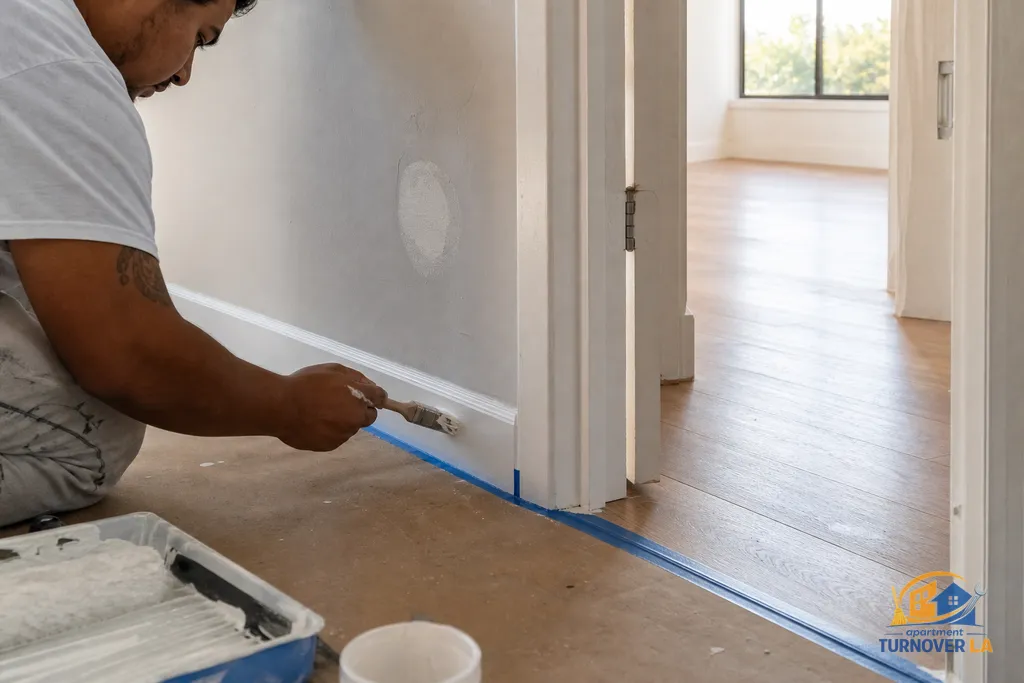
Flooring work often exposes baseboards and wall edges. If you are coordinating repairs after a leak or an insurance claim, the LA market for small drywall patches is commonly $175 to $350 per patch. Our pricing is exact and published. A small drywall patch and texture is $150 per patch with TurnOver LA, and a medium drywall repair is $240 per patch. Repainting per room is $395, paint touch-up only is $200, and ceilings plus baseboard or trim are $125.
If a flooring vendor pulls baseboards and you need punch work, a half day handyman punch list is $230 and a full day is $425. Market day rates for reliable handyman work in LA often fall between $400 and $700. We also include floor detailing in our Make Ready and can remove project debris with unit cleanout or junk haul at $200 for a studio, $310 for a 1 bedroom, and $420 for a 2 bedroom or larger. These services land in 48 hours to help avoid vacancy loss that usually runs $80 to $200 per day in LA submarkets.
How should a tenant ask for a flooring upgrade the right way?
A straightforward, written request usually gets the best result. Include the problem, location, and a clear photo. Offer access windows and ask for a realistic timeline. If you are willing to contribute to a better product, state the offer and ask the owner to keep the material in place if you move. Here is a simple structure that works:
- What is wrong: rip at bedroom doorway, tack strip exposed.
- Why it matters: tripping hazard, minor bleeding incident.
- What you propose: like-for-like carpet with 8 lb pad, neutral color.
- Access: available Thursdays and Fridays, 8 to 5.
- Confirmation: request written approval and product spec.
If the owner declines because the issue is cosmetic, ask for a timeline for reevaluation. In rent controlled buildings, removing or downgrading flooring quality can count as a services reduction, so keep that in mind when discussing alternatives. You can read the state overview on repairs and services in the California DCA Landlord-Tenant Guide.
What does TurnOver LA do and not do on flooring jobs?
We do not install or replace flooring. We handle the surrounding turnover sequence so units hit the market faster and cleaner. That includes Make Ready deep cleaning with floor detailing at $225 for a studio, $255 for a 1 bedroom, $335 for a 2 bedroom, and $425 for a 3 bedroom or larger. We paint, patch, and repair at published prices, then deliver listing media so you can relaunch quickly.
- Paint touch-up only: $200
- Repainting per room: $395 per room
- Ceilings and baseboard or trim: $125
- Small drywall patch and texture: $150 per patch
- Medium drywall repair: $240 per patch
- Half day handyman punch list: $230; Full day: $425
- Unit cleanout and junk haul: Studio $200, 1 bedroom $310, 2 bedroom $420, 3 bedroom or larger $420
- TLA Launch Pad Media Package: $399
Book the sequence, not just a task. We turn in 48 hours citywide, from Westlake to West Hollywood. For cleaning and paint scopes, you can start here: Make Ready service and Painting and drywall. Get instant quote in 30 seconds
Can tenants change flooring in rent controlled LA units without risk?
Short answer, not without risk. In LAHD RSO units, owners must maintain housing services at the same or better level. If you remove carpet that provides sound attenuation and install hard surface, downstairs neighbors may complain and the building may face enforcement or rent decrease actions. Ask for permission first, specify underlayment ratings, and plan for trim and thresholds so the assembly performs like-for-like or better.
Common flooring change scenarios in LA rentals
| Scenario | Can tenant proceed alone | Who normally pays | Notes |
|---|---|---|---|
| Add area rugs with pads | Yes if lease allows | Tenant | Reduces impact noise in upstairs units |
| Replace carpet with LVP | No | Owner or cost share if negotiated | Needs approval, underlayment spec, transitions |
| Swap like-for-like carpet | No | Owner | Coordination at vacancy to reduce disruption |
| Repair pet urine damage | No | Tenant if damage exceeds wear | Cleaning, pad replacement, possible subfloor treatment |
| Water damage insurance claim | No | Owner or insurer | Requires mitigation, may involve drywall and baseboards |
| Flooring change in RSO unit | No | Owner if approved | Service reduction risk without consent |
For law specifics on deposits, read California Civil Code §1950.5.
How to keep timelines tight if flooring is changing at turnover?
Plan the order. Flooring installers prefer clean, empty units. A simple LA-ready sequence that works:
- Unit cleanout and junk haul if needed.
- Make Ready deep clean to de-grease kitchens and clear floor dust from prior work.
- Paint walls and trim. Leave baseboards off if the flooring vendor requests it.
- Flooring install or repair with underlayment and transitions.
- Final paint touch-ups and baseboard caulk.
- Listing media, then publish.
Across LA, a full flooring replace can add 2 to 5 days. Each day of vacancy is usually $80 to $200 in loss depending on submarket. Our scopes finish in 48 hours so the listing window opens sooner. See our Painting and drywall and Make Ready service to map your path. Get instant quote in 30 seconds