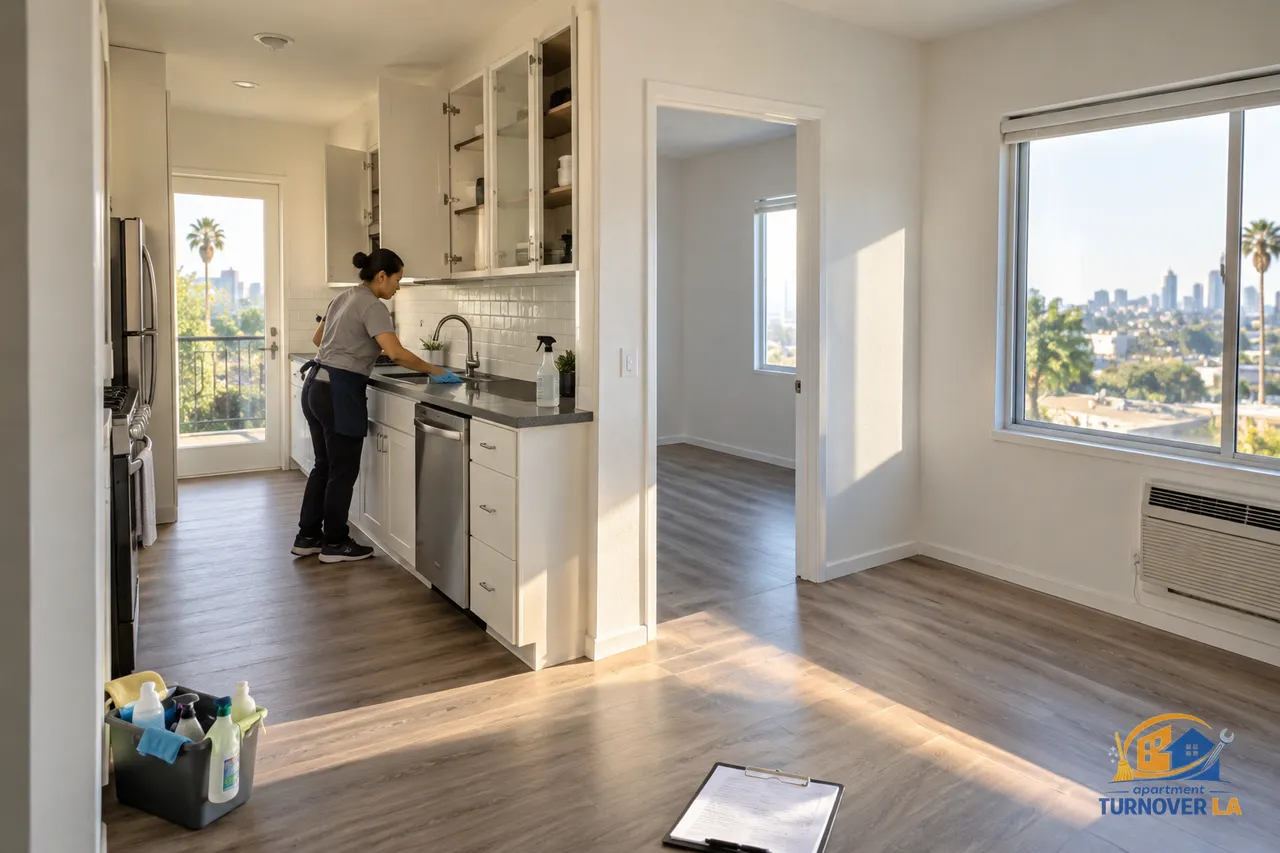
Quick answer: Across LA, turnover cleaning commonly falls around $75 to $250 for a typical unit, with about $150 often cited as a general benchmark. For a defined apartment Make Ready, TurnOver LA charges $225 for a studio, $255 for a 1 Bedroom, $335 for a 2 Bedroom, and $425 for a 3BR or larger, including a deep clean and 12-point photo report with a 48-hour turnaround.
How much you should charge for an apartment turnover clean depends less on a single hourly number than on the unit size, condition, and scope you can document before work begins. A fixed, unit-based price is usually easier for landlords to approve and easier for a cleaner or vendor to deliver consistently. Get instant quote in 30 seconds
What should you charge for a turnover clean in Los Angeles?
Start with the local market, then price a defined scope rather than a vague promise to make the unit clean. Across LA, a standard turnover clean commonly lands in the general $75 to $250 range, and roughly $150 is a frequently discussed benchmark for a typical turnover. That range is useful context, but it often excludes photo documentation, heavy grease removal, interior cabinets, or the return trip created by unclear expectations.
TurnOver LA keeps the base scope fixed through its Make Ready service: $225 for a Studio, $255 for a 1 Bedroom, $335 for a 2 Bedroom, and $425 for a 3BR or larger. Each includes a deep clean and a 12-point photo report. That report matters when the owner is off site, when a manager needs leasing approval, or when a deposit file may later need support. The quote covers labor and the crew's own supplies. Paint, parts, and fixtures are inspected on site, priced separately, and added only with approval.
How does unit size change a fair turnover-cleaning price?
Unit size is the cleanest starting point because it predicts bathrooms, kitchen surface area, cabinet volume, flooring, and the time required for a final quality check. It is better than charging one flat rate for every unit, which underprices a two-bathroom unit and encourages rushed work in larger apartments. A 1,200 square foot apartment may need more attention than a small one-bedroom, but layout and condition still matter as much as square footage.
Use bedrooms as the base, then identify condition items before dispatch. Across LA, a small turnover may fall near the lower end of the general $75 to $250 market range, while a larger or more neglected unit can exceed it. TurnOver LA's defined base rates are $225 for a Studio, $255 for a 1 Bedroom, $335 for a 2 Bedroom, and $425 for a 3BR or larger. Do not bury move-out debris, wall damage, or lock work inside the cleaning rate. Separating those items prevents an apparent cleaning overcharge and gives the owner a usable approval trail.
What should an apartment turnover clean include?
A turnover clean should cover the surfaces that affect habitability, showing condition, and the next resident's first impression. At minimum, define kitchen degreasing, appliance cleaning, bathroom sanitizing, cabinet and drawer interiors, floor cleaning, baseboards, fixtures, windowsills, and removal of ordinary loose debris. For a more detailed room-by-room scope, use this apartment turnover checklist before the cleaner arrives.
The critical operational distinction is between cleaning and restoration. Dust in a cabinet is cleaning. A swollen cabinet door, burned-out fixture, torn screen, or wall hole is not. TurnOver LA's Make Ready package includes the deep clean and a 12-point photo report, which lets the manager see what needs a second trade instead of discovering it after marketing starts. For units with accumulated grease, smoke film, or neglected bathrooms, a separately scoped deep cleaning service may be appropriate. The scope should state whether the refrigerator, oven, blinds, patios, and interior windows are included, not leave them to assumptions.
Who is responsible for move-out cleaning and what can be charged back?
The outgoing tenant is generally responsible for returning the unit reasonably clean, but a landlord cannot treat every cleaning task as a tenant charge. California rules distinguish cleaning needed because of a tenant's condition from routine turnover work and ordinary wear. Before withholding any amount, compare move-in evidence, move-out photos, invoices, and the actual condition of the unit. The California Civil Code §1950.5 is the starting point for security-deposit deductions.
A practical rule is to charge only for cleaning beyond the condition reasonably expected after normal use. For example, cleaning food residue from an oven after a short tenancy may support a documented charge, while resetting a unit between residents is often an owner operating cost. Review the distinction in California cleaning fees after move-out and keep the cleaner's scope and photo report in the file. California's deposit timing is also strict, so review the 21-day deposit return guide before sending an itemization.
Need the walls done before you re-list?
Turnover painting, scuff removal and patching, with a photo record of the condition we left behind.
$395 per room · 48-hour turnaround
Get an instant quoteWhat is the 5-5-5 rule for cleaning?
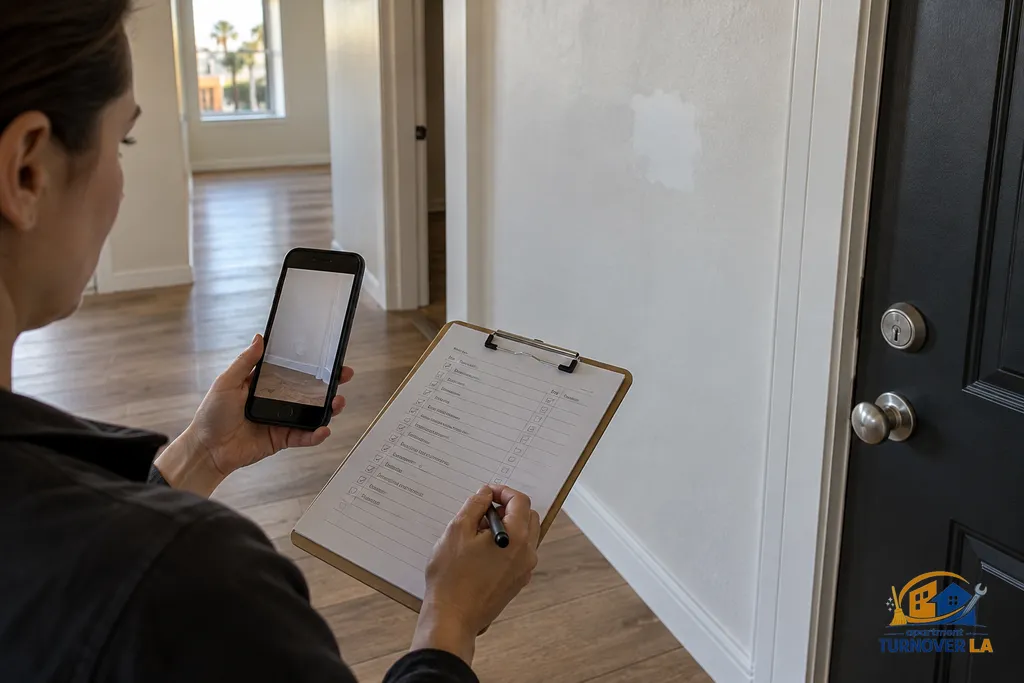
The 5-5-5 rule is not a California legal standard or a universal cleaning-industry formula. It is best used as an internal control method: spend five minutes assessing the room, identify five high-impact cleaning targets, then take five verification photos or checks before closing out. For a turnover, that makes the crew slow down at the points most likely to create a callback.
In a kitchen, the five targets might be the oven, refrigerator, sink, cabinet interiors, and floor edges. In a bathroom, they may be the toilet, tub or shower, vanity, mirror, and exhaust cover. The verification step should include more than attractive wide photos. Photograph inside the oven, under the sink, the refrigerator shelves, damaged walls, and anything requiring owner approval. This is particularly useful in older Los Angeles multifamily buildings, where a clean unit can still have worn fixtures or prior patchwork. It also prevents the cleaner from silently absorbing repair work that belongs on a maintenance ticket.
Get instant quote in 30 seconds
How do you keep a turnover-cleaning quote from growing mid-job?
Set the base price by unit type, then create separate approval points for condition issues. Ask for current photos before scheduling, confirm whether furniture or trash remains, and specify whether appliances are empty and accessible. On arrival, document exceptions before removing them. This protects the vendor from unpaid scope creep and gives the property manager a clean choice: approve the extra work, defer it, or assign it elsewhere.
For example, across LA, general turnover-cleaning prices may stay in the $75 to $250 market range when the apartment is vacant and reasonably maintained. TurnOver LA's 1 Bedroom Make Ready is a flat $255 for the defined cleaning and 12-point photo report. If the unit contains abandoned furniture or bags of debris, that is a cleanout issue, not a cleaning variation. TurnOver LA lists unit cleanout / junk haul at $500. If a wall has a hole, small drywall patch + texture is $150 / patch. Keeping those lines separate helps an owner decide quickly and keeps the cleaning invoice credible.
Which turnover items should be priced outside the cleaning scope?
Cleaning, painting, repairs, security, and listing preparation should be managed as connected tasks, but billed as distinct scopes. That distinction gives managers better control over deposit documentation, owner approvals, and leasing dates. A cleaner should report a scuff or damaged lock, not conceal it with an improvised fix. When the unit is rent ready, the photo record should show the condition that leasing is actually offering.
For minor wall appearance issues, TurnOver LA lists paint touch-up only at $200. A small drywall patch + texture is $150 / patch, while repainting per room is $395 / room. For security between residents, a full apartment rekey (up to 2 locks) is $150. These are not cleaning charges, and they should not be described as such to a departing tenant. If the unit needs several trades, sequence them: cleanout first, repairs and paint next, then the final Make Ready clean and photos. That order avoids cleaning dust twice and reduces the chance that a lease-ready unit sits vacant. In many LA submarkets, each vacant day can cost roughly $80 to $200 in lost rent.
Set a price that your cleaner, manager, and owner can all verify
The best turnover-cleaning price is a repeatable rate with a written scope, condition photos, and clear boundaries around repairs. Do not compete only on the lowest number. A low quote that excludes cabinet interiors, appliances, reporting, or a final inspection can create more vacancy time than it saves. The relevant measure is how reliably the unit moves from keys returned to ready for leasing.
For a straightforward Los Angeles apartment, use the general $75 to $250 market range as context, then compare a documented fixed package. TurnOver LA's Make Ready rates are $225 for a Studio, $255 for a 1 Bedroom, $335 for a 2 Bedroom, and $425 for a 3BR or larger, with a 48-hour turnaround. Build the property file around the same photos and written scope used to approve the work. It will make vendor management, deposit decisions, and the next turnover easier to defend.