Quick answer: Across LA, a typical 1BR turnover costs $1,750 to $3,500 in the broader market, driven by vacancy days and scope. With TurnOver LA, a 1BR Make Ready is $255, with optional add-ons priced a la carte and a 48-hour turnaround. To calculate turnover rate, divide annual move-outs by total units, then multiply by 100.
If you need a tenant turnover calculator for LA, use a simple model: turnover rate equals move-outs divided by units, then multiply by 100. Pair that with a cost model that totals vacancy loss plus make-ready work. We include real LA cost ranges and exact TurnOver LA pricing, plus a copy-ready input list. Get instant quote in 30 seconds
What is tenant turnover and what does a calculator do?
Tenant turnover is the cycle from the day a resident gives notice through make-ready, marketing, and a signed new lease. A good calculator gives you two outputs: turnover rate and turnover cost per unit or per building. Rate tells you how often units change hands. Cost tells you how much each vacancy consumes in cash and time. In Los Angeles, cost is usually dominated by vacancy loss, often $80 to $200 per day depending on submarket, followed by cleaning, paint, handyman items, rekeying, and listing media. Use the calculator to compare preventable costs, sequence crews, and set make-ready standards. The output should help you schedule, budget, and reduce idle days, not just report past performance.
How do you calculate tenant turnover rate for LA buildings?
Use the basic formula many operators miss because they overcomplicate it. Turnover Rate percent equals number of move-outs during a period divided by total number of units, then multiply by 100. For example, a 24-unit building in Koreatown with 7 move-outs last year has a turnover rate of 7 divided by 24 equals 0.2917, or 29.17 percent. Track this quarterly and annually. For a mixed portfolio, calculate by property, then roll up. In LA, consider tracking two rates in parallel if you operate under the LAHD Rent Stabilization Ordinance and non-RSO stock, since lease terms and rent-control dynamics can influence retention. Keep your denominator as total rentable units to avoid noise from units held offline for renovation.
What costs belong in a tenant turnover calculator?
The cleanest structure is vacancy days plus direct make-ready costs plus leasing costs. In LA, build the cost side with these common inputs:
- Vacancy days by submarket times a daily baseline of $80 to $200
- Cleaning and reporting, often a deep clean with a photo report
- Paint touch-up or repaint per room, plus ceiling or trim as needed
- Handyman punch list time for repairs and safety items
- Cleanout or junk haul for left-behind items
- Rekey and lock hardware changes
- Listing media for the new ad
- Any odor treatment or specialty remediation if needed
Market costs vary. To anchor your model, the LA market often falls in the $1,750 to $3,500 range for a standard 1BR turn when vacancy loss is included. With TurnOver LA, you plug exact line items from our live menu and you do not pay rush fees because every job has a 48-hour turnaround.
What is a good tenant turnover rate in Los Angeles?
For stabilized LA assets, 25 to 35 percent annually is common for small buildings and scattered site portfolios. Garden-style properties near employment centers like Culver City or Playa Vista may run higher due to mobility. Older RSO stock can run lower if rents sit below market and residents stay longer. A good rate is the one that aligns with your leasing strategy and does not spike vacancy days. If you are above 40 percent in a non-student submarket, investigate controllable causes like maintenance response, cleanliness standards, and communication. Your calculator should flag the buildings where high rate plus high vacancy days combine into outsized cash loss. Fixing cleanliness standards and day-one showability usually yields the fastest drop in idle days.
Is a 30 percent turnover rate bad in LA?
Thirty percent is not automatically bad. In many LA neighborhoods, 25 to 35 percent is normal for non-luxury units and mom-and-pop portfolios. The problem is not the rate alone, it is the cost per turn. A building at 30 percent with a 3-day average vacancy gap is likely healthier than a building at 20 percent with 10-day gaps. Use your calculator to monitor idle days, not just move-outs. If 30 percent comes with excessive days vacant, tighten your make-ready standard and schedule. Lock in a 48-hour make-ready window, pre-order paint and hardware, and set show-ready photo deadlines so leasing can publish within two days.
How do vacancy days change the math by LA submarket?
Vacancy loss is where most money disappears. Assume a baseline of $80 to $200 per day in LA. On the Westside, Venice and Santa Monica often land near the higher end due to rent levels. In the Valley, North Hollywood and Van Nuys may sit closer to the middle. Downtown LA can swing widely based on class of building and parking. A 5-day gap in Santa Monica at $180 per day is $900 lost rent, before cleaning or paint. Your calculator should let you set a daily vacancy value per building, not a single portfolio average. That one input often changes which scope you approve and whether you greenlight a same-week relist or a deeper refresh.
What are typical LA market costs vs TurnOver LA line items?
Most blogs quote vague ranges. Below is a practical side-by-side you can plug into your sheet. The left column is a typical LA market range based on broad operator surveys. The right column lists exact TurnOver LA prices with a 48-hour turnaround on every job.
| Scope item | Typical LA market range | TurnOver LA price |
|---|---|---|
| Make Ready deep clean plus photo report, 1BR | $250 to $400 | 1 Bedroom $255 |
| Make Ready deep clean plus photo report, Studio | $200 to $325 | Studio $225 |
| Make Ready deep clean plus photo report, 2BR | $300 to $500 | 2 Bedroom $335 |
| Make Ready deep clean plus photo report, 3BR | $375 to $650 | 3BR or larger $425 |
| Paint touch-up | $200 to $450 | Paint touch-up only: $200 |
| Repaint one room | $350 to $650 | Repainting per room: $395 per room |
| Ceilings or trim | $125 to $250 | Ceilings and baseboard or trim: $125 |
| Small drywall patch | $150 to $300 | Small drywall patch plus texture: $150 per patch |
| Medium drywall repair | $200 to $450 | Medium drywall repair: $240 per patch |
| Half-day handyman | $225 to $400 | Half-day handyman punch list: $230 |
| Full-day handyman | $400 to $700 | Full-day handyman punch list: $425 |
| General maintenance visit | $100 to $175 | General maintenance or safety visit: $125 |
| Cleanout junk haul 1BR | $300 to $500 | 1 Bedroom $310 |
| Cleanout junk haul 2BR | $375 to $600 | 2 Bedroom $420 |
| Rekey front plus deadbolt | $100 to $180 | Lock rekey, front plus deadbolt: $110 |
| Smart lock install | $175 to $300 | Smart lock install: $210 |
| Listing media package | $300 to $600 | TLA Launch Pad Media Package: $399 |
Plug these into your calculator as line items. For scope control, link your standards to our Make Ready spec so cleaners, painters, and leasing know exactly what day-two show-ready means. Get instant quote in 30 seconds
Need the unit turned before the next tenant?
We do the move-out clean and send you a photo report you can attach to the deposit itemization.
Get an instant quoteHow do you calculate total cost per turn using TurnOver LA prices?
Use this structure: Total Turn Cost equals Vacancy Days times Daily Rate plus Sum of Line Items. Example, a 1BR in Hollywood with a 3-day gap at $140 per day. Vacancy loss equals $420. Add Make Ready 1BR equals $255, Paint touch-up equals $200, Half-day handyman equals $230, Lock rekey front plus deadbolt equals $110, Listing media equals $399. Total equals $1,614. If you approve a full repaint of one room at $395 instead of touch-up, new total equals $1,809. Your calculator should let you toggle these choices and show the rent-ready date impact next to the dollars.
Can you build this calculator in a simple spreadsheet?
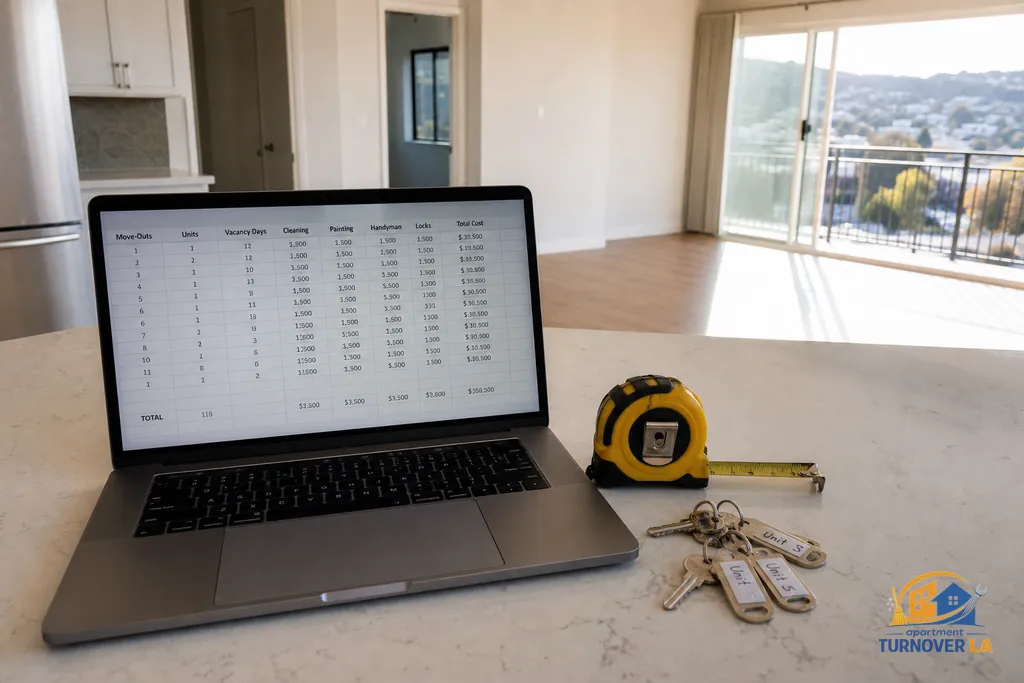
Yes. Create these inputs per unit or per building: Units, Move-outs, Vacancy days target, Daily vacancy value, Make Ready line by size, Paint scope, Handyman scope, Cleanout, Locks, Listing media, Other. Then add references to live prices so a manager cannot mistype a rate. Formulas to use: Turnover Rate equals Move-outs divided by Units times 100. Vacancy Loss equals Vacancy days times Daily vacancy value. Total Cost per Turn equals Vacancy Loss plus Sum of line items. Add a summary that shows Rate, Average vacancy days, Average cost per turn, and Total annual vacancy cost. Color-code any unit above your vacancy-day target so it pops on the weekly turn meeting.
How should LA rules and deposits affect your calculator?
Timing matters. In California you have 21 days from move-out to account for the security deposit. See California Civil Code §1950.5 and our guide on the 21-day deposit return. Your calculator should forecast deposit offsets for cleaning or damages beyond normal wear and tear, then net that against your cash outlay. Track whether a unit is subject to the LAHD Rent Stabilization Ordinance. If you operate pre-1995 RSO units, vacancy decontrol and renewal practices can change your turnover planning. Also note the new cap on residential security deposits in California under AB 12 (2023) security deposit cap. For what you can legally deduct, review the California DCA Landlord-Tenant Guide.
What operational moves lower your cost per turn in LA?
There are five that pay off quickly. First, pre-schedule a 48-hour make-ready window with your vendor, triggered on notice to vacate. Second, standardize paint codes and keep touch-up on site so you can approve touch-up at $200 instead of defaulting to full repaints. Third, use a half-day handyman punch at $230 to bundle small safety repairs. Fourth, rekey the same day using Lock rekey, front plus deadbolt at $110 so leasing can access without delay. Fifth, publish listing media within 48 hours using the $399 package so you do not burn weekend demand. Add all five as default switches in your calculator and your vacancy days will fall.
When should you bring in a handyman versus a painter?
If the walls are sound and most marks are within a few small areas, prioritize paint touch-up at $200 and assign a half-day handyman punch at $230 for items like loose outlets, sticky doors, and loose hardware. If more than one room has coverage or color-matching issues, use Repainting per room at $395, and consider Ceilings and baseboard or trim at $125 where grime lines persist. For hardware upgrades or safety work, include the General maintenance or safety visit at $125. Link these scopes in your calculator to specific triggers from your inspection. If your intake photos show nail pops or dents, add Small drywall patch plus texture at $150 per patch or Medium drywall repair at $240 per patch. See our handyman and general maintenance service and painting and drywall service pages for scope details.
Example LA scenarios you can copy into your sheet
- Studio in Silver Lake, 2 vacancy days at $120 per day. Costs: Studio Make Ready $225, Paint touch-up $200, Rekey front plus deadbolt $110. Total equals $775 vacancy loss plus $535 work equals $1,310.
- 1BR in Westwood, 4 vacancy days at $170 per day. Costs: 1BR Make Ready $255, Half-day handyman $230, Small drywall patch $150, Listing media $399. Total equals $680 vacancy loss plus $1,034 work equals $1,714.
- 2BR in Glendale, 3 vacancy days at $130 per day. Costs: 2BR Make Ready $335, Repainting per room $395, Cleanout 2BR $420, Full apartment rekey up to 2 locks $150. Total equals $390 vacancy loss plus $1,300 work equals $1,690.
Add a 12-point photo report to each turn using the Make Ready base. This creates proof for deposit accounting and speeds approvals because everyone works from the same images. If odors are an issue, see our guides on pet odor removal and smoke smell removal. For full scope planning, use the apartment turnover checklist and see LA market context in apartment turnover cost in Los Angeles. Get instant quote in 30 seconds
Final notes on using your calculator every week
A calculator is only useful if it is reviewed on a schedule. Hold a 15-minute turn meeting every Tuesday. Review units by rent-ready date, not by who is to blame. Confirm that scopes match the standards and prices listed above. If a unit tips past 48 hours, require a note for the delay, then remove the blocker. Bundle handyman work into the half-day or full-day options as needed. Rekey on day one so leasing can show as soon as cleaners finish. By keeping prices explicit and timelines short, you protect rent and keep the turn predictable.