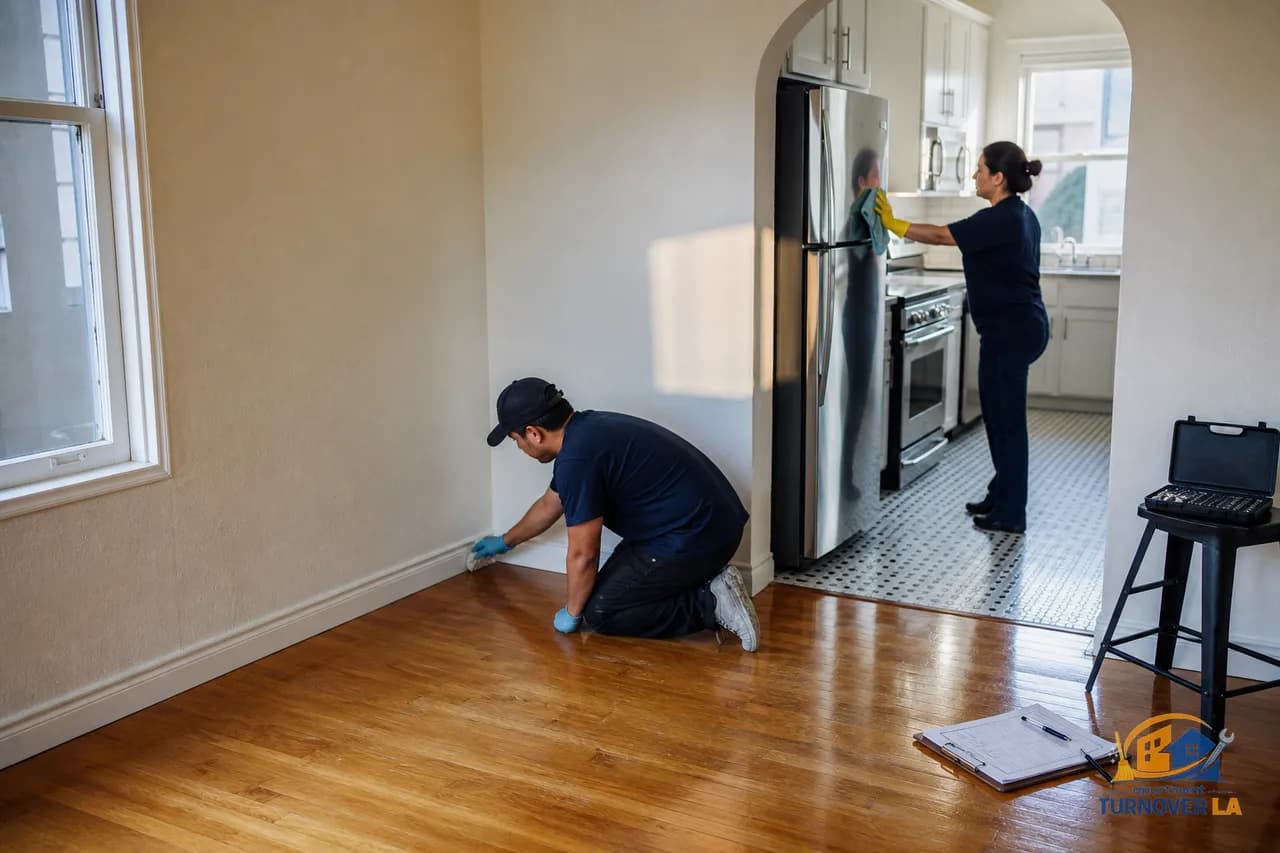
Quick answer: Tenant turnover is the period from a tenant’s move-out through make ready and re-leasing the unit. In Los Angeles, vacancy loss typically runs $80 to $200 per day, so speed matters. Across LA, a 1BR move-out clean often runs $275 to $450. With TurnOver LA, Make Ready for a 1BR is $255 with a 48-hour turnaround, which helps cap idle days. Get instant quote in 30 seconds
Tenant turnover is the full cycle that starts when a resident gives notice, continues through move-out, cleaning, repair, and rekey, and ends when the next lease is signed. In short, it is everything required to return a unit to rent-ready condition and back on market. The economics in LA hinge on daily vacancy cost and tight coordination of the work.
What is tenant turnover in practical terms?
Tenant turnover is the process of moving from one occupant to the next. Operationally it includes notice and scheduling, pre-inspection, move-out, make ready work, rekey or smart lock setup, marketing, showings, screening, and lease-up. The unit is non-revenue during much of this window, which is why each day matters in LA. Baseline vacancy loss in LA submarkets runs $80 to $200 per day, from North Hollywood to Santa Monica.
Your scope usually includes cleaning, paint touch-up or repaint, drywall patches, minor maintenance, and safety checks. Rekeying or installing a smart lock between tenants is standard. Documentation matters too. Photos, receipts, and itemized deductions must align with California Civil Code on deposits. Tight sequencing reduces idle time and keeps you within the 21-day deposit return period.
How do you calculate tenant turnover rate?
Turnover rate measures how many rented units cycle out over a period. A basic formula is: number of move-outs in the period divided by average occupied units in the period. If a 40-unit building in Hollywood has 10 move-outs this year and averages 38 occupied units, the turnover rate is 10 divided by 38, about 26 percent.
Track it quarterly and annually. Separate voluntary move-outs from non-renewals you initiated. In LA, also tag units covered by the LAHD Rent Stabilization Ordinance, since RSO buildings often show different patterns than non-RSO stock. Consistent definitions are key so the metric is useful for budgeting, staffing, and marketing adjustments.
What is a good tenant turnover rate in LA?
Context matters. In stabilized multifamily across LA, a yearly turnover rate in the 25 to 35 percent range is common, with lower rates in RSO properties in Mid-City and higher in newer non-RSO product in Downtown LA. Many small owners target sub-25 percent in buildings with longer average tenancy and steady renewal incentives.
You can drive the rate down through renewals and service quality, but your net operating income also depends on how few vacancy days you carry when turnover does happen. A 30 percent annual rate with a 3-day average downtime can outperform a 20 percent rate with 10-day gaps. Focus first on shaving days through tight scopes and reliable 48-hour work blocks.
Is a 30 percent turnover rate bad?
Not by itself. A 30 percent annual rate can be normal for smaller portfolios or student-adjacent areas like Westwood. The red flag is long idle time and uncontrolled make ready costs. At $80 to $200 per day of vacancy, an extra 5 days costs $400 to $1,000 per unit turnover, which often exceeds any marginal savings from deferring small repairs.
If you are at 30 percent with 7 to 10 days of downtime, prioritize scheduling discipline. Pre-approve standard scopes, line up vendors before keys are returned, and assign make ready within 24 hours of move-out. Lock-in a two-day field block and then list immediately with complete photos.
What actually happens during turnover, step by step?
A reliable turnover workflow is predictable. Here is a simple sequence that works in LA buildings from Echo Park to Glendale:
- Receive and log notice, review lease and deposits, send move-out instructions.
- Pre-inspect 7 to 10 days before move-out, set a provisional scope and materials list.
- Move-out day, collect keys, confirm utilities, capture move-out photos.
- Make ready work block, cleaning, paint, minor repairs, safety items, rekey or smart lock.
- Quality control, 12-point photo set, document any deposit deductions.
- Listing prep, photos and copy, publish to your channels, open for showings.
- Screen, approve, sign, fund, and deliver keys or smart credentials.
Standardizing the seven steps keeps your vacancy clock short and your documentation clean for lawful deposit handling.
What does tenant turnover cost in Los Angeles today?
Across LA, a 1BR turnover often totals one month’s rent once you include vacancy, make ready, painting, and marketing. Breaking it down helps. Market move-out or make ready cleaning for a 1BR commonly ranges $275 to $450. With TurnOver LA, Make Ready, which includes a deep clean and 12-point photo report, is $255 for a 1 Bedroom, with a flat 48-hour turnaround. Studios are $225, 2 Bedrooms are $335, and 3BR or larger are $425.
Painting across the market often runs $300 to $700 per room. With TurnOver LA, repainting per room is $395 per room, paint touch-up only is $200, and ceilings and baseboard or trim are $125. Drywall patches in LA are often $175 to $350 for small areas. Our small drywall patch plus texture is $150 per patch and medium drywall repair is $240 per patch.
Market rekey in LA usually runs $125 to $200 for a basic cylinder change. With TurnOver LA, rekey first lock is $100, lock rekey front plus deadbolt is $110, or a full apartment rekey up to 2 locks is $150. Smart lock installation across the market runs $150 to $350 for labor. Our smart lock install is $210. Handyman half-day rates in LA are often $250 to $400. Our half-day handyman punch list is $230, or a full day is $425. For junk removal, LA market pricing is commonly $300 to $700 per load. Our unit cleanout or junk haul is $500 per load, with additional junk load $500 per load. For listing media, LA photographers often charge $250 to $600 depending on add-ons. Our TLA Launch Pad Media Package is $399.
Every job we schedule is set to 48 hours, which is a practical hedge against $80 to $200 daily vacancy cost. Get instant quote in 30 seconds
Need the unit turned before the next tenant?
We do the move-out clean and send you a photo report you can attach to the deposit itemization.
Get an instant quoteHow does LA law affect turnover timelines and deposits?
Deposit handling and timelines shape your turnover pace. California requires landlords to return security deposits within 21 calendar days after the tenant moves out, with itemization and receipts where applicable. See California Civil Code §1950.5 for the rules. The California DCA Landlord-Tenant Guide and the California Tenants Guide both explain documentation standards and allowable deductions.
AB 12 (2023) caps most residential security deposits at one month’s rent, with limited exemptions. That cap increases pressure to keep make ready costs reasonable and well documented. In the City of Los Angeles, properties covered by the LAHD Rent Stabilization Ordinance have additional rules on rent increases and certain types of terminations, which can influence turnover patterns. Always confirm coverage and compliance before you schedule no-fault actions that could trigger relocation requirements.
For more detail on timing and documentation, see our guides on the 21-day rule and what counts as normal wear and tear in California: /guides/california-21-day-deposit-return and /guides/normal-wear-and-tear-california.
Should I rekey or install a smart lock between tenants?
Rekeying is the minimum. It secures the unit and is usually expected under modern safety standards. In LA, rekey is standard practice between occupants. Rekey market rates run $125 to $200. With TurnOver LA, the rekey first lock is $100, front plus deadbolt is $110, or a full apartment rekey up to 2 locks is $150.
Smart locks can shorten leasing friction by enabling self-guided tours and easier key handoff. Smart lock install market labor ranges $150 to $350. Our smart lock install is $210. We coordinate it inside the same 48-hour make ready block. If you prefer to keep metal keys, at least combine a rekey with a safety check, which we bundle through our general maintenance visit at $125.
For a complete clean-and-secure workflow, see our Make Ready service page here: /services/make-ready. If you want a direct security scope, see /services/locks-security.
What should be in a make ready scope for LA apartments?
A clear scope avoids both under-cleaning and over-spending. A standard LA make ready for a typical 1BR includes kitchen degrease and detail, bath descale and sanitize, appliance exterior and interior wipe, floor detailing, blinds and tracks, baseboards, and inside cabinets. Add paint touch-up, drywall patch or two as needed, door hardware tune, outlet or GFCI checks, and a smoke or CO alarm test.
At TurnOver LA, Make Ready covers the deep clean plus a 12-point photo report. For punch work, add a half-day handyman at $230 if your pre-inspection suggests more than five small items. For units with heavy junk, add a unit cleanout at $500. If odor remediation is needed, plan extra time and reference our guides on pet and smoke smell for LA apartments: /guides/pet-odor-removal-apartment-los-angeles and /guides/how-to-remove-smoke-smell-from-apartment.
How do you cut vacancy days without cutting corners?
You win the vacancy battle before keys are returned. Do a pre-inspection a week out, pre-authorize a base scope, and stage your crew for day one. If you can, batch all field work into a 48-hour window. That lets you list by day three and start showings while the scent of fresh paint dries.
Use a standard photo set at end of make ready to publish immediately with your listing. Our TLA Launch Pad Media Package is $399 and is designed for fast lease-up photography. Pair that with instant rekey or a smart lock, then slot showings. Document everything for deposit compliance. Each saved day is $80 to $200 back to your NOI.
For deeper planning help, see our apartment turnover checklist and cost breakdowns: /guides/apartment-turnover-checklist and /guides/apartment-turnover-cost-los-angeles. For a view on the math landlords use to value days, see /guides/property-managers-vacancy-loss-los-angeles.
When should you repaint vs touch up during turnover?
Touch up if the existing paint is within the same batch and under two years old, and if scuffs do not telegraph under new light. Market paint costs add up fast at $300 to $700 per room. Our paint touch-up only is $200. If walls show patchwork or color variation, do a full repaint. Our repainting per room is $395 per room, and ceilings and baseboard or trim are $125.
A good rule in Los Feliz and similar older stock is to repaint high-traffic rooms more often and use touch-up in bedrooms if the finish allows it. Fresh paint lifts perceived cleanliness. That often shortens marketing time by a few showings, which is another way to save vacancy days.
What listing prep helps apartments lease faster after turnover?
Photos sell the unit while your make ready is still fresh. Stage with blinds open, lights on, and counters clear. Shoot wide angles of living, kitchen, bath, and bedrooms. Add one hallway or exterior frame if it helps orientation. Publish to your leasing channels same day the unit is ready.
Across LA, real estate photo packages range $250 to $600. Our TLA Launch Pad Media Package is $399 and we queue it inside the same 48-hour work block. Pair that with compelling, accurate copy and a competitive initial asking rent. That mix tends to trim 1 to 3 days off average days vacant in mid-market neighborhoods like Palms or Mar Vista.