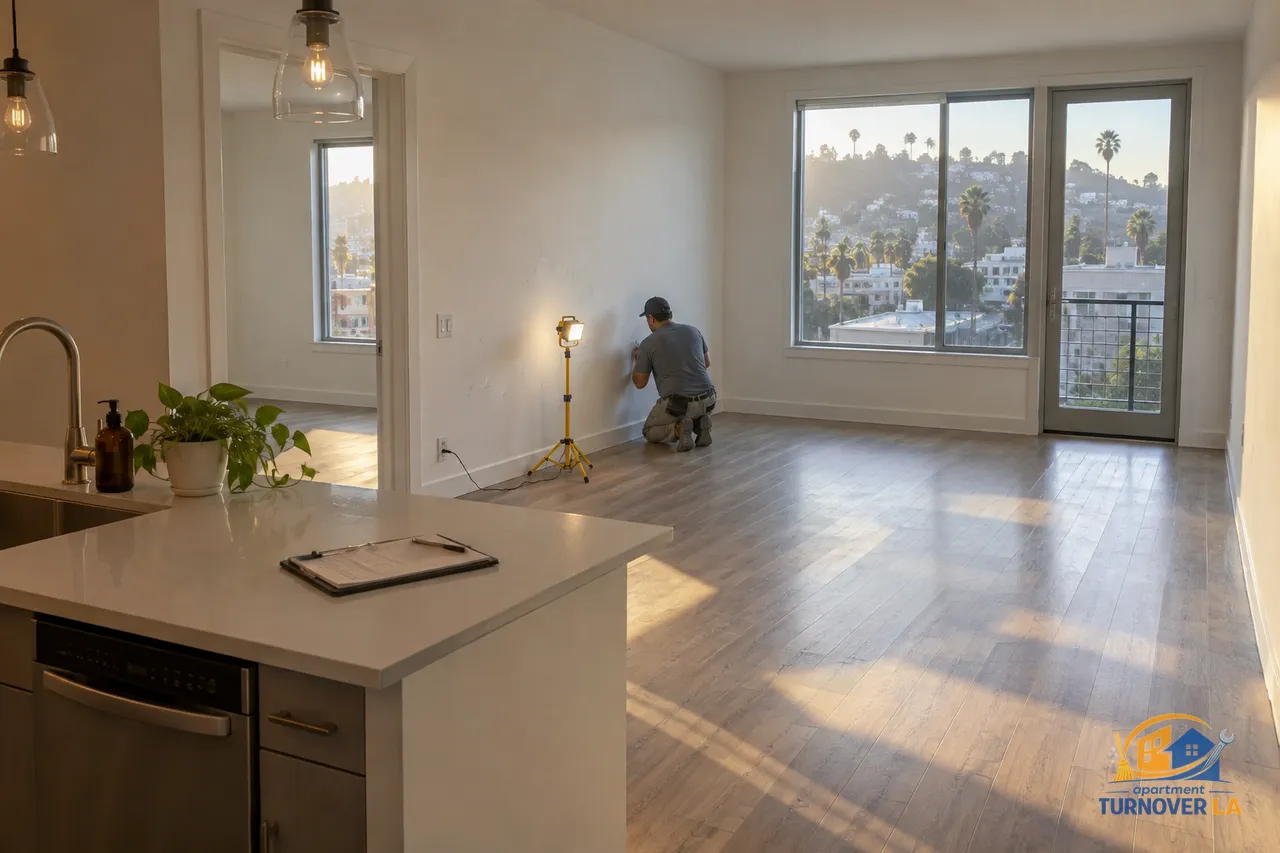
Quick answer: An apartment turnover fee is the cost of getting a vacant unit ready for the next renter, not an automatic charge a landlord can simply pass on. Across LA, basic turnover preparation commonly runs $225 to $425. TurnOver LA's Make Ready is $225 for a studio, $255 for a one bedroom, $335 for a two bedroom, and $425 for a three bedroom or larger, with a 48-hour turnaround.
An apartment turnover fee should be a working budget category, not a mystery line item on a former tenant's ledger. It covers the condition work between occupancies, while any security-deposit deduction must be tied to legally allowed, documented costs. For a vacant unit that needs a clean, condition record, and a clear next step, Get instant quote in 30 seconds.
What is turnover in renting?
Turnover is the period from possession back from an outgoing resident to a rent-ready home for the next one. The work usually starts with a condition walk, photos, cleaning, repair decisions, keys, and removal of items left behind. It ends when the unit is safe, clean, marketable, and ready for a signed applicant to receive possession.
The phrase "turnover fee" is used loosely. A property manager may mean the owner's internal unit-prep budget. A vendor may mean a line item for cleaning or a package. A landlord should not treat it as a fixed penalty charged to every departing tenant. Under California Civil Code §1950.5, deductions need a permissible purpose and support. Ordinary turnover administration is not, by itself, a damage invoice.
For an LA owner, separate four buckets from day one: normal turnover work, tenant-caused work, owner upgrades, and vacancy loss. That separation makes deposit accounting and future budgeting much cleaner.
How much does an apartment turnover fee cost in LA?
Across LA, basic turnover preparation commonly runs $225 to $425 before separate repairs, hauling, locks, paint, or parts. That is a general market context, not a promise that every vacant unit can be made ready at the low end. Heavy grease, pet odor, wall damage, abandoned furniture, and deferred maintenance change the scope quickly.
With TurnOver LA, the base Make Ready service is a flat $225 for a studio, $255 for a one bedroom, $335 for a two bedroom, and $425 for a three bedroom or larger. It includes a deep clean and 12-point photo report, with a 48-hour turnaround. Labor and the crew's own supplies are covered. Paint, parts, and fixtures needed for the job are assessed on site and added only with owner approval.
A useful distinction: the make-ready price is not a bundled repair allowance. If a wall needs work, a small drywall patch plus texture is $150 per patch. If the unit needs a cleanout, a unit cleanout or junk haul is $500. Price the base condition separately from verified corrective work so the invoice stays understandable.
Can a landlord charge a tenant an apartment turnover fee?
Usually, no, not as an automatic flat fee just because a tenant moved out. California security-deposit rules focus on unpaid rent, cleaning needed to return the premises to its move-in level of cleanliness, restoration for tenant damage beyond ordinary wear, and certain other statutory items. The California DCA Landlord-Tenant Guide is a useful operating reference, but owners should apply the statute and lease to the actual facts.
A tenant can be charged for supported cleaning or repair when the condition warrants it. A landlord cannot relabel normal aging as a turnover fee. Faded paint, routine floor wear, and small scuffs after ordinary occupancy are different from unauthorized paint, holes, or excessive filth. Review the difference before estimating deductions in normal wear and tear in California.
Document the move-in condition, pre-move-out inspection option, final condition, invoices, and receipts where applicable. California's deposit timing rules also matter. Use this 21-day deposit return guide before issuing an accounting. California's AB 12 changed the deposit cap, not the requirement to substantiate lawful deductions.
How do you calculate apartment turnover cost?
Calculate turnover as the sum of unit-prep work, tenant-chargeable work where documentation supports it, owner-paid improvements, and vacancy carrying cost. Do not bury all four in one "fee." That shortcut makes it hard to see whether the problem was a damaged unit, slow vendor coordination, or an over-scoped renovation.
Use this five-part calculation for each vacancy:
- Start with the base make-ready scope and unit size.
- Add condition-specific labor, such as paint, drywall, maintenance, locks, or hauling.
- Add approved materials separately, including paint, parts, or fixtures.
- Record eligible tenant charges apart from owner costs and normal wear.
- Add lost rent for the actual days the unit was unavailable.
Vacancy can be the larger number. In Los Angeles, an empty unit often costs about $80 to $200 per day depending on submarket and rent level. A three-day delay can therefore cost $240 to $600 before any work is added. That is why a 48-hour field turnaround has practical value, even on a modest one bedroom. Get instant quote in 30 seconds.
Need the unit turned before the next tenant?
We do the move-out clean and send you a photo report you can attach to the deposit itemization.
Get an instant quoteWhat should a 48-hour turnover workflow include?
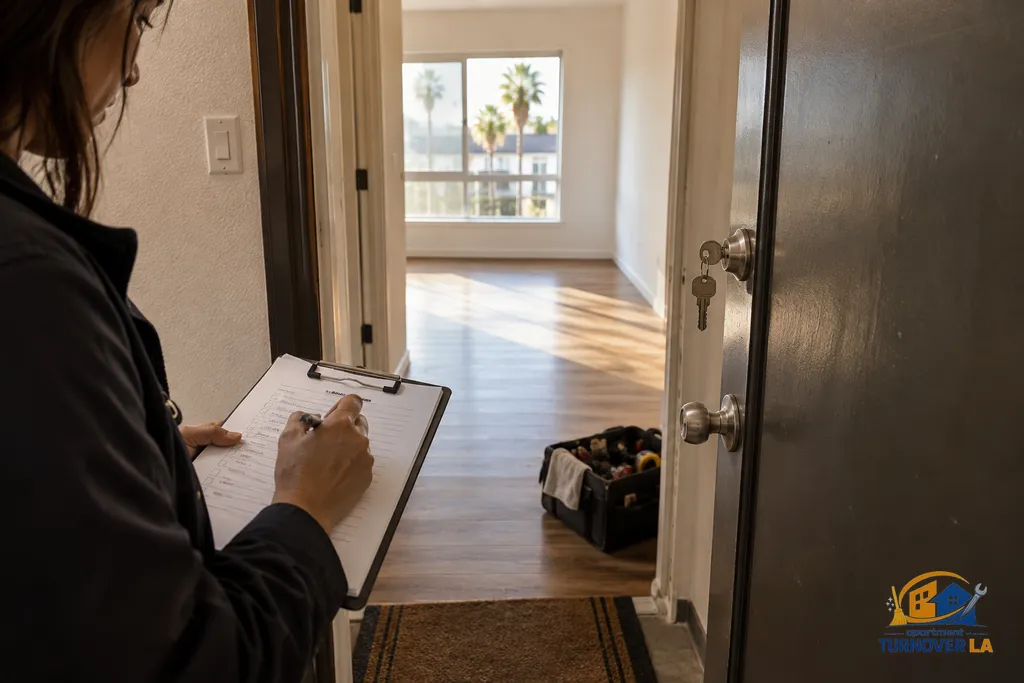
A fast turnover works when decisions are made in sequence, not when every trade arrives at once. First, photograph the unit before cleaning or hauling. That preserves the condition record. Next, identify safety and access issues, including locks, smoke detectors, leaks, exposed wiring, and tripping hazards. Then clean and inspect the now-visible surfaces. Finally, complete approved punch work and take the final photos.
TurnOver LA's Make Ready includes a 12-point photo report. That report is more than a marketing extra: it gives the owner a condition checkpoint after cleaning, when hidden damage and deferred items are easier to spot. If the inspection finds a maintenance list, a half-day handyman punch list is $230 and a full-day handyman punch list is $425. Those are separate catalog line items, not assumed additions to Make Ready.
For units with outgoing furniture or bags of debris, schedule hauling before final cleaning. A cleanout and junk haul is $500 for the unit, with an additional junk load at $500 per load. Cleaning around abandoned furniture creates duplicate labor and weakens the final condition report.
Is the 2% rule useful for apartment turnover planning?
The 2% rule is commonly used as a rough acquisition screen, comparing monthly rent with purchase price. It is not a California deposit rule, a legal turnover-fee formula, or a reliable unit-turnover budget. LA multifamily owners should not use it to decide what a departing tenant owes.
A more useful operating benchmark is turnover days. Track the time from keys returned to rent-ready, then from rent-ready to lease signed. Keep cleaning, repairs, vendor scheduling, and leasing delay as separate columns. If a unit sits ten days because a $150 drywall patch was not approved until day six, the issue is not the patch price. It is the approval process and the vacancy exposure it created.
For buildings subject to local rent rules, confirm the operating framework before making changes around a vacancy. The LAHD Rent Stabilization Ordinance applies to covered units and should be reviewed alongside the lease and current local guidance. The turnover crew can document physical condition, but rent and compliance decisions remain an owner or manager responsibility.
Which costs belong to the owner versus the former tenant?
The owner typically pays for ordinary wear, routine unit preparation, elective upgrades, and costs incurred to improve marketability beyond restoring the prior condition. The former tenant may be responsible for documented cleaning or damage beyond ordinary wear, subject to California law, depreciation, and the available evidence. Materials should never become a vague markup category. Keep approved paint, parts, and fixtures identifiable on the final invoice.
For example, paint touch-up only is $200 through TurnOver LA. Repainting per room is $395 per room. The first figure may fit a turnover caused by normal presentation needs, while the second may be relevant after documented tenant damage or as an owner refresh. The reason for the work, the unit's prior condition, and the useful life of the surface matter more than the label on the invoice.
Do not wait until the final accounting to sort this out. Compare move-in and move-out records before authorizing scope. Our guide to landlord charges for tenant turnover provides a practical framework for keeping maintenance, damage, and upgrade decisions apart.
Build the turnover fee into a repeatable operating system
The best apartment turnover fee is visible before the lease ends. Maintain a standard scope, condition-photo process, approval path for materials, and vacancy-day tracker. That gives a small LA landlord the same basic control a larger portfolio gets from a dedicated turns coordinator.
Start with the actual condition rather than a presumed all-in number. Across LA, basic turnover preparation commonly runs $225 to $425. TurnOver LA's Make Ready is $225 for a studio, $255 for a one bedroom, $335 for a two bedroom, and $425 for a three bedroom or larger, including deep cleaning and a 12-point photo report within 48 hours. Add only the repair, lock, cleanout, or material scope the unit actually needs.
That approach protects the deposit file and reduces vacant days without treating a former tenant as the default payer for ownership costs. When the unit is vacant and the scope is clear, Get instant quote in 30 seconds.