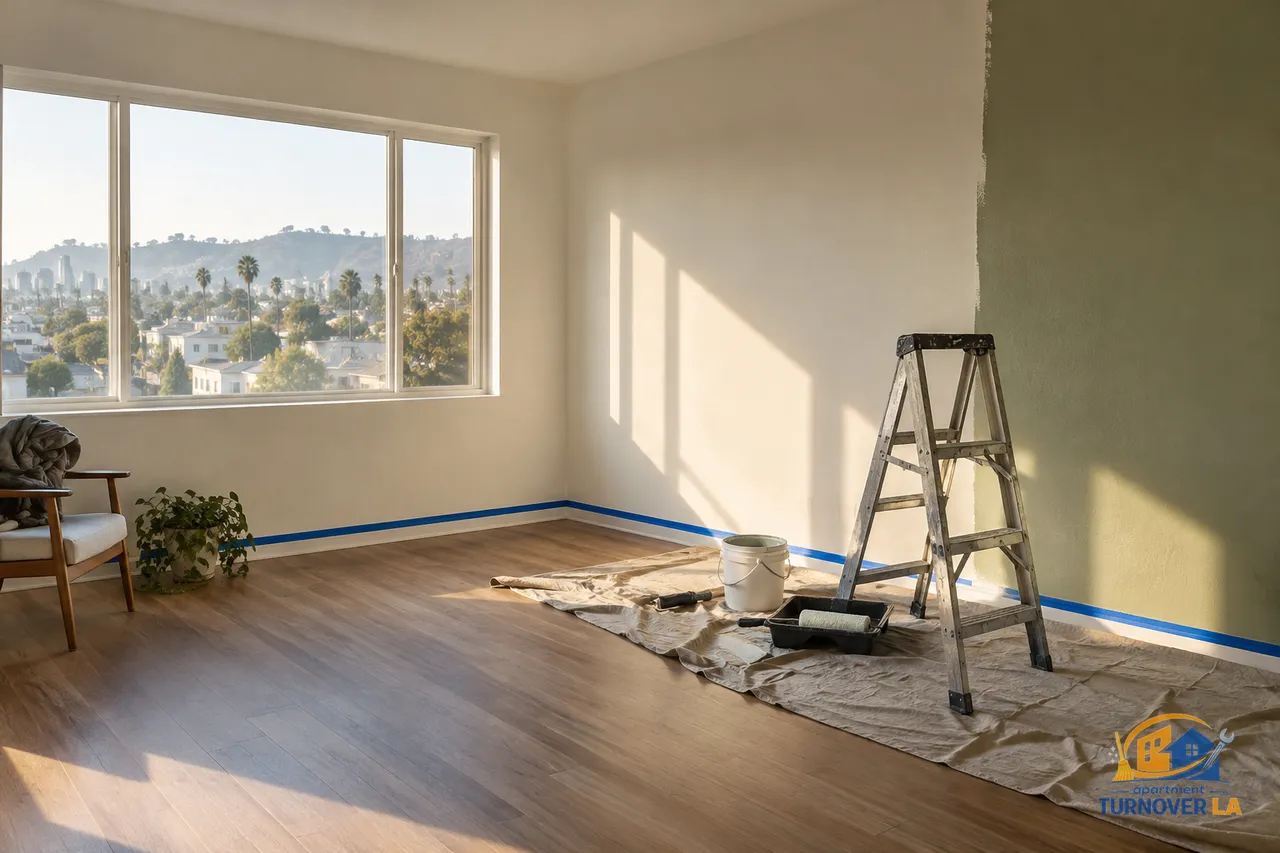
Quick answer: Yes, it can be okay to paint an apartment in Los Angeles, but a renter should get written landlord approval before opening a can. A full 1,000 square foot interior repaint commonly runs about $2,000 to $5,000 in the LA market, while TurnOver LA lists repainting at $395 / room when a landlord needs turnover work completed within 48 hours.
Painting an apartment is usually a lease and written-permission question, not a blanket California right for tenants. For landlords, the practical question is whether the existing finish needs a touch-up, a room repaint, or a documented charge for damage beyond ordinary wear.
Get instant quote in 30 seconds
Can a tenant paint an apartment without permission?
Usually, no. A tenant should not assume that a light color, an accent wall, or a small bedroom makes painting permissible. The lease may prohibit alterations altogether, require prior written consent, specify approved colors and sheen, or require the tenant to restore the original color before move-out. A verbal okay from an onsite manager is harder to prove later, so an email approval that identifies the room, color, finish, and restoration responsibility is safer for both sides.
California does not set a universal rule saying every renter may repaint after a certain number of years. The useful baseline is the written rental agreement and a move-in condition record with dated photos. A landlord who approves tenant paint should also decide whether the work must be professionally completed, whether low-VOC paint is required, and who retains any leftover paint for future touch-ups. Those details prevent a simple color change from becoming a four-wall reset during turnover.
For a broader move-out documentation process, use this apartment turnover checklist before keys are returned.
What should a Los Angeles paint approval include?
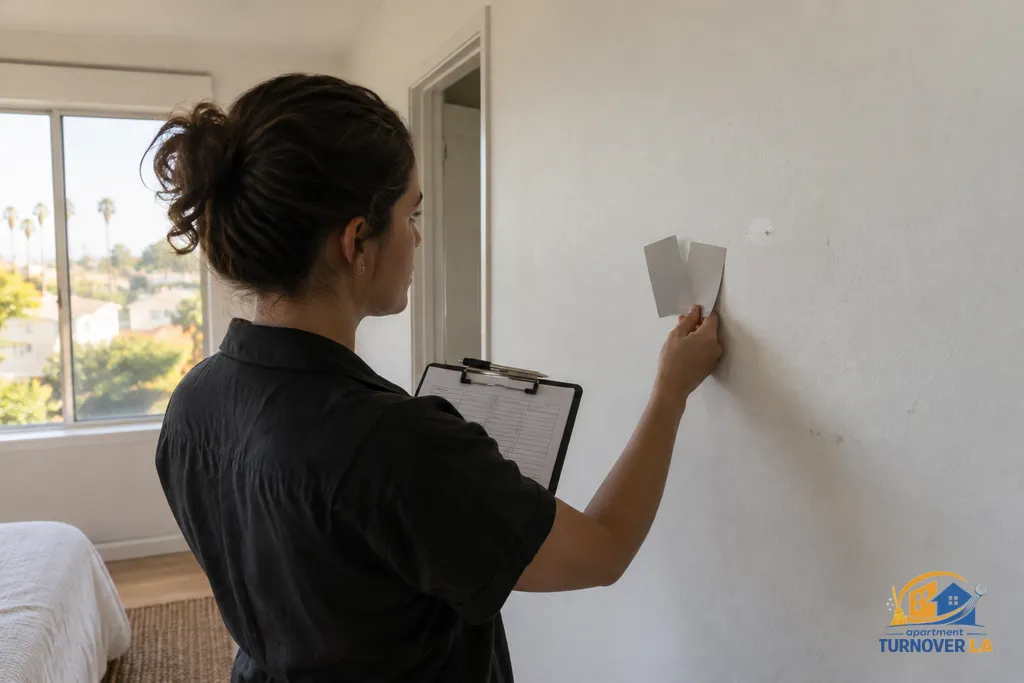
Approval should be specific enough that the next manager can understand it without relying on memory. “Tenant may paint” leaves too many open questions. A short written addendum or email should identify the permitted room, exact brand or color reference, finish, whether ceilings and trim are excluded, and the deadline for restoring the unit if required.
It should also state workmanship expectations. Paint on outlet covers, windows, floors, baseboards, cabinet hardware, and smoke alarms is not an acceptable result. In older LA buildings, the owner should control any prep work around damaged plaster, suspected lead-based coatings, or water-stained areas. Painting over an active leak or loose drywall only hides a repair that will return.
The approval should distinguish a tenant improvement from a maintenance request. If the walls are heavily marked because the prior finish is worn, the owner may choose to repaint as part of routine readiness. If a tenant wants a dark or nonstandard color for preference, restoration terms should be clear before the work begins.
Who pays for paint at move-out in California?
The answer depends on why the painting is needed. Faded paint, light scuffs, minor nail holes, and normal aging generally fall under ordinary wear rather than a tenant charge. Deeply saturated colors left without approval, extensive marker or adhesive damage, unauthorized murals, and paint overspray may support a deduction when the cost is reasonable and documented.
California's security-deposit rules allow deductions for repair of tenant-caused damage beyond ordinary wear, subject to the requirements in California Civil Code §1950.5. The practical record is a before-and-after photo set, invoices or good-faith estimates, the lease clause, and an itemized statement. Owners should not charge a departing tenant to upgrade an entire aged unit when only one area was damaged.
The distinction matters in LA rent-stabilized properties too. The LAHD Rent Stabilization Ordinance affects many landlord-tenant decisions, but it does not turn ordinary wall aging into a deductible tenant repair. See our guide to normal wear and tear in California for common examples and documentation tips.
Need the walls done before you re-list?
Turnover painting, scuff removal and patching, with a photo record of the condition we left behind.
$395 per room · 48-hour turnaround
Get an instant quoteHow much does it cost to paint a 1,000 square foot apartment?
Across Los Angeles, a full interior repaint of a 1,000 square foot apartment commonly falls around $2,000 to $5,000 in the general market. The range moves with wall condition, number of rooms, ceilings, trim, occupied versus vacant access, paint quality, and how much masking and repair the crew needs. It is a market context figure, not a TurnOver LA quote.
TurnOver LA prices the scopes below as separate catalog line items, rather than presenting the market range as its price. Repainting is $395 / room, and paint touch-up only is $200. Ceilings and baseboard/trim are $125, while sand + repaint cabinets/shelving is $135. If wall damage is uncovered, small drywall patch + texture is $150 / patch and medium drywall repair is $240 / patch.
| Scope | Typical LA market context | TurnOver LA catalog price |
|---|---|---|
| Full 1,000 sq ft interior repaint | $2,000 to $5,000 | Priced by verified room scope, $395 / room |
| Small touch-up visit | Varies by access and matching | $200 |
| Small wall patch before paint | Varies by texture and drying needs | $150 / patch |
Labor and the crew's supplies are covered in the quote. Paint, parts, and fixtures needed for the job are priced at the onsite inspection and added to the final invoice only with owner approval.
Get instant quote in 30 seconds
How many hours does it take to paint an apartment?
A simple vacant room can often be prepped and painted in a working day, but an apartment is not just wall area. The timeline includes protecting floors, removing or masking plates, patching holes, sanding, spot priming, cutting in, applying coats, drying, reinstalling hardware, and final inspection. Dark colors, nicotine residue, glossy paint, damaged drywall, and crowded occupied rooms add time.
For turnover scheduling, use this sequence rather than booking painters before the unit has been assessed:
- Photograph walls and identify any tenant-caused damage.
- Complete leak, drywall, or electrical repairs before paint.
- Confirm colors, sheen, and owner approval for materials.
- Remove junk and clean grease or residue that will affect adhesion.
- Paint after repairs, then complete final cleaning and a condition report.
TurnOver LA works on a flat 48-hour turnaround for every job, with no rush or same-day upcharge. That is a scheduling commitment, not a reason to skip dry time or paint over a repair that is still wet. When several trades are involved, a coordinated painting and drywall service reduces handoff gaps.
When is a touch-up better than repainting the room?
Touch-up works when the owner has the original paint, the existing color has not faded noticeably, and the marks are isolated. It is often the right response for a few scuffs near a doorway, minor furniture rubs, or a small patched nail hole. TurnOver LA's paint touch-up only service is $200, which can be more efficient than repainting sound walls simply because the unit is vacant.
A full room repaint is usually better when touch-up flashes in different light, the former tenant used a different sheen, several patches cross the wall, or there is broad discoloration. One fresh rectangle in the middle of an aged wall can make the room look less rent-ready than the original scuff. In that situation, $395 / room provides a defined repaint scope instead of repeated small fixes.
This is also where inspection photos matter. A 12 point photo report included with a Make Ready service helps managers record unit condition after cleaning and before marketing. It gives leasing staff a current visual record, not a vague note that the walls were “fine.”
What should a landlord inspect before approving or billing for paint?
Start with cause, then condition, then scope. Check for moisture staining, loose tape joints, cracks, grease, smoke residue, adhesive pull, and color mismatch before deciding that a wall merely needs paint. A brown ceiling ring below an upstairs bathroom, for example, is a repair issue first. Painting it without finding the source creates a repeat vacancy problem.
Next, compare the move-out condition with move-in photos and any approved alteration record. Document each chargeable area close up and from room distance, then use a scope that restores the affected condition rather than improving unrelated surfaces. The California DCA Landlord-Tenant Guide is a useful statewide reference on deposits and landlord-tenant responsibilities, while our guide on landlord turnover charges addresses the operational side of allocating costs.
A clean handoff protects everyone: the tenant sees what is being assessed, the owner can approve materials, and the next renter receives a consistent finish. For paint, repairs, cleaning, and documentation on one turnover schedule, start with the specific scope and avoid treating every marked wall as an automatic full repaint.