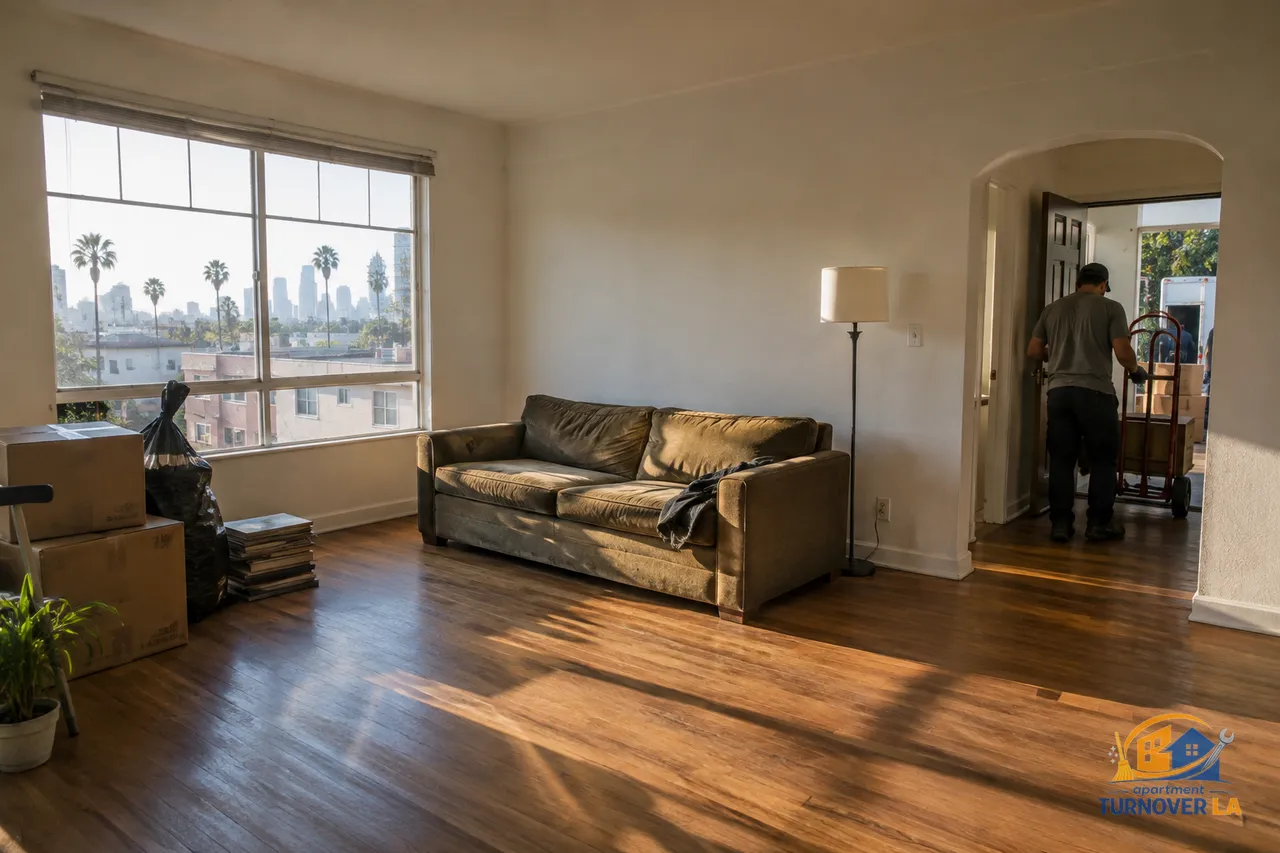
Quick answer: Los Angeles junk pickup ads can start at $75 for one curbside item, but that is not a comparable price for clearing a vacant apartment. TurnOver LA charges a flat $500 for a unit cleanout or junk haul, with a 48-hour turnaround. Before anything is removed, landlords should separate ordinary trash from property that may be abandoned.
Junk removal in an LA apartment is a turnover task, not just a hauling errand. The fastest cleanouts start with possession, documentation, and a clear decision about what can be disposed of. For a vacant unit that needs furniture, bagged debris, and loose items removed, TurnOver LA's cleanout service is $500 for a unit cleanout or junk haul.
Get instant quote in 30 seconds
What counts as a junk cleanout in an LA apartment?
A junk cleanout is the removal of unwanted items left in a unit, storage area, patio, or parking space after the owner has the right to take possession and dispose of them. In practice, that can include broken furniture, bagged household trash, old shelving, damaged mattresses, small appliances, carpet remnants, and nonhazardous turnover debris. It is different from a regular trash pickup because a turnover produces mixed material, often inside the unit and on more than one floor.
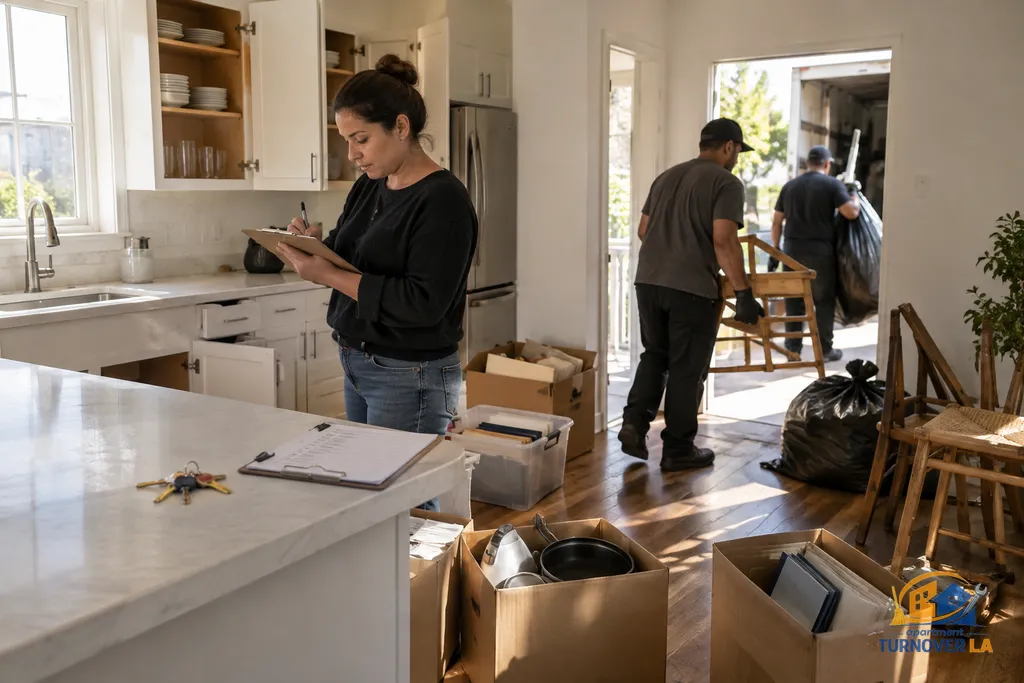
Start by walking every room, closet, balcony, and assigned storage space. Photograph the condition before the crew moves anything. Then separate building-owned items, tenant belongings that may require notice, reusable fixtures, and clear trash. This step prevents a common delay: a crew arriving to haul an apartment while the manager is still deciding whether a box of papers or a bike can legally leave the property. For a full sequence after vacancy, use this apartment turnover checklist.
How much does apartment junk removal cost in Los Angeles?
Across LA, advertised junk-removal pricing can start around $75 for a single curbside item, but that entry price is not the same as an in-unit turnover haul with furniture and mixed debris. For the full-unit cleanout category, TurnOver LA is a flat $500 for a unit cleanout or junk haul. If the volume exceeds the initial load, an additional junk load is $500 per load.
| Job scope | General LA market context | TurnOver LA catalog price |
|---|---|---|
| One-item curbside pickup | Advertised starting prices can be about $75 | Scope separately from a unit cleanout |
| Vacant apartment cleanout | Price varies by volume, access, and item mix | Unit cleanout / junk haul: $500 |
| Overflow beyond the initial haul | Typically priced by extra volume | Additional junk load: $500 / load |
Access changes the work even when the pile looks small. A third-floor walk-up, a narrow rear stair, a no-parking block, or a building elevator reservation can add handling time. Tell the estimator about those conditions, plus mattresses, appliances, construction debris, and anything that may need special disposal. The quote covers labor and the crew's own supplies. Paint, parts, or fixtures needed elsewhere in the turnover are inspected and added only with approval.
Can a landlord throw away property left by a former tenant?
Not automatically. A landlord should not treat every item left after move-out as trash, especially when the unit was not clearly surrendered or items have apparent value. California's rules on property left behind set out notice and storage requirements in many situations, so the possession date and condition of the items matter. Review California Civil Code §1950.5 and the California DCA Landlord-Tenant Guide before authorizing disposal of questionable belongings.
Operationally, make three groups: obvious garbage, building property, and possible tenant property. Photograph each group with wide shots and close shots, note where it was found, and keep a simple inventory for anything that is not plainly refuse. Do not let a cleanout crew make the legal judgment for you. This is particularly important in older buildings around Koreatown, where shared garages, storage cages, and unlabeled common areas can make ownership unclear.
Security-deposit deductions are a separate issue. A haul invoice does not by itself establish what can be charged back. Compare cleaning, damage, and disposal records against the move-in condition and the applicable rules. This guide on landlord charges for tenant turnover explains the documentation side of that decision.
Is it illegal to leave garbage cans out in Los Angeles?
It can create a compliance problem, but the practical answer depends on the property's collection service, pickup schedule, and local placement rules. A cart that is out for collection is not the same as using the sidewalk, parkway, alley, or curb as a long-term staging area for a move-out. Do not solve an apartment cleanout by leaving loose bags, furniture, or boxes beside the bins and assuming regular collection will take them.
For a turnover, keep the work contained on the property until a scheduled haul or approved bulky-item collection is in place. Bag ordinary trash, keep egress paths clear, and avoid blocking shared driveways, alley access, or parking. This matters in dense multifamily blocks because a few large items can quickly become a notice from management, an obstruction complaint, or a delayed collection.
If the apartment still needs cleaning once the unwanted items are gone, schedule the cleaning after hauling, not before. A vacant one-bedroom is easier to inspect and detail once floors, cabinets, and closets are empty. TurnOver LA's Make Ready service is $255 for a one-bedroom and includes a deep clean plus a 12-point photo report. That sequence also keeps clean surfaces from being dirtied during hauling.
Need the unit turned before the next tenant?
We do the move-out clean and send you a photo report you can attach to the deposit itemization.
From $225 · 48-hour turnaround
Get an instant quoteWhere can landlords get free bulky-item pickup in Los Angeles?
Free bulky-item pickup may be available through the property's waste-service arrangement, but it is usually best for planned curbside disposal, not an urgent apartment turnover. The owner or manager should verify eligibility, request the pickup through the correct provider, confirm the accepted items, and follow the placement instructions for that address. Apartment buildings can have separate account rules, collection locations, or management approval requirements.
Use that option when the move-out date leaves enough time and the items are accepted. It is less useful when a unit has mixed debris, interior furniture, bags throughout the apartment, or a lease-up deadline. A crew-based cleanout avoids waiting for a collection window and avoids asking staff to drag heavy items through common areas.
There is another distinction worth making: free pickup does not determine whether belongings can be disposed of. Resolve the abandoned-property question first, then choose the disposal path. For a unit that needs to be listed quickly, schedule the cleanout as one defined turnover step, followed by cleaning, repairs, and listing photos.
Get instant quote in 30 seconds
What is the best way to remove yard waste and patio debris?
The best method is to separate green waste from apartment junk before the haul is scheduled. Branches, leaves, planter soil, and bagged trimmings may follow a different collection route than furniture, appliances, and mixed household debris. Do not mix paint, chemicals, batteries, e-waste, or other potentially hazardous material into green waste or a standard junk pile. Identify those items early so the manager can arrange the appropriate disposal method.
For apartment turnovers, patio work often reveals more than yard waste. A balcony or rear yard may have broken planters, abandoned grills, damaged outdoor furniture, and loose trash alongside leaves. Photograph the area before clearing it, especially if the space was assigned to a tenant. Then clear the nonhazardous debris, sweep the surface, and inspect drains, gates, railings, and exterior lighting.
This is also a good point to identify repair work rather than covering it with a quick cleanup. Loose hardware, damaged screens, or a gate that does not latch can be added to a handyman punch list. TurnOver LA prices a half-day handyman punch list at $230 and a full-day handyman punch list at $425, with parts priced after inspection and approved first.
How should a manager schedule a cleanout without losing rent days?
Schedule the cleanout immediately after lawful possession and documentation, then put each following trade in the order that protects finished work. In LA, vacancy commonly costs $80 to $200 per day depending on the submarket, so a cleanout that drifts for several days can cost more than the operational shortcut it was meant to save. TurnOver LA uses a flat 48-hour turnaround on every job, without a rush or same-day upcharge.
Use this turnover order:
- Confirm possession and document the unit, storage, patio, and parking areas.
- Separate possible abandoned property from clear trash and building-owned items.
- Complete the cleanout and remove remaining debris from access paths.
- Inspect for patches, paint, safety items, and cleaning needs.
- Complete Make Ready, then take listing media after the unit is rent-ready.
This order reduces duplicate trips. It also gives the property manager a clean field of view for decisions about wall patches, cabinet damage, and odor. For broader vacancy planning, see how property managers calculate vacancy loss in Los Angeles. A cleanout is not glamorous work, but it is the handoff that determines whether every other turnover task starts on time.
What should happen after the apartment junk is gone?
After the haul, inspect the empty unit before sending in cleaning or paint. Empty rooms expose scuffed walls, holes behind furniture, cabinet shelf damage, stained flooring, and pest or moisture issues that a full room can hide. Take updated photos, note any damage outside normal wear, and authorize only the work that is actually needed.
For many managers, the next step is a Make Ready. TurnOver LA lists Make Ready at $225 for a studio, $255 for a one-bedroom, $335 for a two-bedroom, and $425 for a three-bedroom or larger unit. It includes a deep clean and 12-point photo report. If a cleanout reveals wall damage, a small drywall patch plus texture is $150 per patch, while a medium drywall repair is $240 per patch.
A documented final condition also helps keep the deposit process organized. California deposit timing and itemization rules deserve their own review, especially for properties subject to local rules such as the LAHD Rent Stabilization Ordinance. The practical goal is simple: remove what can be removed, document what needs a decision, repair what affects rent readiness, and avoid reopening a unit after cleaning.