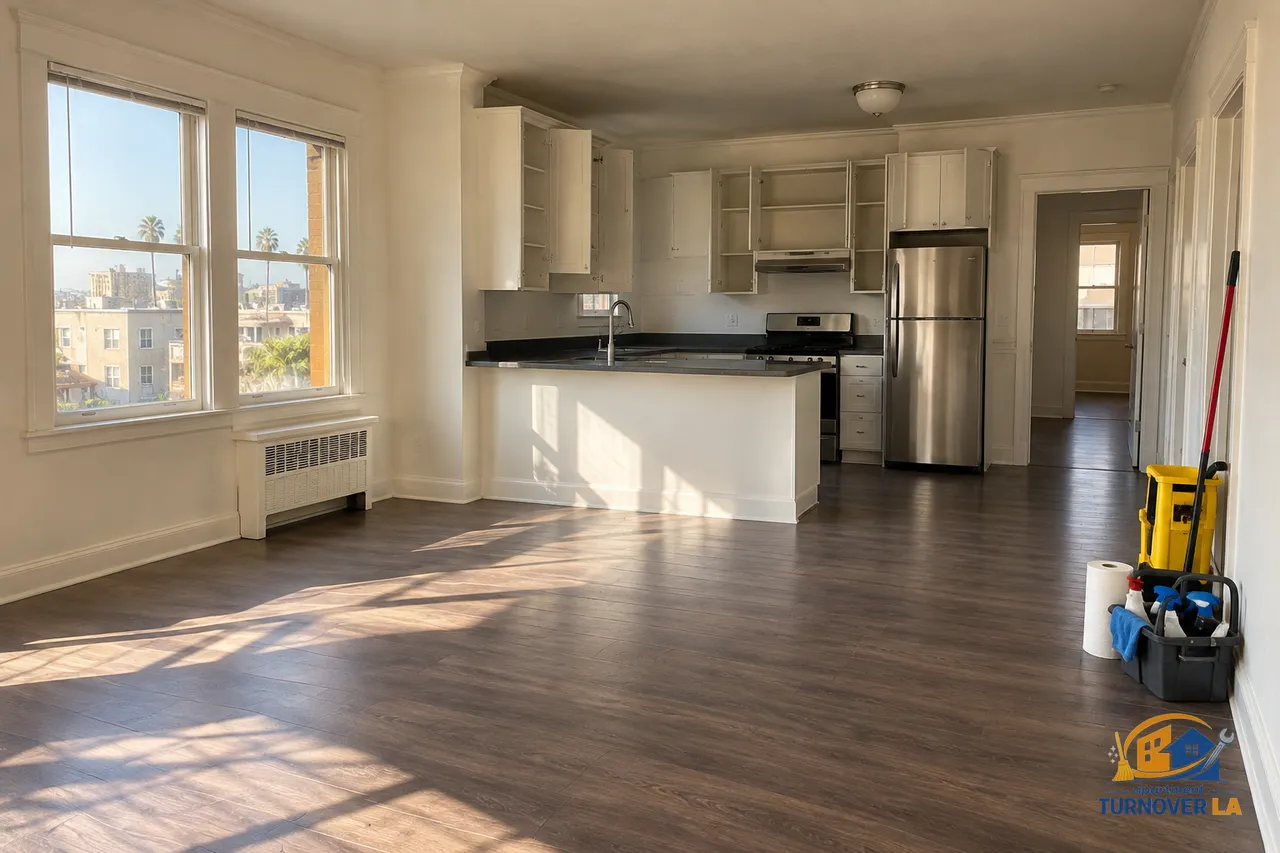
Quick answer: Across LA, published move out cleaning benchmarks commonly land around $250 to $550 for an empty home, although size and condition can push the number lower or higher. TurnOver LA handles move out cleaning through its Make Ready package: Studio $225, 1 Bedroom $255, 2 Bedroom $335, and 3BR or larger $425. Each includes a deep clean and 12-point photo report, with a flat 48-hour turnaround.
For an empty apartment, we charge by bedroom count rather than guessing from a tenant's description over the phone. The right scope still depends on condition, especially grease, pet odor, trash, wall damage, and items left behind. Get instant quote in 30 seconds
What do you charge for a move out clean in LA?
Across LA, a standard empty-unit move out clean is often discussed in the $250 to $550 market range. National published ranges can be wider, roughly $120 to $420 on the low end of the market and $200 to $600 for average homes, because square footage, condition, and included tasks vary widely. Those are market reference points, not TurnOver LA prices.
With TurnOver LA, a move out cleaning job is booked as a Make Ready package, which combines the deep clean with a 12-point photo report. Our current pricing is shown below.
| Vacant apartment size | TurnOver LA Make Ready price |
|---|---|
| Studio | Studio $225 |
| One bedroom | 1 Bedroom $255 |
| Two bedroom | 2 Bedroom $335 |
| Three bedrooms or larger | 3BR or larger $425 |
The package is designed for a landlord or manager who needs a clean unit and a documented condition handoff, not merely a cleaner who leaves when the surfaces look better.
What is usually included in a move out cleaning?
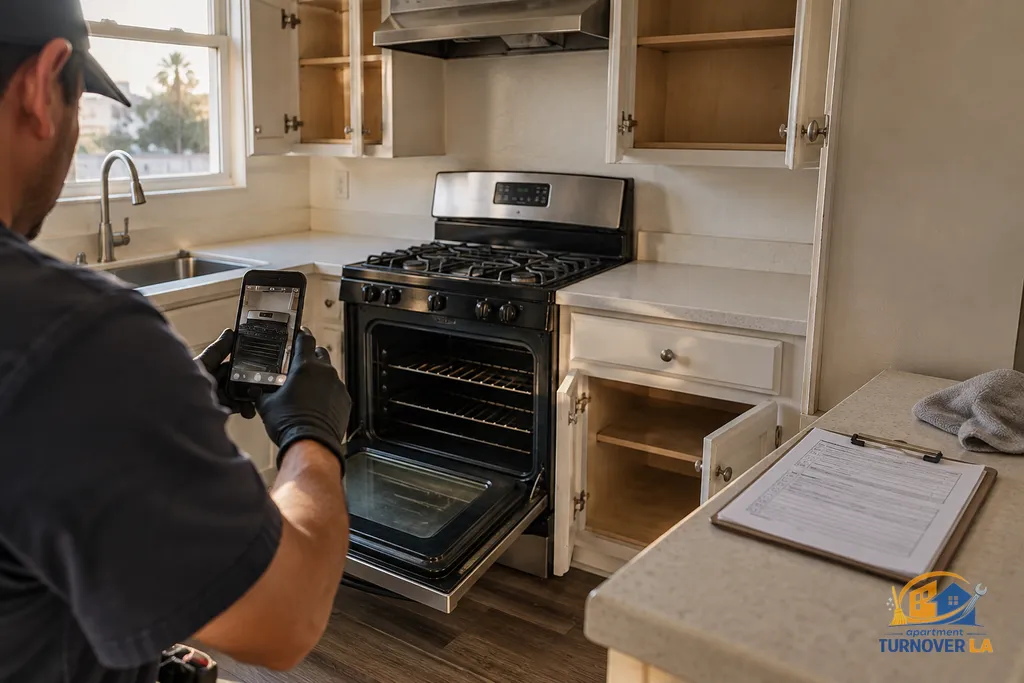
A credible move out clean starts with the areas a prospective renter, manager, or deposit dispute will notice first: kitchen grease, bathroom residue, floors, interior cabinets, appliances, closets, and visible ledges. In a vacant apartment, the crew can reach wall edges, baseboards, and the floor behind where furniture had been. The goal is an empty, presentable, inspection-ready unit.
TurnOver LA's Make Ready includes a deep clean plus a 12-point photo report. That report matters operationally because it gives the manager a post-cleaning record before painters, repair techs, or a new resident enter the unit. For task-level expectations, see our guide to move out cleaning in Los Angeles. If the unit needs cleaning without the turnover photo handoff, review the deep cleaning service scope before booking.
A clean does not automatically include repairing tenant-caused damage, removing abandoned furniture, repainting, or replacing missing hardware. Those are separate turnover decisions.
What changes the cost and scope of an empty-unit clean?
Bedroom count is a useful starting point, but condition determines whether cleaning is truly the only work needed. An empty one-bedroom with a wiped refrigerator and clear floors moves differently from one with baked-on oven grease, nicotine film, a pet smell, or bags of abandoned belongings. The clean itself may be straightforward while the unit still cannot be shown because another trade has to go in.
Before a crew arrives, check these five items:
- Is every cabinet, closet, and appliance empty?
- Is there trash, furniture, or a mattress left in the unit?
- Are there odors from smoking, pets, or moisture?
- Are wall marks actually cleanable, or is paint and drywall work needed?
- Are utilities on, including water and power?
Labor and the crew's own supplies are covered in the quote. If the job requires materials such as paint, parts, or fixtures, those are priced during the on-site inspection and added only with your approval. This separation keeps a cleaning quote from becoming an unexplained repair invoice.
Is Make Ready different from a basic deep clean?
Yes. A basic deep clean focuses on cleaning condition. Make Ready is built around the turnover handoff: deep cleaning, a 12-point photo report, and a flat 48-hour turnaround on every job. That is useful when a manager needs to decide what happens next, rather than discovering a stain, broken blind, or empty smoke-detector location after the cleaner has left.
The distinction is especially practical when several vendors are involved. Photos taken after cleaning give the painter and repair technician a cleaner starting record. They also help the owner separate pre-existing condition from work completed during the turnover. For a fuller scope comparison, see what Make Ready means for a rental.
Do not use a cleaning crew as a substitute for a punch-list inspection. Cleaning can expose scuffs, drywall holes, failed caulk, and missing fixtures that were hidden by tenant belongings. Get instant quote in 30 seconds
Need the unit turned before the next tenant?
We do the move-out clean and send you a photo report you can attach to the deposit itemization.
From $225 · 48-hour turnaround
Get an instant quoteCan you charge a departing tenant for move out cleaning?
Sometimes, but not simply because the apartment was occupied. Under California Civil Code §1950.5, a landlord may use a security deposit for cleaning needed to return the premises to the level of cleanliness it had at the beginning of the tenancy. Ordinary use is not the same as chargeable cleaning.
The practical question is evidence. Compare move-in photos, the move-in inspection record, and the condition at surrender. Keep invoices and use post-cleaning photos to document what was done. California generally requires an itemized statement and return of any remaining deposit within 21 days, which is covered in our guide to the California 21-day deposit return rule.
For LA rentals covered by local rent rules, cleaning charges still need the same factual support. Review the LAHD Rent Stabilization Ordinance for the local program context, and get legal advice for a disputed deduction or a fact-specific lease question.
What are the 5-5-5 rule and the 80/20 cleaning rule?
Neither is a California legal standard or an industry scope of work. The so-called 5-5-5 rule is used differently by different cleaning companies and social media posts. It may refer to five tasks, five minutes per task, or a short reset schedule. It is not a reliable way to price or inspect a vacant rental.
The 80/20 rule is more useful as a planning habit: a small group of areas usually drives most of the first impression. In an apartment turnover, that is commonly the kitchen, bathroom, floors, appliances, and odor. Start there, then inspect the less visible areas such as cabinet interiors, closet shelves, window tracks, and baseboards.
For a landlord, the better rule is to define a finish line before work begins. A photo report and a written scope prevent the familiar problem where a unit is “clean” but still has greasy cabinet interiors or a bathroom that will not pass a showing-day inspection.
Should furniture removal and repairs be scheduled before cleaning?
Usually, remove furniture and trash first. Cleaners need access to floors, closets, cabinets, and the areas behind large items. If a mattress, sofa, or abandoned bags remain in the unit, the crew cannot properly inspect or clean the surfaces around them. A cleanout and junk haul is the cleaner sequence when belongings are still present.
Repairs are more situational. Do repair active leaks, exposed wiring, broken glass, and other safety issues before or alongside cleaning. Cosmetic drywall patches and painting often happen after the initial clean reveals their full extent. Then schedule a final wipe or touch-up if repair dust, sanding, or paint work affects finished surfaces.
This order reduces repeat visits: clear the unit, clean it, inspect it, complete repairs and paint, then perform a final condition check. It also avoids paying for cleaning around furniture that will be hauled away later.
How should a landlord use the cleaning report after the job?
Treat the report as a turnover handoff, not as marketing photography. Review it while the unit is empty and decide immediately whether the next action is paint, drywall, maintenance, lock work, or listing preparation. A two-bedroom in Koreatown can lose meaningful rent every day it sits vacant, and LA vacancy loss commonly falls in the $80 to $200 per day range depending on the submarket. A prompt decision matters more than an endless cosmetic wish list.
Use the photos to close out the prior tenancy file, approve needed work, and confirm the unit is ready for the next phase. If you need to distinguish billable cleaning from ordinary aging, review normal wear and tear in California before applying a deposit deduction.
The fastest turnover is not the one with the fewest tasks. It is the one with a clear scope, visible documentation, and no gap between cleaning and the next decision. Get instant quote in 30 seconds