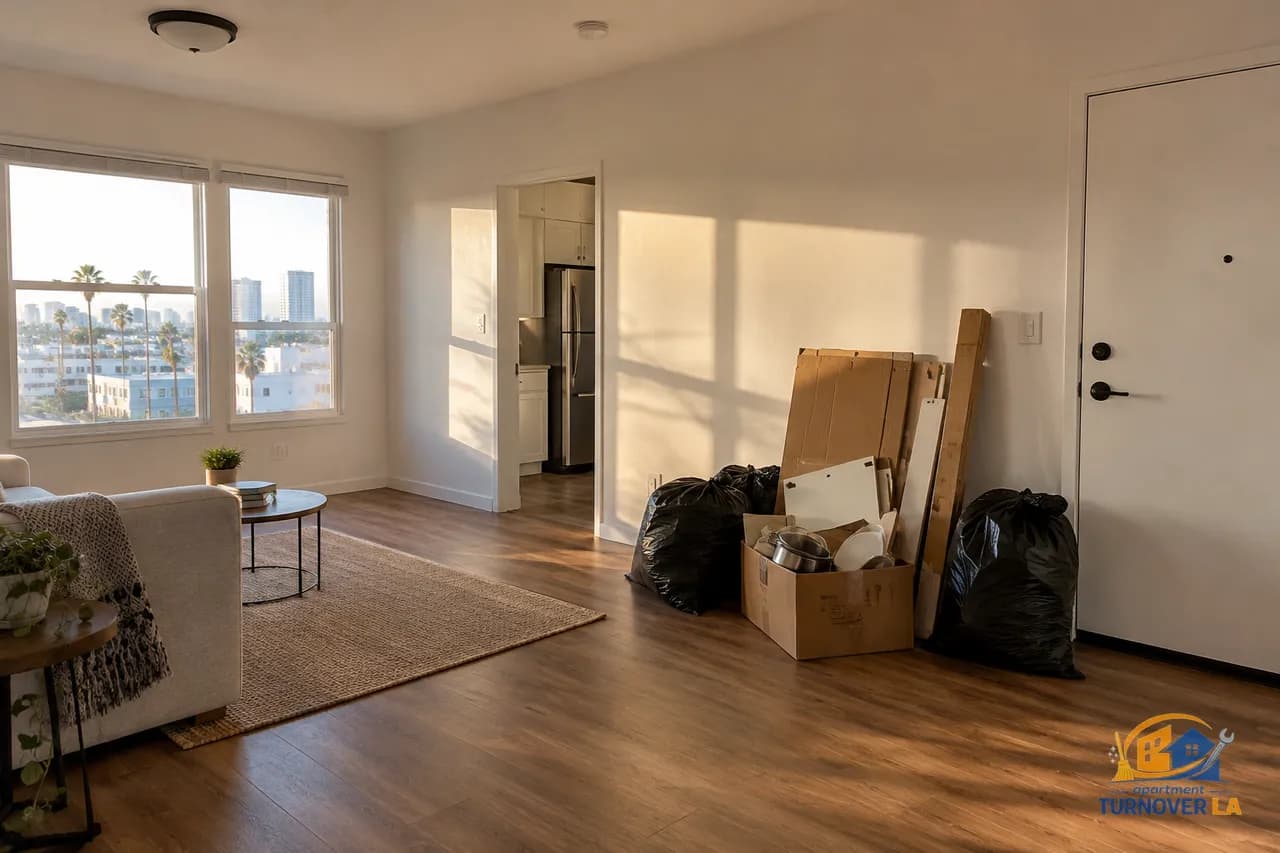
Quick answer: Across Los Angeles, general junk hauling is often quoted at $75 to $375 for a small load, but that range may not cover a full vacant-unit cleanout. TurnOver LA charges a flat $500 for a unit cleanout or junk haul, with an additional junk load at $500 per load. The practical cheap option is the crew that can clear the unit within the turnover schedule without leaving disputed items behind.
Cheap junk removal in Los Angeles is usually a question of scope, not just the lowest advertised pickup price. For a landlord or property manager, a $500 TurnOver LA unit cleanout can be the better value when it clears a vacant apartment for the next trade and avoids a second hauling visit. Get instant quote in 30 seconds
How much does cheap junk removal cost in Los Angeles?
Across LA, general-market hauling quotes commonly run $75 to $375 for a small junk pickup. That is useful context for a few bags, a chair, or a curbside-ready item, but it is not automatically comparable to clearing furniture, loose belongings, kitchen contents, and debris from a vacant unit. With TurnOver LA, a unit cleanout or junk haul is a flat $500. If the volume exceeds the original load, an additional junk load is $500 per load.
The important comparison is the load definition. A low quote can rise after the crew sees stairs, elevator access, loose debris, mattresses, appliances, or a volume larger than the photo suggested. Ask whether the quote is for one truck section, one labor hour, or a complete unit. For apartment turnovers, document what must leave room by room before approving work. That makes the price discussion operational instead of theoretical.

What does “cheap” actually mean for an apartment cleanout?
For an apartment turnover, cheap means the removal cost is lower than the delay and rework it prevents. A vacant day in Los Angeles can cost roughly $80 to $200 depending on the submarket, so an incomplete haul that delays cleaning, repairs, or showings can erase the savings from a bargain pickup. The right service is the one that clears the agreed scope in sequence with the rest of the turn.
A unit cleanout also differs from household decluttering. The departing tenant may leave a dresser, food, cleaning products, damaged blinds, abandoned shelving, and bags of mixed items. Those items affect access for cleaners and repair crews. TurnOver LA handles this work through its apartment cleanout and junk haul service, built around vacancy work rather than a casual curb pickup. The crew's labor and supplies are covered in the quote. If a job needs materials, parts, paint, or fixtures elsewhere in the turn, those are identified at inspection and added only with approval.
How can you compare junk-haul quotes without getting surprised?
Compare quotes by operational scope before comparing the final number. The fastest way to receive an inaccurate price is to describe a unit as “some junk” when the actual job includes furniture, bags, exterior storage, and a blocked walkway. A short inventory prevents most disputes and helps determine whether the $500 unit cleanout is the right starting scope.
- List every room, patio, storage area, and parking-space item to be removed.
- Take wide photos that show volume, not just close-ups of the largest item.
- Identify stairs, elevator reservations, gate codes, and parking limitations.
- Separate personal property that must be retained from items approved for disposal.
- Confirm whether another load may be needed before the crew arrives.
- Schedule removal before cleaning and before repair work that needs clear access.
This process also gives an owner a record of the condition at possession. For a broader sequence of inspections and vendor handoffs, use the apartment turnover checklist.
What should be removed before the cleaners and painters arrive?
Remove all approved junk before deep cleaning, paint touch-ups, drywall work, and final listing photos. A crew cannot properly clean behind a sofa, patch a wall hidden by shelving, or judge whether flooring needs attention when the room is full of abandoned belongings. Clearing first reduces duplicate labor and lets each trade see the actual condition of the apartment.
A common turnover order is possession inspection, documented cleanout, repairs, paint, deep clean, lock work, and final photos. The exact order may shift if there is active water damage or a safety issue, but junk should not remain as a placeholder while the rest of the work begins. Once the unit is empty, you can pair the haul with a Make Ready service that includes a deep clean and 12-point photo report. That report is useful for confirming that the apartment is ready for the next leasing step after the cleanout.
Need the unit turned before the next tenant?
We do the move-out clean and send you a photo report you can attach to the deposit itemization.
From $225 · 48-hour turnaround
Get an instant quoteCan a landlord charge a former tenant for junk removal?
Sometimes, but do not treat every left item as an automatic deduction. California security-deposit rules require itemized accounting and documentation for allowable deductions. Review California Civil Code §1950.5 and the California DCA Landlord-Tenant Guide before deciding what to charge or how to handle property that may need separate notice procedures.
Operationally, photograph each room before touching the contents, capture the item list, save the haul invoice, and keep notes on why removal was necessary. Do not mix actual cleanout work with ordinary turnover preparation in a vague line item. The distinction matters when a tenant asks for support for a deduction. Our guide to landlord charges for tenant turnover explains the documentation question in more detail. Clear records are more useful than a generic “trash removal” label.
Should you donate, recycle, or haul everything away?
Separate usable items before booking disposal if donation or recycling is realistic within the turnover timeline. In practice, most apartment managers need a firm removal date more than a complex diversion plan. Damaged particleboard furniture, open food, stained mattresses, mixed bags, and broken household goods are rarely efficient donation candidates. A delay while someone tries to place them can hold up the whole turn.
For items with obvious reuse value, decide in writing who is responsible for pickup and by what deadline. If the item is still there after that deadline, it becomes part of the cleanout scope. Do not leave a “donation pile” in a hallway, garage, or common area where it creates access or liability issues. The useful operational rule is simple: items that remain in the unit after possession and have no scheduled recipient should be inventoried and cleared so the apartment can move forward.
When is a $500 unit cleanout better than a small pickup quote?
A $500 unit cleanout is better when a small pickup quote would require multiple visits, excludes loose material, or cannot work within the turnover schedule. The general market's $75 to $375 range may fit a small, clearly defined load. TurnOver LA's flat $500 unit cleanout is the clearer comparison when the job is a vacant apartment with removal work spread across rooms. If the amount exceeds the first load, the catalog price is $500 per additional junk load.
The useful calculation is not just haul cost. Add the cost of lost access for the cleaner, maintenance person, painter, and leasing team. A one-vendor turnover sequence can prevent the common problem of finding a closet full of items after the cleaning crew has already left. Get instant quote in 30 seconds For a fuller look at how vendor coordination affects vacant days, see one vendor for cleaning, painting, and repairs in Los Angeles.
How fast can a cleanout fit into an LA turnover schedule?
TurnOver LA provides a flat 48-hour turnaround on every job, with no rush or same-day upcharge. The best scheduling practice is to book as soon as possession, access, and the removal scope are known. That gives the cleanout a defined place before cleaning and repairs, rather than forcing other crews to work around clutter.
Give the crew gate instructions, parking details, floor number, elevator rules, and a contact who can authorize scope questions. In older LA buildings, narrow stairwells and limited alley access can change loading time even when the unit itself is small. Ask the outgoing inspector to identify items in cabinets, patios, and storage areas, since those are the places that often produce an unexpected second load. Once the unit is clear, the next vendor can enter without guessing what stays. Get instant quote in 30 seconds