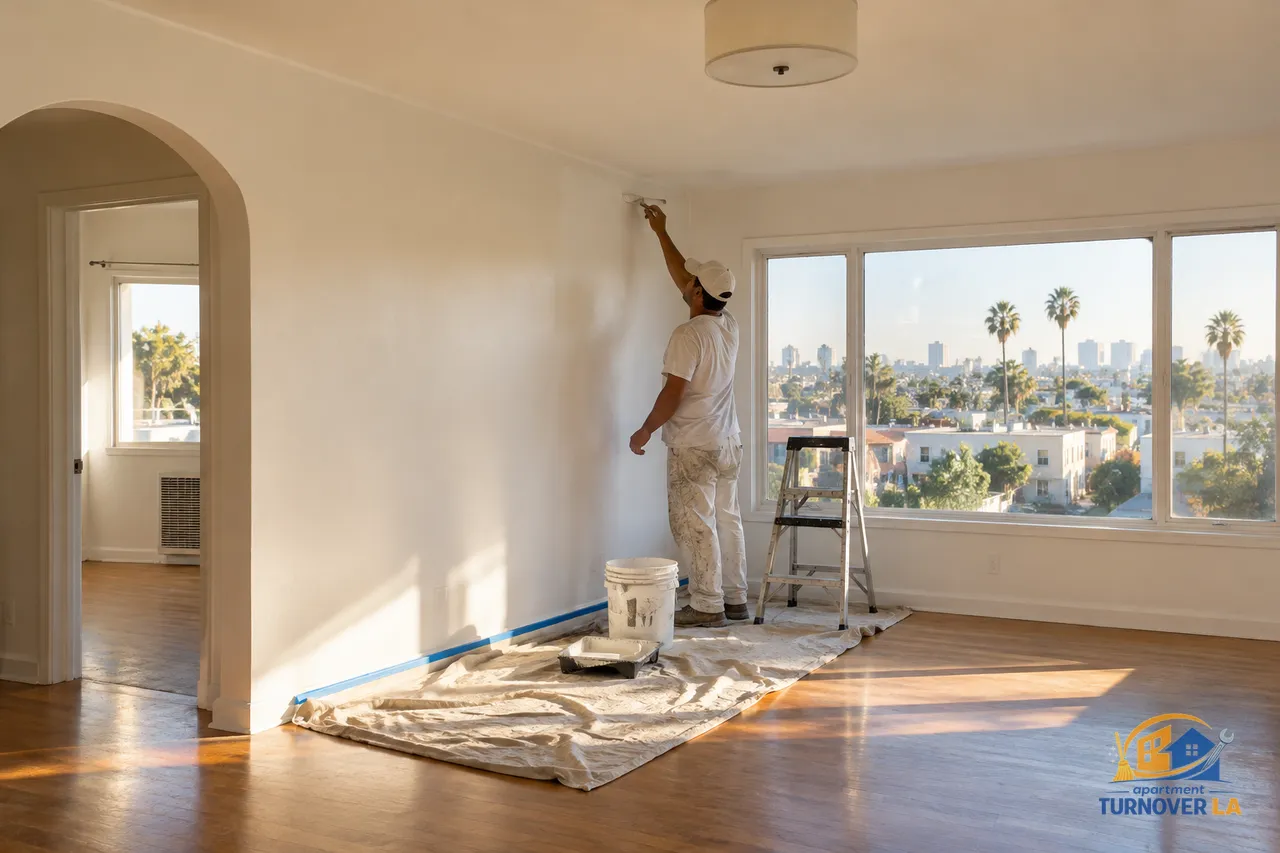
Quick answer: Across LA, repainting a 1,500 sq ft apartment commonly lands around $3,000 to $7,500 in the general painting market, depending on room count, prep, ceilings, and wall repairs. TurnOver LA prices vacant-rental repainting at $395 / room, rather than by floor area, with paint and other job materials approved separately after the on-site inspection.
For a 1,500 sq ft apartment, square footage is a starting point, not a reliable paint bid. A two-bedroom with open rooms and clean walls can require less work than a smaller unit with dark colors, damaged drywall, and painted ceilings. Get instant quote in 30 seconds
What does it cost to paint a 1,500 sq ft apartment in LA?
In the general LA market, a full interior repaint of a 1,500 sq ft apartment is commonly quoted at $3,000 to $7,500. That broad range reflects how contractors count rooms, wall area, coats, repairs, occupied-unit protection, and whether ceilings and trim are included. It is market context, not a TurnOver LA rate.
With TurnOver LA, vacant-unit repainting is $395 / room. This pricing method is more useful for turnover planning because floor area does not tell you how many separate rooms need cutting in, masking, prep, and cleanup. A landlord should identify the rooms to be repainted, then add only needed scope items. For example, TurnOver LA lists $200 for paint touch-up only, $125 for ceilings and baseboard/trim, and $150 / patch for a small drywall patch + texture. Labor and crew supplies are in the quote. Paint, parts, and fixtures are inspected and added only with your approval.
Why is square footage not enough to price apartment painting?
A 1,500 sq ft unit can have very different paintable wall area depending on its layout. A loft with fewer partitions may have a large open living area but fewer door frames and corners. A three-bedroom apartment of the same floor area has more bedrooms, closets, halls, doors, trim, and transitions between rooms. Those details take time even when the floor plan is unchanged.
Ceiling height matters too. Many older LA buildings have taller ceilings, while a newer apartment may have standard-height ceilings but more built-ins. Dark existing paint, nicotine staining, greasy kitchen walls, and poor prior touch-ups can require additional prep or coats. This is why a per-square-foot online estimate can be misleading for a rental turnover.
Before requesting a bid, count rooms, note whether each needs a full repaint or only touch-up, and flag visible wall damage. That produces a scope a painter can actually schedule. It also helps you decide whether painting and drywall work is needed before the cleaners arrive.
What is included in a turnover painting scope?
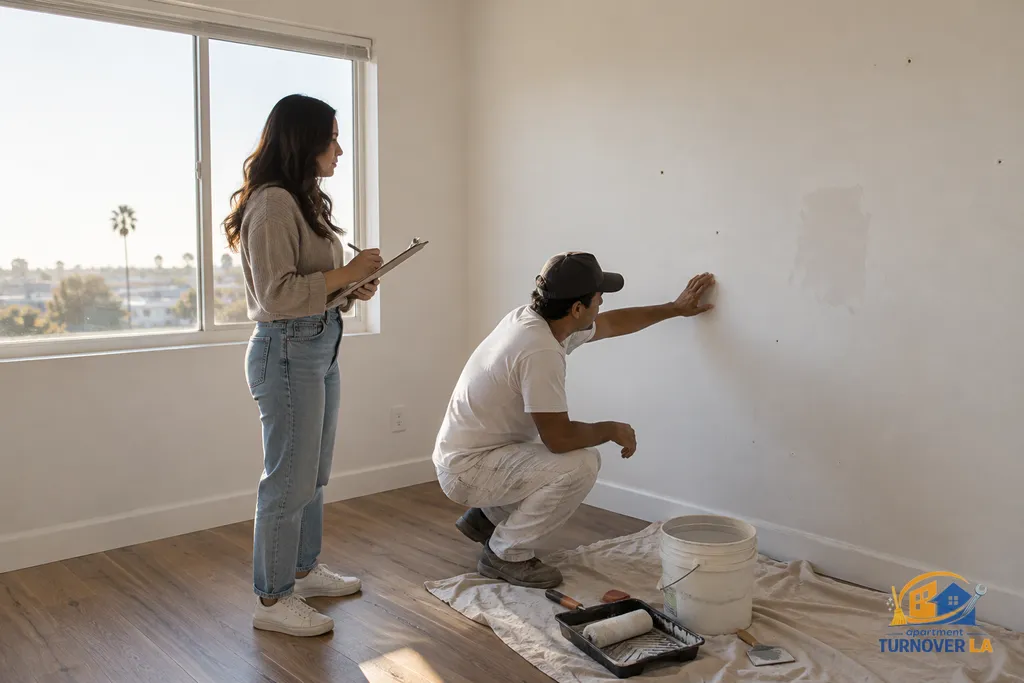
A practical turnover painting scope starts with wall condition, not a blanket decision to paint everything. In a recently occupied apartment, inspect each room under good light for scuffs, nail holes, adhesive damage, unauthorized color changes, patch flashing, and stains. Photograph the findings before work starts, especially if security-deposit accounting may be involved.
TurnOver LA's $395 / room repainting line is for the room repaint scope. If the unit only has localized marks, $200 paint touch-up only may fit better. Where a tenant's picture hardware or impact damage has left visible holes, a small drywall patch + texture is $150 / patch and a medium drywall repair is $240 / patch. Ceiling and baseboard/trim work is $125 when that scope is needed.
The sequencing matters. Repairs should be completed and sanded before final paint. After paint cures, schedule the final clean so dust, tape fragments, and paint flecks do not remain in the unit. A Make Ready service can handle the turnover clean and provide a 12-point photo report after the work is complete.
Need the walls done before you re-list?
Turnover painting, scuff removal and patching, with a photo record of the condition we left behind.
$395 per room · 48-hour turnaround
Get an instant quoteHow do wall condition and color changes affect the price?
Wall condition is the largest variable after the number of rooms. Clean, neutral walls with a few minor scuffs may only need targeted touch-up. Walls covered in heavy marks, tape residue, crayon, smoke film, or a saturated accent color often require more preparation and a full repaint for an even result. A fresh coat cannot hide loose paper, dents, or untextured patches.
Color changes also affect coverage. Going from charcoal, red, blue, or glossy finishes to a standard rental neutral can take more than one coat. The inspection is where that requirement should be identified, along with the paint product and quantity. TurnOver LA's quote covers labor and crew supplies. Paint and any required materials are priced at the on-site inspection, then added to the invoice only after approval.
Do not treat drywall repairs as an afterthought. A repaired wall needs time for drying, sanding, texture matching, and primer before it can blend into the final paint. For a deeper look at the repair side, see this guide to drywall patching in LA rental apartments.
Can a landlord charge a departing tenant for repainting?
Sometimes, but not for ordinary wear. California security-deposit rules generally allow deductions for repairs beyond ordinary wear and tear, while routine aging of paint from normal occupancy is usually the owner's responsibility. The applicable rule is in California Civil Code §1950.5, and the California DCA Landlord-Tenant Guide provides practical state guidance.
The distinction is fact-specific. One small scuff where furniture rubbed a wall is different from widespread unauthorized dark paint, large holes, or substantial wall damage. Keep move-in photos, move-out photos, inspection notes, invoices, and an itemized accounting. Do not automatically assign the whole repaint to the former tenant because the unit benefits from a fresh coat.
For the operational and documentation side of this decision, review normal wear and tear in California rentals and the guide to the California 21-day deposit return deadline. Those records matter when the scope moves from standard turnover maintenance to a claimed tenant-caused repair.
How should you schedule paint work during a vacancy?
Schedule the inspection as soon as possession is confirmed. The goal is to identify whether the unit needs touch-up, room-by-room repainting, repairs, ceilings, or trim before other vendors start work. A common delay is ordering a cleaner first, then discovering repairs and sanding are still required. That can create a second cleaning visit and push listing photos back.
A reliable sequence is: remove remaining belongings, inspect and document, complete drywall repair, paint, handle maintenance punch items, then deep clean and photograph the finished unit. TurnOver LA has a flat 48-hour turnaround on every job, without a rush or same-day upcharge. That matters when vacancy can cost an LA owner roughly $80 to $200 per day depending on submarket.
Keep the work order specific. List rooms, wall colors, ceiling and trim decisions, known repairs, and access instructions. The more precise the scope, the less likely a crew finds an unapproved condition after arrival. Get instant quote in 30 seconds
A practical way to budget the painting scope
Budget from observed work, not from the apartment's advertised square footage. Start with the full repaint rooms, then separate items that are optional or condition-based. This avoids treating a 1,500 sq ft apartment as though every square foot requires identical labor.
| Scope item | General LA market context | TurnOver LA catalog rate |
|---|---|---|
| Full 1,500 sq ft interior repaint | Commonly $3,000 to $7,500, depending on scope | $395 / room |
| Localized wall marks only | Varies by prep and access | $200 for paint touch-up only |
| Ceiling and baseboard/trim scope | Often priced separately | $125 |
| Small patch before painting | Varies by texture match | $150 / patch |
Use this five-step process when you walk the unit:
- Count rooms that need complete repainting.
- Mark rooms that can be handled with touch-up instead.
- Photograph every hole, stain, and damaged texture area.
- Decide whether ceilings and trim are in scope.
- Approve paint and material selections after the on-site inspection.
This approach keeps the work order tied to the actual condition of the apartment and makes the final invoice easier to review. Get instant quote in 30 seconds