
Quick answer: Same-day junk removal is available from some LA haulers when their route has room, but it is not a reliable turnover plan. Across Los Angeles, a junk pickup commonly runs about $150 to $800 depending on volume and disposal type. TurnOver LA charges $500 for a unit cleanout or junk haul, with a flat 48-hour turnaround and no rush upcharge.
Can you get same-day junk removal in Los Angeles today? Sometimes, particularly for a small curbside load, but a vacant-unit cleanout often needs more than a truck arriving fast. A landlord needs the abandoned-property question, hazardous-material separation, access, and turnover sequence handled before the next crew is blocked.
For a standard apartment cleanout, TurnOver LA schedules the work within 48 hours for a flat $500. That gives owners and managers a dependable operating window instead of paying for a same-day promise that may disappear when traffic, disposal restrictions, or an oversized load changes the route.
Get instant quote in 30 seconds
Is same-day junk removal realistic for an LA apartment turnover?
It can be realistic for loose furniture, bagged trash, and a clearly described small load. It is less reliable when a crew finds mattresses, appliances, construction debris, electronics, or belongings that may still require a landlord decision. Many LA search results advertise same-day availability, but availability means a provider has space on that day's route. It does not confirm that every item can go, that the crew can access the unit, or that the full cleanout will be completed before the leasing team needs photos.
For turnovers, use a 48-hour operational target. It leaves time to document the unit at possession, identify property that should not be discarded yet, reserve elevator or alley access, and put the cleaning and repair work in the right order. In dense buildings around Koreatown, a truck can lose an hour to loading-zone access alone. The cleanout should happen before the final clean, paint touch-up, and listing photos, not alongside them.
A same-day request is best treated as an availability question. A 48-hour cleanout is a schedule you can build the turnover around.
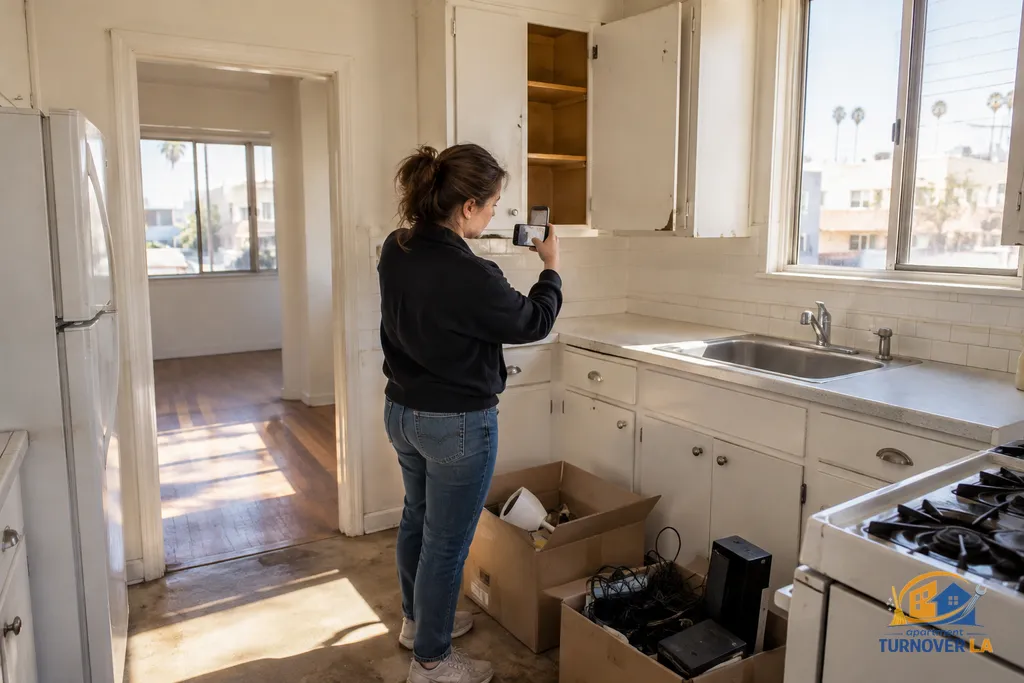
How much does junk removal cost in Los Angeles?
Across LA, junk removal commonly costs about $150 to $800 for a pickup, with the actual price driven by truck volume, labor, stairs, parking, and disposal category. A few bags or one curbside item can sit near the low end. A furnished apartment, heavy debris, or a second truck load can exceed that range. Local providers often quote after seeing photos or the load because volume is hard to judge from a tenant's description.
With TurnOver LA, a unit cleanout / junk haul is $500. If the volume requires another load, the additional junk load is $500 / load. That structure is useful when a manager needs a clean approval record: the initial scope is clear, and a second load is identified rather than buried in an open-ended estimate. Labor and the crew's own supplies are included. Any job materials needed for related repairs, such as replacement parts or paint, are inspected on site and added only with approval.
Do not compare a low curbside quote with an occupied-unit cleanout without checking access, stairs, loading distance, and item restrictions. Those are different jobs.
What should be removed before a cleanout crew arrives?
The first pass should separate items by ownership and disposal risk, not by how inconvenient they are. Photograph every room after possession, including closets, cabinets, balconies, and the parking space. Then set aside personal papers, mail, prescription containers, financial records, keys, and anything that could reasonably be mistaken for a tenant's personal property. California deposit rules and notice obligations do not disappear because a unit must be listed quickly.
Use this five-step handoff before booking removal:
- Photograph the unit and make a room-by-room item list.
- Set aside documents, medications, keys, mail, and possible personal property.
- Identify items that need special handling, including paint, batteries, e-waste, chemicals, and appliances.
- Confirm truck access, gate codes, elevator reservations, and parking instructions.
- Send clear photos of the pile, plus any stairs or long carry route, with the booking request.
The California DCA Landlord-Tenant Guide is a useful starting point for landlord and tenant responsibilities. For the deposit accounting timeline, see California Civil Code §1950.5 and our guide to the California 21-day deposit return. A cleanout crew can haul authorized junk. It should not decide whether disputed belongings are abandoned.
Can Los Angeles provide free bulky-item pickup instead?
LA sanitation bulky-item programs can be useful for planned, eligible residential pickups, especially when the property has time to work within the city's process. They are not a substitute for a turnover cleanout when a unit must be cleared, cleaned, repaired, and photographed on a fixed leasing schedule. Eligibility, pickup timing, placement rules, and multifamily service arrangements can all affect whether the program fits the job.
The key difference is operational control. A city pickup may be appropriate for one mattress or a few large items at a property that can wait. A private unit cleanout is designed around the apartment handoff: crew arrival, carrying items out of the unit, clearing the space, and documenting the result for the next vendor. This distinction matters in a building with a narrow rear alley, a shared trash enclosure, or a leasing appointment already on the calendar.
If a bulky-item pickup is available, do not place material at the curb early just to save a hauling fee. It can create a blocked walkway, neighbor complaints, scavenging, or a code issue. Keep the pile secured and schedule around the actual pickup commitment.
Need the unit turned before the next tenant?
We do the move-out clean and send you a photo report you can attach to the deposit itemization.
From $225 · 48-hour turnaround
Get an instant quoteWhen should junk removal happen in the turnover sequence?
Remove junk before the final cleaning, repair closeout, and media appointment. That sounds obvious, but it is one of the easiest ways to lose a day. A painter cannot properly assess wall damage behind a sofa. A cleaning crew cannot degrease cabinets full of abandoned food. Listing photos do not work if a discarded bed frame is still in the bedroom.
A practical sequence is possession documentation first, then authorized cleanout, then repairs, deep cleaning, locks, and listing media. If the apartment needs only light debris removal and cleaning, pair the cleanout with a Make Ready service. Make Ready includes a deep clean and a 12-point photo report, which gives the manager a documented condition check after the unit is cleared. Where patching or a door adjustment appears during the walk, use handyman and general maintenance after the haul rather than sending a repair crew into a blocked unit.
This order avoids a common LA turnover mistake: paying a cleaner to work around junk, then paying again once the junk leaves. It also keeps the photo report focused on the apartment's actual condition, not on the former resident's belongings.
Get instant quote in 30 seconds
Which items can complicate a same-day junk pickup?
Mattresses, standard household furniture, and bagged nonhazardous trash are generally straightforward once access is confirmed. The problems are the items that cannot simply be mixed into a general load. Paint cans, solvents, batteries, fluorescent bulbs, e-waste, propane cylinders, medical sharps, chemicals, and certain appliances may require separate handling. Construction debris can also change the scope, especially where drywall, tile, or heavy material is involved.
Water-damaged drywall is a frequent turnover example. If the drywall is soft, stained, or actively affected by moisture, hauling the damaged section is only part of the job. The source of water needs to be addressed before a patch and paint are approved. Otherwise, the new repair can fail and the unit loses another day. Our guide on drywall patching in LA rental apartments covers the repair side of that decision.
Tell the hauler about these materials before arrival. A truthful scope protects the schedule. It also prevents the worst same-day outcome: a crew arrives, identifies prohibited material, and the vacant unit remains blocked while you source another vendor.
Is a 48-hour cleanout fast enough to limit vacancy loss?
In most cases, yes. Vacancy loss in LA commonly lands around $80 to $200 per day depending on the submarket and unit rent. The costly part is usually not the difference between a same-day and next-day truck. It is the chain reaction from an unclear scope: junk remains, cleaning gets delayed, paint cannot start, photos move, and the listing misses its target date.
A 48-hour plan works when it is booked at possession and the manager provides photos, access instructions, and a clear decision on personal property. The flat timeline also avoids a rush premium that erases the value of moving a single day sooner. Track the cleanout as one milestone in the turnover board, not as a separate errand.
For a broader view of what an empty unit costs while it waits, see property managers' vacancy loss in Los Angeles. For the full work order sequence, use the apartment turnover checklist. The better comparison is not same-day versus 48 hours. It is a documented 48-hour completion versus several vendors waiting on one another.
Book the cleanout before junk delays the next trade
A clear cleanout scope lets the rest of the turnover move. Photograph the unit, separate possible personal property and restricted materials, confirm access, then book the haul before cleaning or repairs are dispatched. For LA owners, that process is more dependable than chasing a vague same-day opening after the unit has already sat vacant.
TurnOver LA charges $500 for a unit cleanout / junk haul and completes jobs within 48 hours. If more volume is found, an additional junk load is $500 / load, with the added scope identified for approval. That is a clean handoff from possession to repairs, cleaning, and listing preparation.