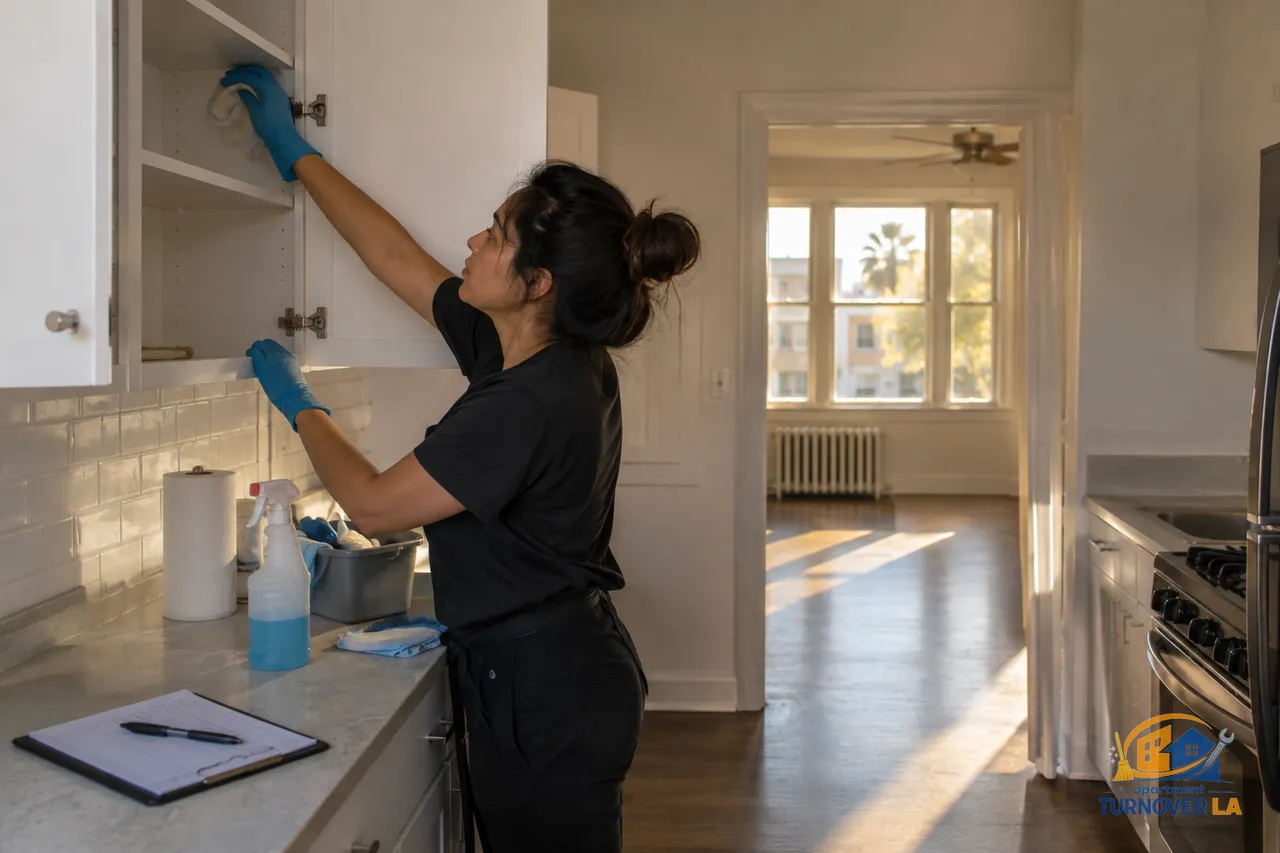
Quick answer: Across LA, move-out cleaning quotes commonly run about $150 to $500 because the job is a reset of an empty unit, not a recurring surface clean. TurnOver LA's Make Ready package is $225 for a studio, $255 for a 1 Bedroom, $335 for a 2 Bedroom, and $425 for a 3BR or larger, with a 48-hour turnaround.
Move-out cleaning costs more because every missed area is visible when the furniture, rugs, toiletries, and tenant belongings are gone. The cleaner is also working toward a landlord handoff standard, where cabinet interiors, appliance buildup, wall edges, and bathroom mineral scale can affect whether the unit can be shown or needs more work.
Get instant quote in 30 seconds
Why does an empty apartment take more cleaning work?
An empty unit is easier to access, but it is not automatically quicker to finish. Furniture normally hides the baseboards, wall perimeters, floor edges, dust pockets, and damage that need attention before a new resident walks in. Once a bedroom is empty, the cleaner can see the full closet floor, the track behind the door, every outlet plate, and the marks around where a bed or dresser sat.
A recurring cleaner can work around a home's lived-in layout and focus on the highest-use surfaces. A move-out crew has a different assignment: return the unit to a presentable, inspectable condition from top to bottom. That means more bending, more detail work, more time inside storage spaces, and more decisions about whether a condition issue is cleaning or a repair. In older LA apartments, especially units with painted-over trim or aging kitchen cabinets, that distinction matters. Cleaning cannot correct peeling paint, failed caulk, or a damaged shelf.
What makes move-out cleaning more expensive than regular cleaning?
The higher price reflects labor intensity, one-time scope, and uncertainty. Regular cleaning follows a repeatable routine because the cleaner knows the home and can maintain it over time. Move-out cleaning starts with no such baseline. The crew has to discover buildup, test what will release safely, and finish every room to a handoff-ready standard in one visit.
Across the general LA market, move-out cleaning typically costs more than recurring cleaning, with quotes often ranging from about $150 to $500 based on unit size, condition, and scope. TurnOver LA posts a clear Make Ready price beside that market context: $225 for a Studio, $255 for a 1 Bedroom, $335 for a 2 Bedroom, and $425 for a 3BR or larger. Each Make Ready includes a deep clean and 12-pt photo report, with a 48-hour turnaround.
| Scope | General LA market context | TurnOver LA Make Ready |
|---|---|---|
| Vacant apartment move-out cleaning | Often about $150 to $500, depending on size and condition | Studio $225, 1 Bedroom $255, 2 Bedroom $335, 3BR or larger $425 |
| Recurring occupied-home cleaning | Usually lower because it maintains known surfaces | Not the same service scope |
The price gap is not simply an empty-unit premium. It is the cost of getting the unit ready for inspection, repairs, photos, and showings without assuming the next visit will fix what this visit misses.
What does a move-out clean actually include?
A proper move-out clean addresses the places a tenant uses over months or years but may not touch during ordinary weekly cleaning. The exact scope should be confirmed before work starts, because heavy grease, smoke residue, pet odor, and trash are separate conditions that can require added work.
A standard vacant-unit cleaning sequence usually covers:
- Kitchen counters, sinks, cabinet interiors, drawer interiors, appliance exteriors, and reachable grease buildup.
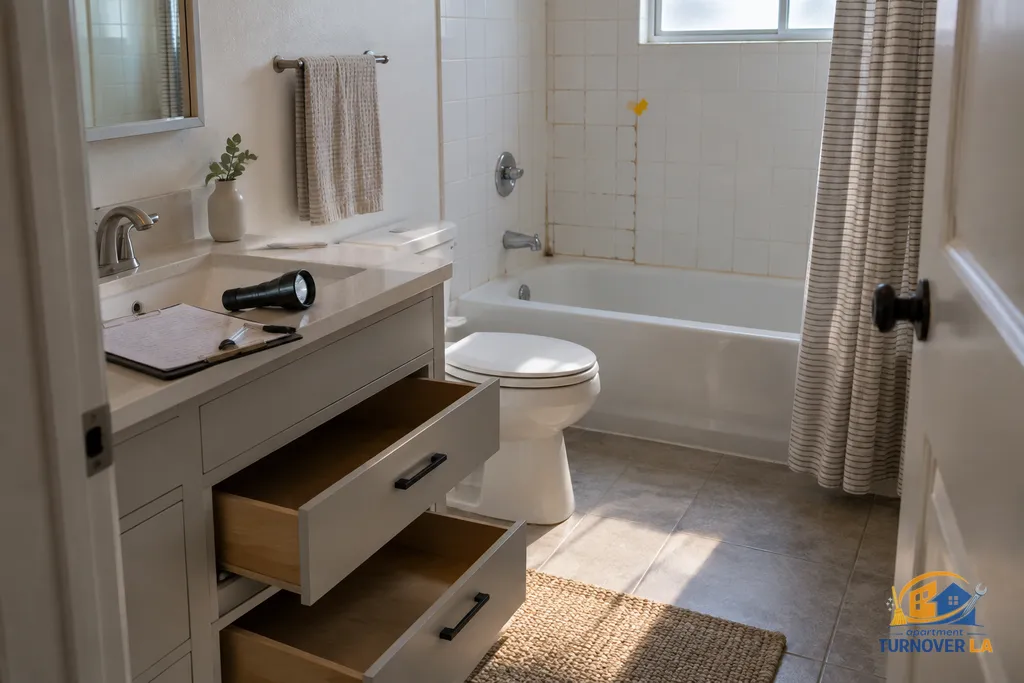
- Bathroom fixtures, shower walls, toilet exterior and base, vanity interiors, mirrors, and visible soap or mineral residue.
- Dusting of ledges, blinds where included, ceiling-fan surfaces where accessible, baseboards, trim, doors, and closet shelving.
- Vacuuming and mopping of exposed flooring, including corners and wall edges revealed after the unit is emptied.
- Removal of ordinary scuffs and fingerprints where they can be cleaned without repainting.
- A final room-by-room check for conditions that need a separate trade, such as drywall damage, a broken blind, or a leaking fixture.
For a more detailed room list, see what a Make Ready service includes and this guide to move-out cleaning in Los Angeles. TurnOver LA's deep cleaning service is useful when cleaning is the primary need. When the unit also needs closeout documentation, the Make Ready package combines the deep clean with a 12-pt photo report.
How do kitchens and bathrooms drive the final cleaning price?
Kitchens and bathrooms create most of the labor variation because they combine moisture, grease, mineral deposits, and enclosed storage. A vacant kitchen can look simple from the doorway, then require detailed wiping inside every drawer, around hinge hardware, under the sink, and along the top edge of cabinet doors. A stove with baked-on residue can also take more time than its exterior suggests.
Bathrooms have the same issue. Soap film, calcium deposits, hair around drain covers, and discoloration at the toilet base are small areas, but they require slow, close-range work. The cleaner also needs to protect finishes. Aggressive tools may remove buildup but scratch an acrylic tub, dull chrome, or damage old grout.
That is why a square-foot estimate alone can mislead a landlord. A clean 2,000-square-foot house with newer finishes may move quickly, while a smaller apartment with neglected kitchen grease and hard-water scale may take longer. The practical question is not only size. It is how much detailed restoration each wet area needs before the next showing.
Need the unit turned before the next tenant?
We do the move-out clean and send you a photo report you can attach to the deposit itemization.
From $225 · 48-hour turnaround
Get an instant quoteDoes the 80/20 rule apply to move-out cleaning?
Yes, but only as a planning tool. The 80/20 rule in house cleaning means a small group of high-use areas often creates most of the visible cleaning result. For an occupied home, that usually means kitchen counters, bathrooms, floors, and common-room surfaces. Those are the areas a recurring cleaner prioritizes when time is limited.
For a move-out, the rule helps identify where to inspect first, not where to stop. Start with the kitchen, bathrooms, entry, appliance surfaces, closets, and flooring transitions because they reveal the most about the unit's condition. Then complete the rest of the turnover scope. A prospective resident opening an empty cabinet or looking behind a bathroom door will notice what a daily resident might overlook.
This is also why a photo report is operationally useful. It gives the owner or manager a record of what was cleaned and flags conditions that are not cleaning issues. In practice, an empty apartment turns hidden perimeter work into visible leasing risk. That is a different assignment from making a lived-in home look good for the week.
Get instant quote in 30 seconds
When does cleaning become a repair or a cleanout?
Cleaning should not be used as a catch-all label for every turnover condition. Grease is cleaning. A cabinet door that will not close is a repair. A scuff may clean off, while a gouge through the paint needs patching and paint. Bags of abandoned belongings or a mattress are a cleanout issue, not part of routine cleaning.
Separating these scopes early protects the schedule and prevents surprise work from being buried in a cleaning quote. TurnOver LA's quote covers labor and the crew's own supplies. Materials the job needs, including paint, parts, or fixtures, are priced at the on-site inspection and added to the final invoice only with approval first. For example, a small drywall patch + texture is $150 / patch, while a unit cleanout / junk haul is $500. Those are distinct turnover decisions with distinct crews and timelines.
A good closeout sequence is clean first, inspect second, then assign repairs. If the clean reveals damaged drywall or failed hardware, book turnover repair work rather than asking the cleaner to work around a condition they cannot correct. That keeps responsibility clear and makes the final walkthrough faster.
Can a landlord charge a tenant for move-out cleaning in California?
A landlord may be able to deduct reasonable cleaning costs, but only when cleaning is necessary to return the premises to the same level of cleanliness as at the start of the tenancy, subject to California's deposit rules. The controlling framework is California Civil Code §1950.5. Normal use is not automatically a billable cleaning claim.
The operational habit is simple: document the move-in condition, document the move-out condition, retain invoices, and distinguish cleaning from repair or normal wear. California requires specific handling and timing for deposit accounting, so managers should also review the California DCA Landlord-Tenant Guide and this practical guide to the California 21-day deposit return.
A photo report helps with the operational record, but it does not turn every turnover cost into a lawful deduction. If a unit needs ordinary refreshing between tenancies, treat that cost as a turnover expense unless the documented condition supports a permitted charge. For the related line between tenant damage and ordinary aging, review normal wear and tear in California.
How can you keep move-out cleaning costs under control?
The best cost control is an early, honest scope decision. Do not wait until the cleaner arrives to discover leftover furniture, smoke odor, a refrigerator full of food, or wall damage. Conduct a pre-turn walkthrough as soon as access is available, take condition photos, and separate cleaning, cleanout, painting, and repair needs before scheduling crews.
Next, decide what actually blocks leasing. In LA, every unnecessary vacancy day can cost roughly $80 to $200 depending on the submarket. A lower cleaning bid is not always the lower turnover cost if it leaves the unit needing a second visit or delays photography and showings. The more useful target is one completed handoff: clean, documented, and clear on any remaining repair decisions.
TurnOver LA's 48-hour turnaround gives managers a defined closeout window rather than an open-ended cleaning task. Use the cleaning result and 12-pt photo report to make the next call quickly, whether that is paint touch-up only for $200, a repair punch list, or listing preparation. The goal is not to overclean. It is to avoid a preventable second trip.