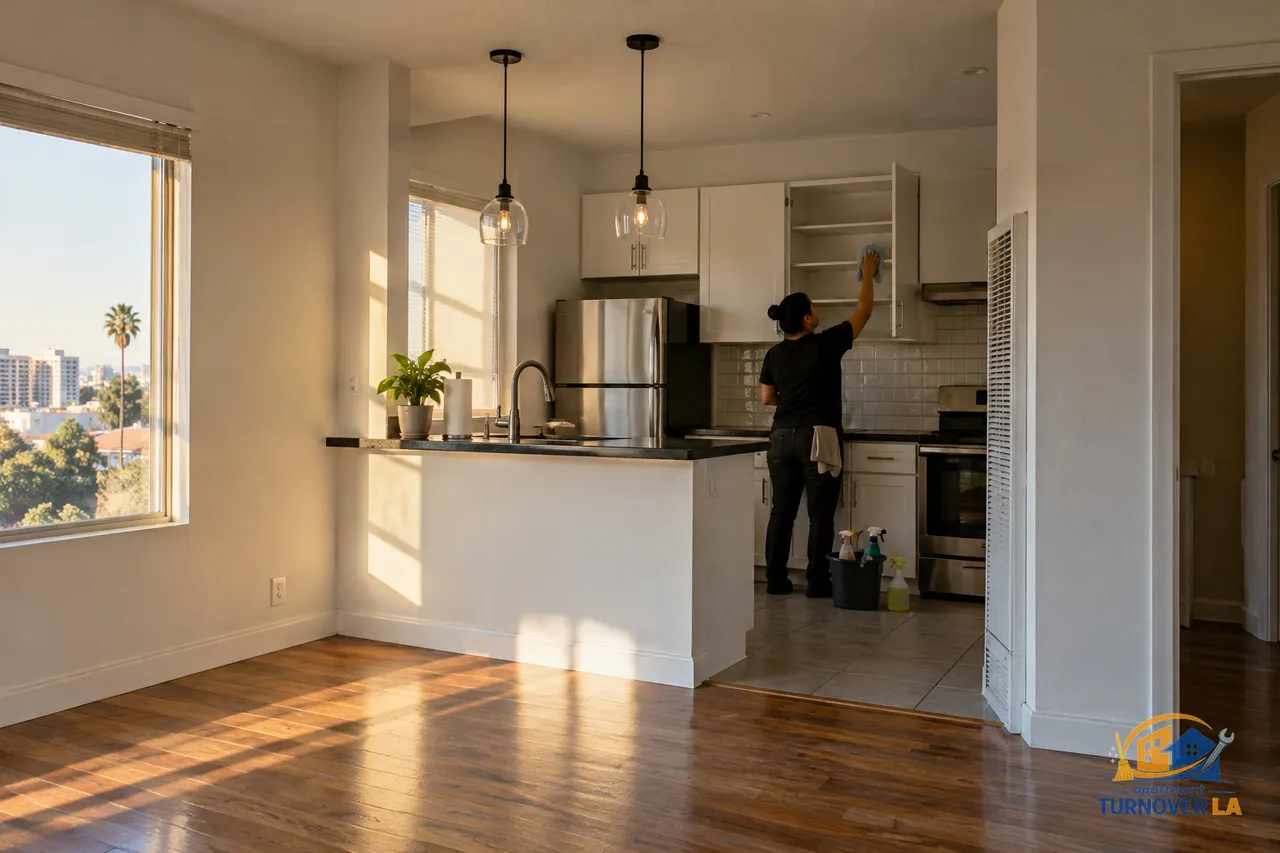
Quick answer: Deep cleaning in Los Angeles commonly runs about $45 per hour on local task platforms, while some one-time services start near $55 before the final scope is known. TurnOver LA's deep-clean-inclusive Make Ready package starts at Studio $225 and includes a 12-point photo report. For vacant rentals, the practical question is whether cleaning alone will make the unit rent-ready.
Deep cleaning removes the buildup that a routine visit skips: cabinet interiors, baseboards, bathroom grout, appliance surfaces, and accumulated kitchen grease. In a vacant LA apartment, it should also be coordinated with damage review, paint touch-up, and access work so one missed issue does not hold up showing the unit.
Get instant quote in 30 seconds
What does deep cleaning in Los Angeles actually include?
A proper deep clean starts with the parts of an apartment that show the last tenancy, even when the floors look passable at first glance. In the kitchen, that means degreasing the range, hood, backsplash, cabinet faces, and accessible cabinet interiors. In bathrooms, it means soap scale at fixtures, residue around the toilet base, grout buildup, mirror edges, vent covers, and the floor behind the door. Throughout the unit, crews should address baseboards, doors, switch plates, closet shelving, windowsills, and reachable light fixtures.
The distinction matters because “deep cleaning” gets used loosely in LA listings. A routine housekeeper may maintain a clean occupied home, while a turnover crew must reset a vacant rental for inspection and showing. TurnOver LA's deep cleaning service is built around that turnover standard, not recurring housekeeping. For room-by-room task detail, see this move-out cleaning guide.
How much does a deep clean cost in LA?
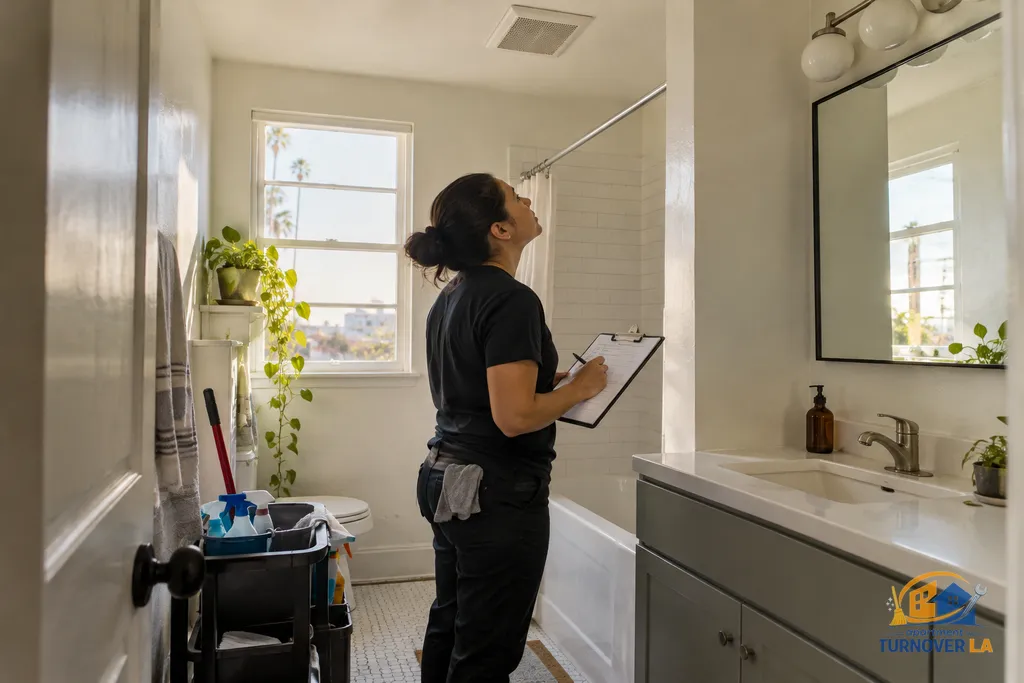
Across Los Angeles, a deep-cleaning booking often costs about $45 per hour on local task platforms, and some one-time cleaning services advertise starting prices near $55. Those are general market reference points, not fixed apartment-turnover quotes. The final bill can move quickly when a cleaner finds grease, scale, pet residue, interior cabinets, or a larger-than-described unit.
With TurnOver LA, the published deep-clean-inclusive Make Ready package is Studio $225, 1 Bedroom $255, 2 Bedroom $335, and 3BR or larger $425. Each includes the deep clean and a 12-point photo report, with a 48-hour turnaround. That structure helps an owner compare a known vacant-unit scope against open-ended hourly cleaning. The quote covers labor and the crew's own supplies. If the job needs paint, parts, or fixtures, those materials are priced at the on-site inspection and added only with your approval.
| Scope | Typical LA market context | TurnOver LA published package |
|---|---|---|
| One-time deep clean | About $45 per hour or starting near $55, depending on scope | Studio $225 Make Ready |
| Vacant 1 bedroom reset | Hourly or custom scope is common | 1 Bedroom $255 Make Ready |
| Vacant 2 bedroom reset | Hourly or custom scope is common | 2 Bedroom $335 Make Ready |
Is $50 an hour good for house cleaning in Los Angeles?
For an occupied home with a short, defined list, $50 an hour can be a reasonable LA cleaning rate. It is less useful as the only comparison point for a vacancy because the owner still needs to know what the cleaner will inspect, what rooms are included, whether the appointment can be completed on schedule, and whether anyone documents the result. Two people billed at the same hourly rate can leave very different units behind.
Before accepting an hourly quote, ask whether kitchen cabinets are included, whether oven and refrigerator interiors are included, who moves light furniture or leftover items, and what happens if cleaning exposes a wall repair or failed fixture. For a vacant rental, a package can simplify the decision. A 1 Bedroom $255 Make Ready gives the owner a deep clean plus a 12-point photo report rather than only a block of labor time. That report is useful when the owner, leasing agent, and maintenance contact are not standing in the unit together.
How is deep cleaning different from Make Ready?
Deep cleaning is the cleaning scope. Make Ready is the turnover process that uses cleaning as one step toward putting the apartment back on the market. A Make Ready package includes the deep clean and a 12-point photo report, so the owner can see the condition after work is complete. It is usually the better fit when a tenant has vacated, keys have changed hands, and the unit needs to be shown quickly.
The difference becomes obvious when cleaning reveals a scuffed wall, a small hole behind a picture frame, a loose cabinet pull, or an inoperative smoke detector. Cleaning does not repair those items. A turnover plan can add painting and drywall work or a maintenance punch list without treating each discovery as a separate vendor search. For a fuller explanation of the term, see what Make Ready means in property management.
Get instant quote in 30 seconds
Need the walls done before you re-list?
Turnover painting, scuff removal and patching, with a photo record of the condition we left behind.
$395 per room · 48-hour turnaround
Get an instant quoteWhat is the 5-5-5 rule, and does it work for a vacant unit?
The 5-5-5 rule is a household cleaning habit, not a turnover standard. It usually means spending five minutes on a small task, five minutes decluttering, and five minutes resetting a room or another similarly brief routine. It can keep an occupied apartment from drifting into disorder. It cannot reliably reset a unit after move-out because it does not account for kitchen grease, hidden cabinet residue, bathroom scale, pet hair, or condition issues that appear only after belongings are gone.
For a vacancy, use a sequence instead. First, clear abandoned property and document the condition. Second, inspect for repairs before cleaning makes the surfaces look better. Third, clean from high surfaces to floors, then complete a final walk-through with lights, plumbing, appliances, doors, and locks checked. This avoids paying for a clean floor twice after a drywall patch or maintenance visit. It also preserves a clearer record if the security-deposit accounting later becomes disputed.
Which cleaning agents belong in an apartment deep clean?
The common categories are water, detergents, degreasers, acids, abrasives, disinfectants, and solvents. A crew does not need to use every category in every room. The right product depends on the surface and buildup: a degreaser for kitchen film, a bathroom-safe acid cleaner for mineral scale where appropriate, detergent for general soil, and disinfectant when sanitation requires it. Mixing products, especially bleach and ammonia-based cleaners, is unsafe and should never be part of a rushed turnover.
Operationally, product choice matters most on older LA finishes. Aggressive abrasives can dull a worn tub, strip a coated fixture, or scratch laminate. Strong cleaners can also expose preexisting damage that should be photographed before a former tenant is charged. This is one reason the post-clean condition record has value beyond presentation. For guidance on separating cleaning from damage, review normal wear and tear in California.
What should be inspected before and after deep cleaning?
Inspect before cleaning so the crew does not erase evidence of a repair need or confuse ordinary use with damage. Photograph stained carpet areas, chipped counters, wall holes, broken blinds, missing smoke detectors, leaking supply lines, and appliance defects before work begins. Then make the cleaning sequence fit the repair sequence. Paint dust, drywall sanding, and a cabinet repair can all create cleanup work after an initial clean.
After cleaning, check the unit as a prospective renter would: open cabinets, run the bathroom fan, flush toilets, turn on every light, look under sinks, test window latches, inspect the refrigerator seal, and verify that doors latch properly. California's California Civil Code §1950.5 sets rules around deposit deductions and documentation, so condition records are not just an internal convenience. The California DCA Landlord-Tenant Guide is also a useful reference for owners handling move-out responsibilities.
How can a landlord keep cleaning from delaying the next listing?
Schedule the access, inspection, cleaning, repair decisions, and final photos as one short chain of work. The common failure is booking cleaners first, then discovering at the final walk-through that a wall needs paint, a lock needs attention, or debris remains in a closet. That can turn a one-day cleaning task into several vendor appointments. In Los Angeles, even a short delay matters when vacancy loss commonly falls in the $80-$200 per day range depending on the submarket.
TurnOver LA works on a flat 48-hour turnaround for every job, without a rush or same-day upcharge. For a straightforward vacant unit, use the deep clean to establish condition, then authorize any approved materials or additional repair work found at the inspection. If cleaning is only one piece of the turnover, the Make Ready package keeps the closeout record in the same workflow. The goal is not a decorative clean. It is a unit that can be inspected, listed, and shown without reopening the work order.
When is a deep clean enough, and when should you add turnover work?
A deep clean is enough when the unit is vacant, structurally sound, odor-free, and free of visible wall damage or maintenance defects. It becomes insufficient when the apartment has patches to repair, broad wall scuffing, nonworking hardware, smoke or pet odor, debris, or access concerns. Cleaning can reveal those issues, but it cannot resolve them.
For owners, the useful decision is whether the unit will pass a leasing walk-through immediately after cleaning. If yes, a cleaning-focused scope may be appropriate. If no, use Make Ready as the base and add the work that inspection confirms. A clear scope, an approved-materials process, a 12-point photo report, and a 48-hour completion target reduce the handoffs that often create vacancy days.