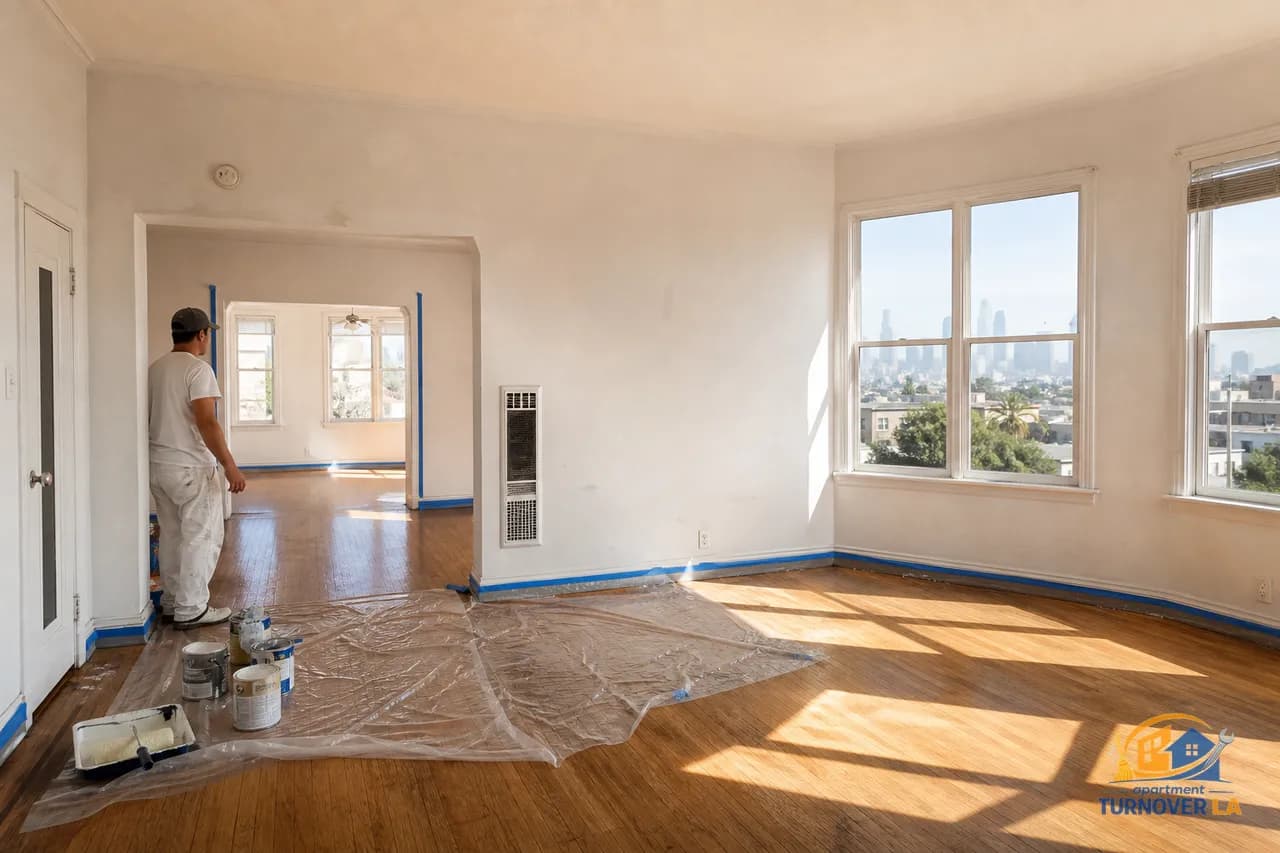
Are landlords required to paint between tenants in California?Quick answer: California does not require landlords to repaint between tenants. You must deliver a habitable, clean unit, and you cannot charge tenants for normal wear and tear like light wall scuffs. If you repaint, costs in LA typically run $300 to $600 per room on the open market. TurnOver LA charges $395 per room with a 48-hour turnaround.
No. There is no California statute that mandates repainting at every turnover. You must comply with habitability, cleanliness, and deposit laws, which means delivering walls that are clean and free of peeling paint, and only charging tenants for damage beyond normal wear and tear.
Get instant quote in 30 seconds
What does California law actually say about repainting?
California law sets standards for habitability and limits on security deposit deductions. It does not tell landlords to repaint between every tenancy. The key rules are:
- You must provide a habitable unit. Paint cannot be lead-based in pre-1978 buildings and cannot be peeling or unsanitary. That is a general habitability expectation explained in the state’s tenant guides.
- You cannot deduct for ordinary wear and tear when returning a security deposit. That includes routine wall scuffs and nail holes from normal picture hanging. See California Civil Code §1950.5 for deposit deductions and timelines. The California Tenants Guide explains ordinary wear and tear and how deductions must be itemized with receipts.
References: California Civil Code §1950.5 and the California Tenants Guide.
For a practical rundown on deposit timing and documentation, see our guide to the 21-day deposit return and our overview of normal wear and tear in California.

How much can a landlord charge for painting in California?
You can charge the tenant for paint work caused by negligence, misuse, or unapproved alterations, not for ordinary wear. California Civil Code §1950.5 requires deductions to be reasonable and documented, with receipts or an estimate and photos. Think marker murals on a bedroom wall, heavy nicotine staining, oil splatter in a kitchen, or an unapproved dark accent that needs extra primer. Those are billable. Faded eggshell in a hallway after three years is not.
Two practical points help in small claims. First, itemize by area and scope, not a single lump. Second, prorate the remaining life of the paint, so the tenant only covers the accelerated portion, not the landlord’s long term refresh. The state’s consumer materials echo this approach on security deposits and normal wear. See the California DCA Landlord-Tenant Guide and the California Tenants Guide for plain language explanations.
In practice the ceiling is the reasonable cost to fix damage beyond ordinary wear, supported by invoices or estimates, less depreciation where appropriate. You cannot charge for routine refresh after a normal stay. If a tenant paints a red accent wall without permission, you can bill to restore the original neutral color. AB 12 now caps most residential security deposits at one month’s rent, which limits how much can be withheld for any repair. See AB 12 (2023) security deposit cap and California Civil Code §1950.5.
Operationally, many LA owners use vendor receipts to support charges. If TurnOver LA performs the work, your line items might read: Repainting per room $395 per room, small drywall patch and texture $150 per patch, ceilings and baseboard or trim $125. Pair those with before and after photos in your deposit letter.
When can a landlord deduct painting from a tenant’s security deposit?
You can deduct for repainting only when the tenant caused damage beyond ordinary wear and tear. Examples include marker or crayon on walls, grease or smoke staining, unauthorized color changes, or significant wall damage that requires patch and repaint. California Civil Code §1950.5 requires itemized deductions with actual or good faith estimated costs and receipts if work is completed within 21 days.
Courts often expect reasonable depreciation for paint. Interior flat paint in LA rentals commonly has a useful life of 3 to 5 years, depending on product, sunlight, and traffic. If a tenant repaints a wall black after 3 years in place, and you must cover with two coats, a prorated charge may be appropriate. Document the condition with photos and invoices, and pair your deductions with your move-in checklist. For more context on line-item proof, see our normal wear and tear and 21-day deposit return guides.
How do you prorate paint charges fairly and defensibly?
Courts look for reasonableness. A common approach is to set a useful life for interior paint, then charge only for the unused portion that the tenant’s damage consumed. For many LA buildings, interior wall paint lasts 3 to 5 years. Studios with cooking in the living space skew shorter, bedrooms skew longer. Document your standard in your house rules or turnover policy.
Example: You repainted 24 months ago. Tenant’s nicotine staining forces a full repaint now. If your useful life is 48 months, 24 months remain, so at most 50 percent of the repaint cost can be charged to the tenant. If only a single accent wall is damaged, bill that wall or the one room portion, not the entire apartment. Tie your math to photos and dates, then attach vendor invoices or line item prices.
Sample billing scenarios you can copy
Here are plain, defensible examples that match our catalog and California standards:
- Unapproved navy accent wall in a 1BR bedroom painted 10 months ago. Bill one room repaint $395. Apply 80 percent remaining life if your standard is 5 years, so tenant share is $316. Photos before and after attached. Primer is included in the room repaint.
- Two medium holes behind a door and TV mount in a living room. Bill two medium drywall repairs at $240 per patch, total $480. If the surrounding wall is otherwise within useful life and blends well after spot paint, do not charge a full room repaint.
- Kitchen cabinet shelving covered in contact paper residue. Bill sand and repaint cabinets or shelving at $135. If walls are fine, do not add room repaint.
- Heavy scuffs and smudges in a hallway after a 4 year tenancy. Bill zero. This is normal wear. If you repaint for marketability, it is an owner expense, not a deposit deduction.
How do you write the 21-day deposit letter for paint?
Keep it short, factual, and referenced. State that charges are for tenant-caused damage beyond normal wear, list each affected room, cite the unit color standard, attach photos, and show proration. Example language:
- Repair and repaint of living room due to unapproved dark color, two-year tenancy against a three-year useful life. Cost $395 room repaint multiplied by one third equals $131.67 charged. See photos 7 to 11.
- Patch and texture one medium anchor hole in bedroom wall, $240 per patch. See photos 12 to 13.
Review our guide on normal wear and tear in California to keep your language consistent with state definitions.
How much does it usually cost to paint an apartment in Los Angeles?
Across LA, interior repainting generally runs $300 to $600 per room for labor and standard materials. Whole-unit pricing varies widely by condition and color changes, often $1,200 to $2,400 for a typical one-bedroom when you hire a retail painter. With TurnOver LA, pricing is line-item and fast: Paint touch-up only is $200, repainting per room is $395 per room, ceilings and baseboard or trim is $125, sand and repaint cabinets or shelving is $135, small drywall patch and texture is $150 per patch, and medium drywall repair is $240 per patch. We turn every job in 48 hours, which reduces vacancy loss that often runs $80 to $200 per day depending on submarket.
| Paint work | Typical LA market price | TurnOver LA |
|---|---|---|
| Repaint, per room | $300 to $600 | $395 |
| Full repaint, one-bedroom | $1,200 to $2,400 | $395 per room, finished in 48 hours |
| Touch-up only | Usually bundled, rarely quoted alone | $200 |
| Ceilings, baseboards and trim | Rarely quoted alone | $125 |
| Sand and repaint cabinets or shelving | Rarely quoted alone | $135 |
| Small drywall patch and texture | Rarely quoted alone | $150 per patch |
| Medium drywall repair | Rarely quoted alone | $240 per patch |
Want an itemized quote mapped to your unit size and scope, including Make Ready cleaning if needed? Get instant quote in 30 seconds
How long does it take to repaint an apartment?
In LA, a one room repaint with light prep typically takes one day in and out, including drying. A full 1BR with consistent color and standard ceilings is usually one working day for experienced painters, then a short return for cuts or trim if needed. Add time for heavy patching, cabinet refinishing, or nicotine remediation. TurnOver LA scopes are scheduled to finish inside a flat 48 hours, which also covers Make Ready cleaning and final photo documentation. That matters in submarkets with high vacancy loss. In Santa Monica or West Hollywood, two extra days empty at 150 dollars per day is 300 dollars of lost rent, which usually dwarfs the price difference between a touch-up and a full repaint.
Need the walls done before you re-list?
Turnover painting, scuff removal and patching, with a photo record of the condition we left behind.
$395 per room · 48-hour turnaround
Get an instant quoteWhat is a practical repaint cycle for LA apartments?
There is no legal repaint clock. Use a cycle that matches your building, unit size, and turnover velocity:
- Studio and micro-units in Koreatown or Downtown LA with fast re-lets: touch-up each turn, full repaint every 1 to 2 turns if walls are scuffed beyond blendable.
- One-bedrooms in West Hollywood or Pasadena with longer stays: touch-up and trim each turn, full repaint every 2 to 3 turns.
- Family-sized units in the Valley with kids and pets: expect hallways and bedrooms to need more frequent repainting and patch work.
- Smoking or heavy cooking evidence: prioritize washing, stain sealing, then repaint. See our guides on smoke smell removal and pet odor cleanup.
If you pair repainting with a Make Ready deep clean, units show faster and you cut days vacant.
How do I decide between touch-up and a full repaint at turnover?
Use this simple six-point test before you buy paint:
- Color match risk: If the last paint is older than 2 years or was custom-tinted, expect mismatch. Partial repaint may telegraph seams.
- Wall washability: If flat paint will not wash clean, a new coat saves labor versus scrubbing.
- Lighting: South and west exposures in Santa Monica and Mar Vista show every patch. Lean full repaint in bright rooms.
- Stains and odors: Nicotine, incense, or cooking oil often require sealing and full repaint in kitchen and entry.
- Traffic lanes: Hallways and around light switches usually need new coats. Bedrooms may touch-up fine.
- Time to rent: If a gap will cost $160 per day in West Hollywood, a 48-hour repaint returns faster than a piecemeal plan.
Three more triggers push a room from touch-up to repaint on their own:
- More than 10 medium patches in one room, or any single patch larger than a postcard.
- Water stains or old leak marks, which telegraph through touch-up.
- Heavy roller lines or missed spots left by a previous painter, which show up in listing photos.
If two or more show up in the same room, repaint that room. If most rooms hit two, do the whole unit so the marketing photos are consistent.
What paint specs and colors extend repaint cycles in rentals?
- Use eggshell in living areas for cleanability without telegraphing patches like flat.
- Semi-gloss in kitchens and baths for steam resistance and easy wipe-downs.
- One standard light neutral across the portfolio so you can reuse stock and blend touch-ups.
- Caulk and back-prime patched areas to avoid flashing.
- Low VOC, Rule 1113 compliant products reduce odor and speed re-entry.
- Avoid accent walls, they complicate touch-ups and inventory.
- Maintain a color and sheen log per unit, and keep labeled quarts for 24 months. These choices allow you to touch up convincingly for more turns, which stretches the 3 to 5 year whole-unit repaint cycle toward the upper end without sacrificing presentation.
Do LA Rent Stabilization Ordinance buildings have special repainting rules?
The LAHD Rent Stabilization Ordinance does not require owners to repaint between tenants. RSO owners must maintain housing services and habitability, which includes keeping walls sanitary and free of peeling or chipping paint. Painting is typically treated as maintenance, not a pass-through improvement, unless it is part of a larger, approved program. Always keep your notices and maintenance logs clear. See the LAHD Rent Stabilization Ordinance for the broader framework on housing services and rent adjustments.
From an operations standpoint, RSO turnover timing matters. In Koreatown and Mid-City garden buildings with smaller units, our clients often choose targeted touch-up and trim at each turn, with a full repaint every 2 to 3 turns, unless there is tenant-caused damage.
Are tenants allowed to repaint their apartment?
Only with permission in writing. Most leases prohibit unapproved color changes and require restoration to the original color. If a tenant paints without consent, you can charge for the reasonable cost to restore to the prior condition, excluding normal wear. Provide clear move-in photos and a simple written color policy. The California DCA Landlord-Tenant Guide explains how alterations and restoration duties should be handled in lease language. If a tenant asks to repaint, you can offer an approved color palette and require a professional finish level.
Tenants can repaint only with written approval that specifies the color, product sheen, and who restores at move-out. Without approval, landlords may charge to return to original conditions. Direct tenants to your approved neutral palette and set a finish standard, for example, eggshell in living spaces, semi-gloss in kitchens and baths. Link the approval to your move-out instructions so expectations are clear.
If you lease in areas like Koreatown or Downtown LA where faster turns matter, consistent colors across units reduce downtime and make touch-up viable.
What does a cost-effective turnover scope look like in LA?
On the open market, a 1-bedroom turnover that includes a basic repaint, light drywall, and cleaning often totals $1,600 to $3,000 depending on vendors. With TurnOver LA, the common scope is straightforward:
- Make Ready deep clean with 12-point photo report, 1 Bedroom $255
- Repainting per room $395 per room, usually bedroom and living room
- Small drywall patch and texture $150 per patch, if needed
- Ceilings and baseboard or trim $125, optional but recommended if trim is dirty
Because we complete scopes in 48 hours, you can cut vacancy loss that often ranges from $80 to $200 per day across LA neighborhoods like West Hollywood, Pasadena, and Downtown LA.
For cleaning details, see our Make Ready service. For wall work, see our interior painting and drywall. If you manage multiple doors, our property manager program keeps pricing predictable across turns.
Get instant quote in 30 seconds
Is touch-up sometimes enough to re-list fast?
Yes, especially when walls are in one consistent color, scuffs are localized, and lighting is forgiving. Touch-up is $200 with TurnOver LA, and you can pair it with Make Ready cleaning so the photos look crisp. In West Hollywood or Pasadena where prospects expect clean presentation, we often touch-up bedrooms and paint living room and hallway only. For quick relists, add trim at $125 and a focused drywall patch or two at $150 per patch if needed. That blend often shows as a full refresh in listing photos.
Tip: schedule photos right after paint cures. Our TLA Launch Pad Media Package is $399 and includes the stills you need to list same day.
A simple repaint policy you can adopt today
- Set a 3 to 5 year full-unit repaint cycle, with kitchens, baths, entries at 2 to 3.
- Touch up at every turnover, repaint rooms that fail the seven triggers above.
- Standardize colors and sheens portfolio-wide, keep labeled touch-up quarts.
- Document move-in and move-out conditions with dated photos.
- Use published pricing to itemize any deposit deductions under California Civil Code §1950.5.
- Account for vacancy loss when deciding between touch-up and full repaint.
- Bundle work so the unit hits the market inside 48 hours.
Ready to set your next repaint and list by the weekend? Get instant quote in 30 seconds
Bottom line: what should LA landlords do between tenants?
You are not required to repaint between tenants, but you should deliver walls that are clean, sanitary, and neutral enough to market quickly. Use touch-up when color and light allow, and repaint high-visibility rooms when blend lines will show. Anchor any tenant charges to damage beyond normal wear, with receipts and photos.
Need paint, patch, and cleaning booked together with a 48-hour completion? Get instant quote in 30 seconds