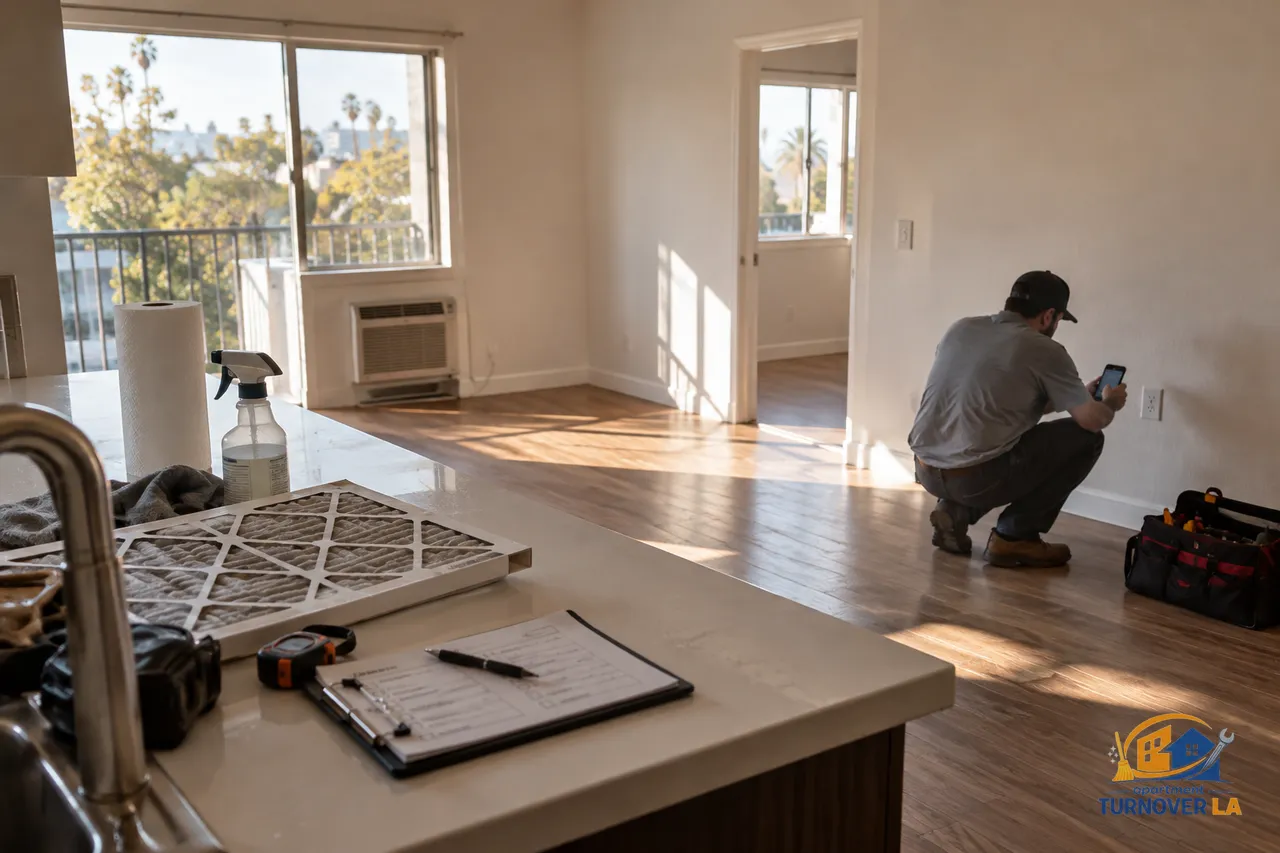
Quick answer: A make-ready is the work completed after a tenant leaves and before a new tenant moves in: cleaning, repair, safety checks, lock work, and condition documentation. In Los Angeles, every vacant day can cost roughly $80 to $200 in lost rent depending on the submarket, so the point is a documented rent-ready unit, not simply a cleaned one.
A make-ready in property management turns a surrendered apartment into a unit a new resident can inspect, lease, and occupy. It combines defined scope, a condition record, and a handoff date so cleaning, maintenance, and leasing are not working from different assumptions. Get instant quote in 30 seconds
What does make-ready mean in property management?
Make-ready means preparing a vacant rental for the next tenancy after possession has returned to the owner or manager. The work normally starts with a walk-through and ends when the unit meets the property's leasing and safety standard, not when one vendor finishes one task. A cleaner may leave a unit spotless while a leaking angle stop, failed smoke alarm, missing blind wand, or unsecured lock still prevents move-in.
For that reason, a usable make-ready has three parts: condition assessment, corrective work, and proof of completion. The proof matters in LA buildings where a leasing agent, owner, or off-site manager may not see the unit between vendors. TurnOver LA's Make Ready service pairs a base deep clean with a 12-point photo report. That report creates a practical record of what was checked at the turnover handoff, rather than relying on a verbal update that the apartment is “done.”
What work should a standard apartment make-ready include?
A standard make-ready should cover the items that affect cleanliness, basic function, safety, and showing readiness. Start with the kitchen, bathrooms, floors, walls, windows, appliances, fixtures, doors, closets, and entry hardware. Then identify defects that need a different trade or owner decision. The base scope should be visible before work begins so nobody assumes a repair is included in a cleaning job.
For example, TurnOver LA's Make Ready base package is a deep clean plus a 12-point photo report. It is not a promise that concealed plumbing, appliance failures, repainting, or discarded furniture will be resolved without inspection. Those items need their own scope. Managers who use one standard list also avoid a common problem: a leasing team schedules photos because the unit is “clean,” then finds wall damage, a stuck window, or personal property still inside. For a fuller task sequence, see this apartment turnover checklist.
Which problems belong outside the base make-ready scope?
Repairs, paint beyond routine cleaning, haul-away, and replacement parts should be identified separately and approved before they are added. This is particularly important in older LA apartments, where a small stain can turn out to be water damage and a loose knob can reveal a worn latch or damaged door bore. A base make-ready should identify the issue promptly, not hide it inside an undefined labor charge.
TurnOver LA's quote covers labor and the crew's own supplies. Paint, parts, and fixtures needed for the job are priced during the on-site inspection and added to the final invoice only with approval. That distinction helps owners compare scopes accurately. A small drywall patch and texture, for example, is a specific repair task, while repainting a room is a broader finish decision. Review painting and drywall work separately from cleaning when walls, trim, cabinets, or patches need attention. It keeps the turnover record clear if a tenant charge is later questioned.
How does a make-ready move an apartment to rent-ready status?
A good workflow answers who has possession, what has been found, who approves extras, and when leasing can enter. The fastest process is not the one that skips checks. It is the one that finds decision items early and keeps each trade from returning after the next trade has already left.
- Confirm possession, keys, access instructions, and whether any belongings remain.
- Walk the unit and record cleaning, damage, safety, hardware, and maintenance findings.
- Complete the base clean and photo documentation while the condition is visible.
- Obtain approval for materials, repairs, paint, or cleanout work outside the base scope.
- Finish approved corrective work, then verify locks, fixtures, smoke and carbon monoxide alarms, and access.
- Release the unit to leasing with photos and a clear list of any owner-deferred items.
TurnOver LA uses a flat 48-hour turnaround on every job, with no rush or same-day upcharge. The practical constraint is not speed alone. It is prompt approval when an inspection finds materials or repairs that were not visible at booking. Get instant quote in 30 seconds
Need the walls done before you re-list?
Turnover painting, scuff removal and patching, with a photo record of the condition we left behind.
$395 per room · 48-hour turnaround
Get an instant quoteHow is a make-ready different from a move-out clean?
A move-out clean is one component of a make-ready. It focuses on removing residue, grease, dust, hair, bathroom buildup, and other cleaning conditions left in a vacant unit. A make-ready has a wider operational purpose: it confirms the apartment can be shown and turned over safely after cleaning is complete.
| Work item | Move-out clean | Make-ready |
|---|---|---|
| Kitchen and bathroom deep cleaning | Included | Included |
| Floors, closets, and interior surfaces | Included | Included |
| Condition photos and completion record | Often not included | Included in TurnOver LA base package |
| Lock, safety, and maintenance review | Usually outside scope | Identified and addressed as needed |
| Paint, repairs, and junk removal | Usually outside scope | Scoped separately when needed |
If cleaning is the only known need, a deep cleaning service may fit. If the unit needs a handoff record and inspection-driven follow-up, make-ready is the more useful category. For common cleaning line items, see the guide to move-out cleaning in Los Angeles.
How do you get into an apartment fast without creating a turnover problem?
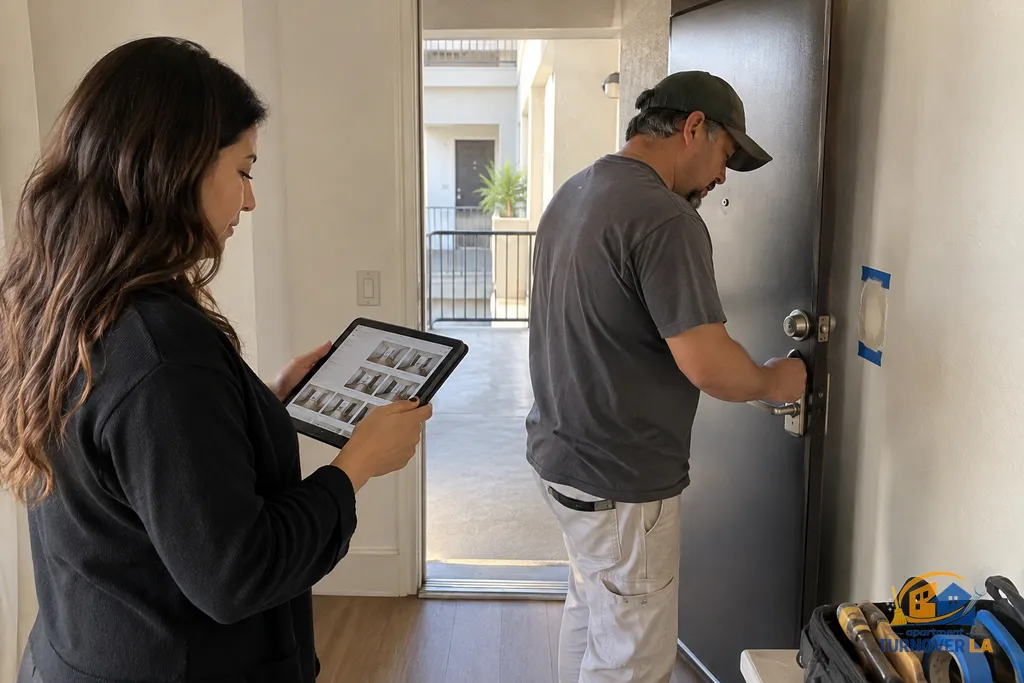
Fast lawful access begins after the manager has confirmed surrender or otherwise has legal authority to enter. Do not treat an abandoned-looking unit as available just because the lights are off or the key is missing. Confirm possession status, document the access decision, retrieve keys under the building's key-control process, and record who entered and when. If a lock must be changed, make sure the work order identifies the correct door and hardware.
Once possession is confirmed, rekeying should happen early enough that vendors can work safely but not so early that access records become confused. TurnOver LA lists a full apartment rekey for up to two locks at $150, and a smart lock install at $210. Those are defined lock services, not substitutes for confirming legal possession. This simple separation between access authority and physical lock work is especially useful for property managers overseeing multiple units and outside vendors. Learn more about ongoing coordination through property manager turnover support.
Can a landlord charge a former tenant for make-ready work?
A landlord cannot simply bill a departing tenant for every turnover task. California rules distinguish tenant-caused damage or cleaning needed to restore the premises from normal wear and routine owner turnover costs. Ordinary aging, minor wall scuffs, and normal use are not automatically chargeable just because the next tenant would prefer a freshly prepared unit. The details matter, including move-in condition, documentation, and receipts or estimates.
California Civil Code §1950.5 sets the security deposit framework, including the itemized statement process. Review the statutory text at California Civil Code §1950.5, and use this guide on the California 21-day deposit return for the operational deadline. LA managers should also understand the LAHD Rent Stabilization Ordinance when a unit is covered. A clean turnover file should separate tenant-related deductions from owner-paid work needed to market the next tenancy.
What does a Make Ready cost with TurnOver LA?
There is no single LA market price for a make-ready because unit size, condition, access, repairs, paint, junk, and materials change the scope. The more useful local benchmark is vacancy: a vacant LA unit can cost about $80 to $200 per day in lost rent, depending on the submarket. That is a vacancy-loss range, not a TurnOver LA service price.
TurnOver LA's base Make Ready prices are flat by unit size: Studio $225, 1 Bedroom $255, 2 Bedroom $335, and 3BR or larger $425. Each includes the deep clean and 12-point photo report. If inspection finds additional needs, those are priced as separate approved items. For example, paint touch-up only is $200, a half-day handyman punch list is $230, and unit cleanout or junk haul is $500. Materials are not embedded in those labor prices: paint, parts, and fixtures are inspected, priced, and approved before they are billed.
Build the make-ready around the next lease, not the last move-out
The best make-ready process gives leasing a unit they can confidently show and gives the owner a clear record of what was completed, deferred, or approved. It also reduces avoidable return trips, especially when cleaning reveals wall, hardware, appliance, or haul-away issues that were not apparent during the first walk-through.
Set the base scope first, inspect before authorizing extras, and keep deposit accounting separate from owner turnover work. That approach is more defensible and usually faster than coordinating cleaning, repairs, locks, and photos as unrelated jobs. Get instant quote in 30 seconds