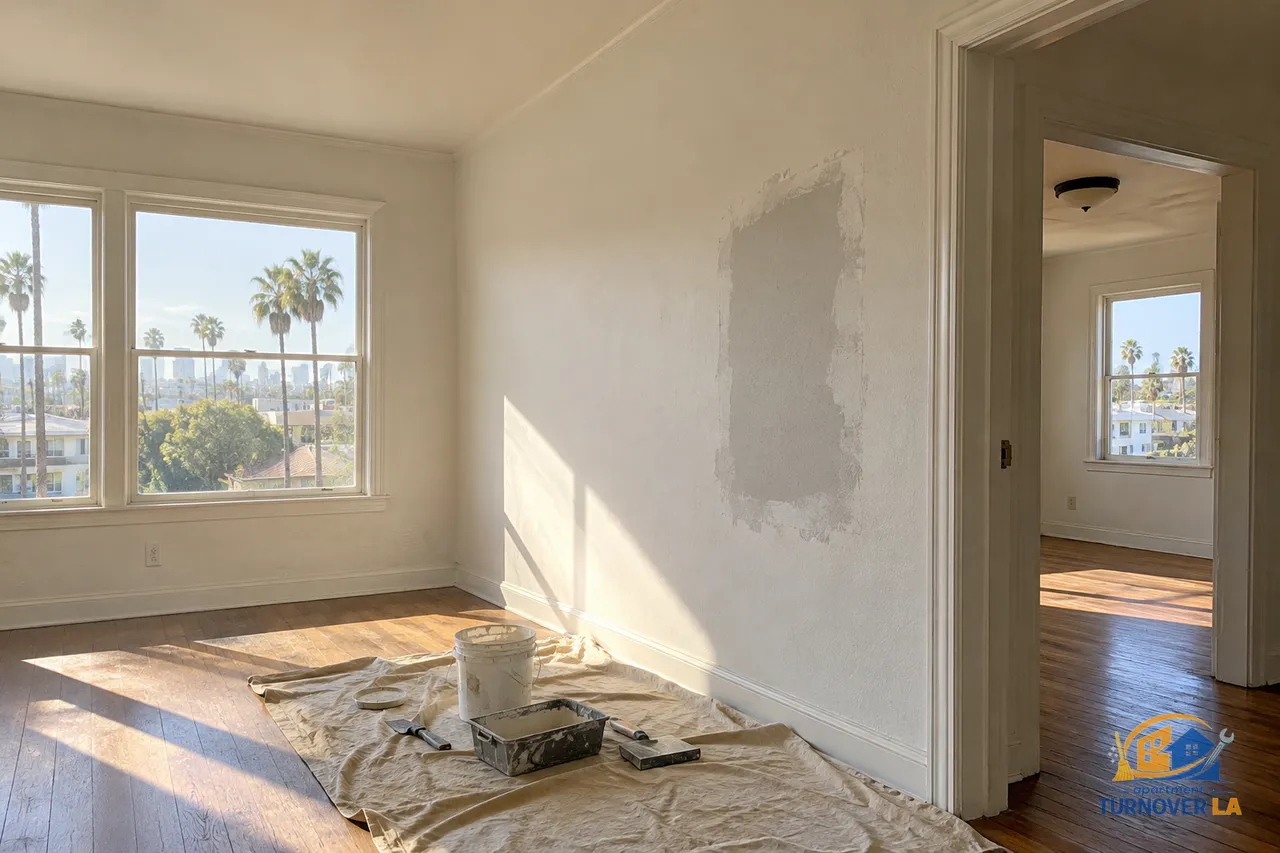
Quick answer: A published Long Beach drywall repair benchmark is about $299, while actual Los Angeles patch pricing changes with hole size, texture, moisture, and paint matching. TurnOver LA charges $150 for a small drywall patch plus texture and $240 for a medium drywall repair, with a 48-hour turnaround. Paint, parts, and other materials are approved separately after inspection.
Drywall repair prices in Los Angeles are usually driven by the repair scope, not simply the square footage of the apartment. For a turnover, the practical question is whether the wall can be patched, textured, painted, documented, and released without holding up the next showing. Get instant quote in 30 seconds
What does drywall repair usually cost in Los Angeles?
Across the local market, a published Long Beach estimate places average drywall repair at about $299. That is a useful benchmark, but it is not a complete turnover quote: a doorknob hole, a failed anchor, a broad water stain, and a ceiling seam can all require different labor and follow-up work. With TurnOver LA, a small drywall patch plus texture is $150 / patch, and a medium drywall repair is $240 / patch. Those are labor-and-supply service prices, while job-specific paint, parts, or fixtures are inspected and approved before they are added to the final invoice.
| Repair scope | Typical local context | TurnOver LA rate | What can change the scope |
|---|---|---|---|
| Small puncture or anchor damage | Often below a broad full-repair benchmark | $150 / patch | Texture, paint match, hidden damage |
| Larger impact area or opened wall section | Often at or above the $299 local benchmark | $240 / patch | Backing, drying, multiple coats, access |
A patch price is most useful when the defect is isolated and dry. For a wider turnover budget, compare this work with the Los Angeles apartment turnover cost guide.
What counts as a small patch versus a medium repair?
A small patch is typically a localized defect that can be backed, filled, sanded, textured, and prepared for paint without opening a large portion of wall. Think picture-hanger damage, a small impact hole, or a failed wall anchor. A medium repair generally involves a larger damaged area, broken gypsum around the opening, more backing, or a repair that needs more blending to disappear under paint.
The important field detail is the edge condition. A six-inch hole with solid surrounding board can be quicker than a smaller hole whose paper face is torn back, corners are crushed, or prior repairs are cracking. Ceiling work also tends to take longer because texture and feathering are viewed in raking light. TurnOver LA's $150 / patch small patch rate includes texture, while $240 / patch applies to a medium repair. The crew should photograph the condition before paint so the owner can distinguish pre-existing wall damage from an incomplete repair.
For holes, scuffs, and failed patches, see our rental drywall patching guide before deciding whether a touch-up is enough.
Can painters fix drywall, or does the repair need a separate crew?
Painters can handle minor surface preparation, but drywall repair and paint matching are two connected, different tasks. The patch must be stable, sanded flat, and textured to match before paint is applied. If paint goes on too soon, a smooth repair can flash through a textured wall, and a poorly feathered edge can remain visible even under a fresh coat.
Across LA, repair quotes often bundle these tasks without making the handoff clear. TurnOver LA separates the defined work: $150 / patch for a small drywall patch plus texture, $240 / patch for medium drywall repair, $200 for paint touch-up only, and $395 / room for repainting per room. This lets an owner choose a local touch-up for a clean, matchable wall or repaint a room where sun fade, tenant paint, or multiple repairs make a touch-up obvious. Materials such as paint are priced after on-site inspection and require approval.
Use our painting and drywall service when the repair needs finish work, or book handyman and general maintenance when the wall damage comes with a broader punch list. Get instant quote in 30 seconds
Can water-damaged drywall be saved?
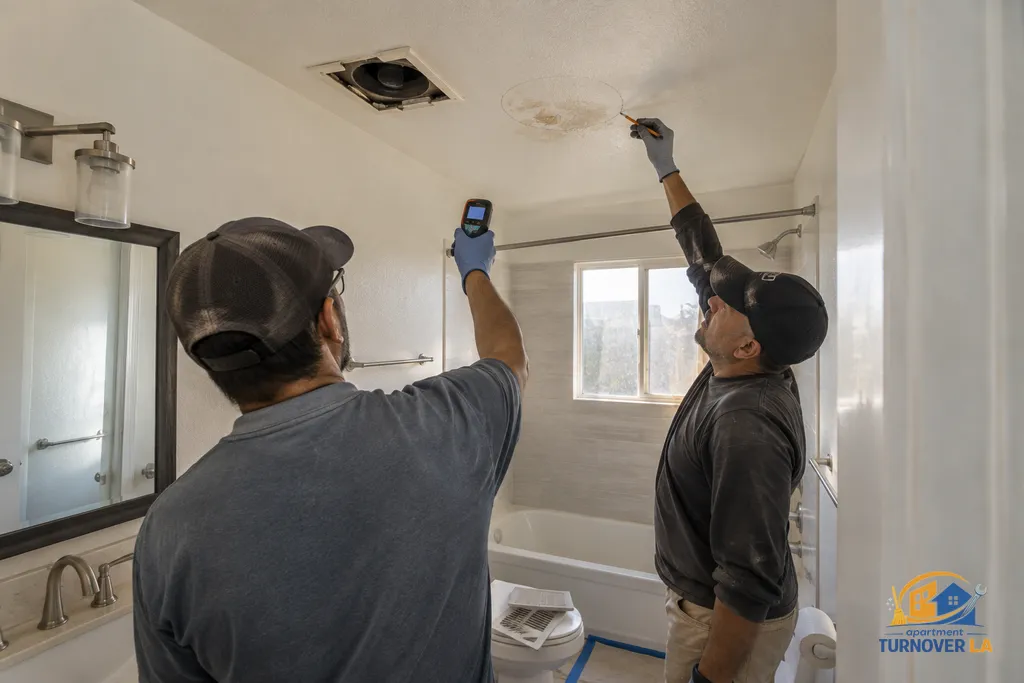
Sometimes, but a dry-looking stain is not proof that drywall is ready to patch. The first operational step is to identify and stop the source: a roof leak, supply line, drain, shower surround, window intrusion, or upstairs overflow. Then the area must be dry, structurally sound, and free of active staining or mold-like growth before it is closed and refinished.
A useful turnover rule is to treat moisture as a gate, not a cosmetic issue. If a ceiling repair is patched before the leak is fixed, the owner pays twice and may lose leasing days when the stain returns. If the board is firm, dry, and the source is resolved, a repair may be feasible. If it is soft, swollen, crumbling, or repeatedly wet, removal and replacement are usually the safer scope. This diagnosis step is why a flat patch rate should not be mistaken for a promise to cover an unknown leak.
For a vacant unit, record the source, drying status, repair extent, and finished result in the turnover file. That record is especially useful when maintenance responsibility is being reviewed after move-out.
Need the walls done before you re-list?
Turnover painting, scuff removal and patching, with a photo record of the condition we left behind.
$395 per room · 48-hour turnaround
Get an instant quoteCan drywall repair be used on plaster walls?
Drywall compound can make limited cosmetic repairs on some plaster surfaces, but it is not a universal solution. Plaster walls often have a harder finish coat, different movement characteristics, and, in older Los Angeles buildings, lath behind the surface. A loose or cracked plaster section may need stabilization and a compatible repair process before it can be skimmed and painted.
The first question is not whether the material is called plaster or drywall. It is whether the substrate is sound. Tap around the damage, check for movement, inspect crack patterns, and determine whether the wall has moisture issues. A shallow nail hole in stable plaster can be a finish repair. A hollow, detached area or recurring crack needs a different scope than a basic drywall patch. Do not quote a wall by the visible hole alone.
This matters in older multifamily units, where a thin modern patch can telegraph through a textured or plaster finish after paint dries. Identify the surface before selecting a texture and paint plan, then document the condition with the move-out file.
Which wall damage can a landlord charge against a deposit?
California allows a security deposit to be used for repairs beyond ordinary wear and tear, subject to the statutory rules and documentation. Review California Civil Code §1950.5 and the California DCA Landlord-Tenant Guide before making deductions. A few small picture holes, faded paint, or ordinary scuffs may be normal use. A punched hole, unauthorized large mount, or deliberate damage is a different analysis.
The field record should connect the condition to a specific repair scope. Photograph the damage before work, retain the invoice, and avoid charging a tenant for a full-room repaint when a documented spot repair resolves the issue. California's deposit timing also matters. Our guide to the 21-day deposit return rule explains the workflow, and our normal wear and tear guide covers common judgment calls.
For LA rent-stabilized properties, turnover work does not replace compliance obligations. Check the LAHD Rent Stabilization Ordinance when the unit is covered.
How do you keep drywall repairs from delaying a turnover?
Start inspection immediately after possession, before cleaners, painters, and vendors cover or move items. Mark every wall defect by room, photograph it, and decide whether it is a patch, a paint touch-up, or a wider repaint. This prevents the common sequence where a cleaner finds a hole late, a painter has already left, and the unit misses a listing window.
Use this five-step turnover sequence:
- Photograph damage and identify any moisture or safety issue.
- Repair and texture the wall before final paint decisions.
- Match paint or schedule room repainting where touch-up will flash.
- Complete cleaning after dusty sanding and repair work.
- Review finish quality, locks, and photographs before marketing.
A vacant LA unit can cost roughly $80 to $200 per day in lost rent depending on submarket, so the useful measure is release readiness, not the lowest isolated patch quote. TurnOver LA provides a 48-hour turnaround on every job, with no rush or same-day upcharge. Get instant quote in 30 seconds
The practical price decision for an LA turnover
For a straightforward hole, start with the actual repair category rather than an online average. The local $299 benchmark provides market context. TurnOver LA's defined rates are $150 / patch for a small drywall patch plus texture and $240 / patch for a medium drywall repair. Add paint work only when the surrounding finish needs it: $200 for paint touch-up only or $395 / room for repainting per room.
That separation helps owners avoid two expensive mistakes: applying paint over an unfinished patch, or repainting more area than the damage requires. It also gives property managers a clean invoice trail when reviewing deposit deductions and turnover budgets. Schedule the inspection early, approve necessary materials before work begins, and let the final wall condition determine whether touch-up or a room repaint is the better release decision.