Quick answer: Los Angeles handyman jobs commonly have a $60-$100 minimum in the general market. TurnOver LA prices a general maintenance or safety visit at $125, a half-day handyman punch list at $230, and a full-day handyman punch list at $425, with a flat 48-hour turnaround. Materials such as parts, paint, and fixtures are approved before they are added to the final invoice.
Handyman services in Los Angeles are most useful when a vacant apartment has several small, rentable-condition issues that do not justify separate vendors. For a turnover, the practical question is not only the hourly rate. It is whether the punch list, materials approval, access, and follow-up can be handled before another day of vacancy is lost. Get instant quote in 30 seconds
What do handyman services cost in Los Angeles?
Across LA, general handyman providers commonly advertise a $60-$100 minimum for a job, based on current local marketplace results. That is a market starting point, not a reliable total for a turnover, because a minimum often covers only arrival and a small amount of labor. With TurnOver LA, a general maintenance or safety visit is $125, a half-day handyman punch list is $230, and a full-day handyman punch list is $425.
Those flat options make more sense when the work can be grouped: tighten loose hardware, adjust doors, replace a supplied fixture, address cabinet issues, and document what was completed during one visit. Labor and the crew's own supplies are included in the quote. Paint, replacement parts, fixtures, and other job-specific materials are identified at the on-site inspection, priced separately, and added only after owner approval.
For a repair paired with a broader unit turn, see our handyman and general maintenance service. It is built around apartment punch lists rather than open-ended residential projects.
What does an apartment handyman handle during a turnover?
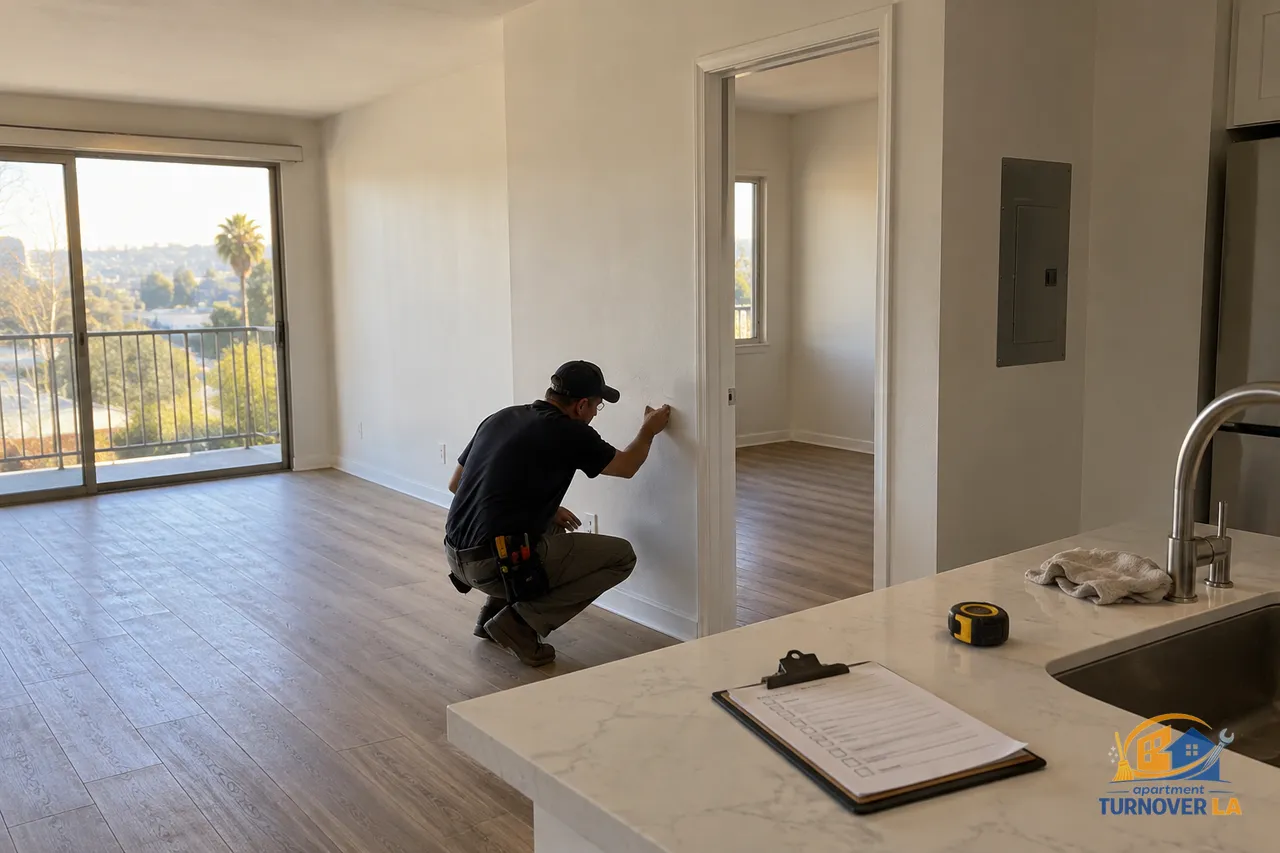
An apartment handyman handles the small corrective work that sits between cleaning and listing the unit. In a typical LA turnover, that means functional and visual items a prospect will notice during a showing: sticking doors, loose knobs, damaged wall areas, cabinet hardware, worn caulk, blinds, shelving, and basic safety concerns. The most requested category is usually not one single repair. It is the combined punch list of scuffs, holes, loose hardware, and deferred maintenance left from occupancy.
A useful apartment punch list separates work into five groups:
- Safety and access issues, including locks, latches, and loose fixtures.
- Water-related concerns, including peeling surfaces or failed caulk.
- Drywall and wall-finish damage visible from normal viewing distance.
- Door, cabinet, closet, and window hardware that does not operate correctly.
- Cosmetic details that affect photos and showings.
That grouping prevents a common turnover mistake: sending a cleaner first, then discovering repairs that create fresh dust and debris. When cleaning, patching, and painting are sequenced correctly, the final condition is easier to inspect and document.
Is the $500 limit for handymen in California still current?
No. The widely repeated $500 figure is outdated. California's minor-work contractor licensing exemption generally increased to $1,000 on July 1, 2025, but it is not a blanket permission to perform any repair without a license. The threshold involves the total value of labor and materials, and work requiring a permit or involving specialty trade requirements can fall outside the exemption. Owners should confirm licensing, permit, and trade requirements before assigning electrical, plumbing, gas, structural, or other regulated work.
For a landlord, the operational point is simple: do not split one larger project into artificial small tickets to fit a threshold. Scope the actual work, decide whether a licensed specialist is needed, and retain records of approvals and invoices. This matters most after a tenant move-out, when repair charges and deductions may be questioned. Review the documentation and timing rules in California Civil Code §1950.5 and the California DCA Landlord-Tenant Guide.
How should a landlord scope a handyman punch list?
A landlord should scope a punch list by location, condition, and decision needed, not by a vague note such as “fix unit.” Start at the entry and work room by room. For every item, note whether it is a safety issue, a repair, a replacement decision, or a paint and finish item. Include photos before work starts, especially where the condition could affect a security-deposit accounting.
A workable turnover scope might read: “Bedroom closet door rubs at top, adjust and test. Hall wall has two anchor holes, patch and texture. Kitchen cabinet pull is loose, tighten or identify replacement. Bathroom ceiling above shower has peeling paint, inspect for active moisture before repainting.” That last sentence is important. Paint over moisture damage before resolving the source, and the failure returns.
For a small set of tasks, a half-day handyman punch list is $230. A fuller unit list is $425 for a full-day handyman punch list. Pair repair work with professional turnover cleaning after dust-producing work is complete. Get instant quote in 30 seconds
Need the walls done before you re-list?
Turnover painting, scuff removal and patching, with a photo record of the condition we left behind.
Get an instant quoteWhen should drywall damage be patched instead of painted over?
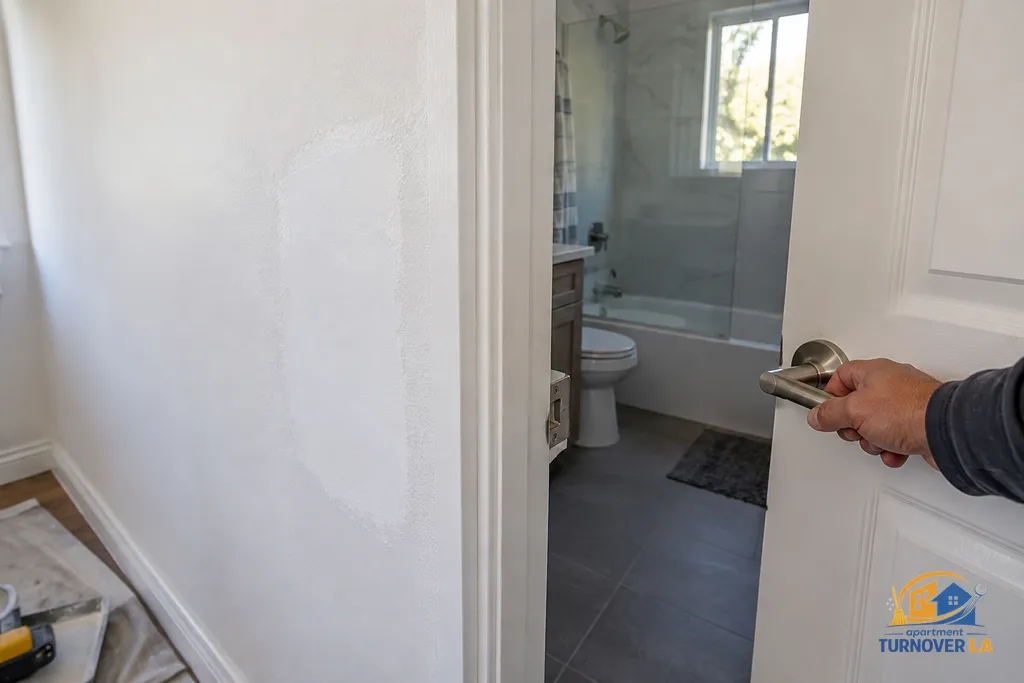
Drywall damage should be patched when it has lost material, has a raised edge, shows torn paper, or will telegraph through a fresh coat of paint. Painting over nail holes, anchor holes, dents, or peeled drywall paper may hide the issue briefly, but it often shows in listing photos and under side light during a showing. Texture matching also matters in older LA buildings, where a smooth patch in an orange-peel wall is easy to spot.
TurnOver LA lists a small drywall patch plus texture at $150 / patch and a medium drywall repair at $240 / patch. Once the surface is properly repaired, paint can be evaluated separately. Paint touch-up only is $200, while repainting per room is $395 / room. These are distinct line items, so the right choice depends on the wall condition and whether existing paint can be matched.
For repair examples and a better damage triage process, see drywall patching for LA rental apartments. Taking clear pre-work photos also helps distinguish tenant damage from ordinary aging under California's normal wear rules.
Can painters handle drywall repair in a rental apartment?
Painters can handle minor drywall prep and patching when it is part of the paint scope, but landlords should not assume every painter will assess the cause of peeling or perform a durable texture match. A wall patch, active leak, swollen drywall, failing bathroom ventilation, and mold concern are different conditions. They need different decisions before paint goes on.
For a turnover, combine the trades only when the repair is clearly cosmetic and dry. TurnOver LA can sand and repaint cabinets or shelving for $135, add ceilings and baseboard or trim work for $125, or repaint a room for $395 / room. Paint and other materials needed for the job are priced during the on-site inspection and require approval before billing.
If the issue is above a shower, inspect for moisture first. Peeling drywall above a shower can be caused by humidity, failed caulk, a ventilation problem, or a leak from above. Repairing the finish without addressing the cause can turn a small turnover item into a repeat visit.
Why does repair scheduling matter more than an hourly rate?
Repair scheduling matters because every delayed handoff can hold up cleaning, photos, showings, and move-in. In LA, vacancy loss commonly runs about $80-$200 per day depending on the submarket. A low initial minimum is not a savings if the vendor needs separate visits, cannot coordinate access, or leaves an unpainted patch that delays the listing.
A practical sequence is inspection, approval of needed materials, repair work, paint touch-up, final clean, then listing photos. TurnOver LA uses a flat 48-hour turnaround on every job, with no rush or same-day upcharge. For units needing a fuller reset, the Make Ready service includes a deep clean and a 12-point photo report, which gives the owner a documented final-condition check after turnover work.
Use the Los Angeles apartment turnover checklist to keep repairs from being missed between key return and listing launch. The checklist is especially useful when more than one person handles inspection, approvals, and leasing.
What should owners document before approving apartment repairs?
Owners should document the condition, the proposed work, the material decision, and the completed result. That record makes the repair easier to manage now and easier to explain later if there is a security-deposit question. It also prevents a crew from guessing whether a worn item should be repaired, replaced, or treated as normal wear.
Keep these items in the turnover file:
- Dated move-out photos and a room-by-room condition note.
- A written punch list with the location of each repair.
- Material options and owner approval for paint, parts, or fixtures.
- Before-and-after photos of damage that may be charged back.
- Invoices separated between cleaning, repair, replacement, and improvement.
The distinction matters. A repair needed to restore tenant-caused damage is not the same as an owner-selected upgrade. For deposit accounting, review normal wear and tear in California alongside the state's deposit rules. When the scope is clear, booking the work is straightforward. Get instant quote in 30 seconds