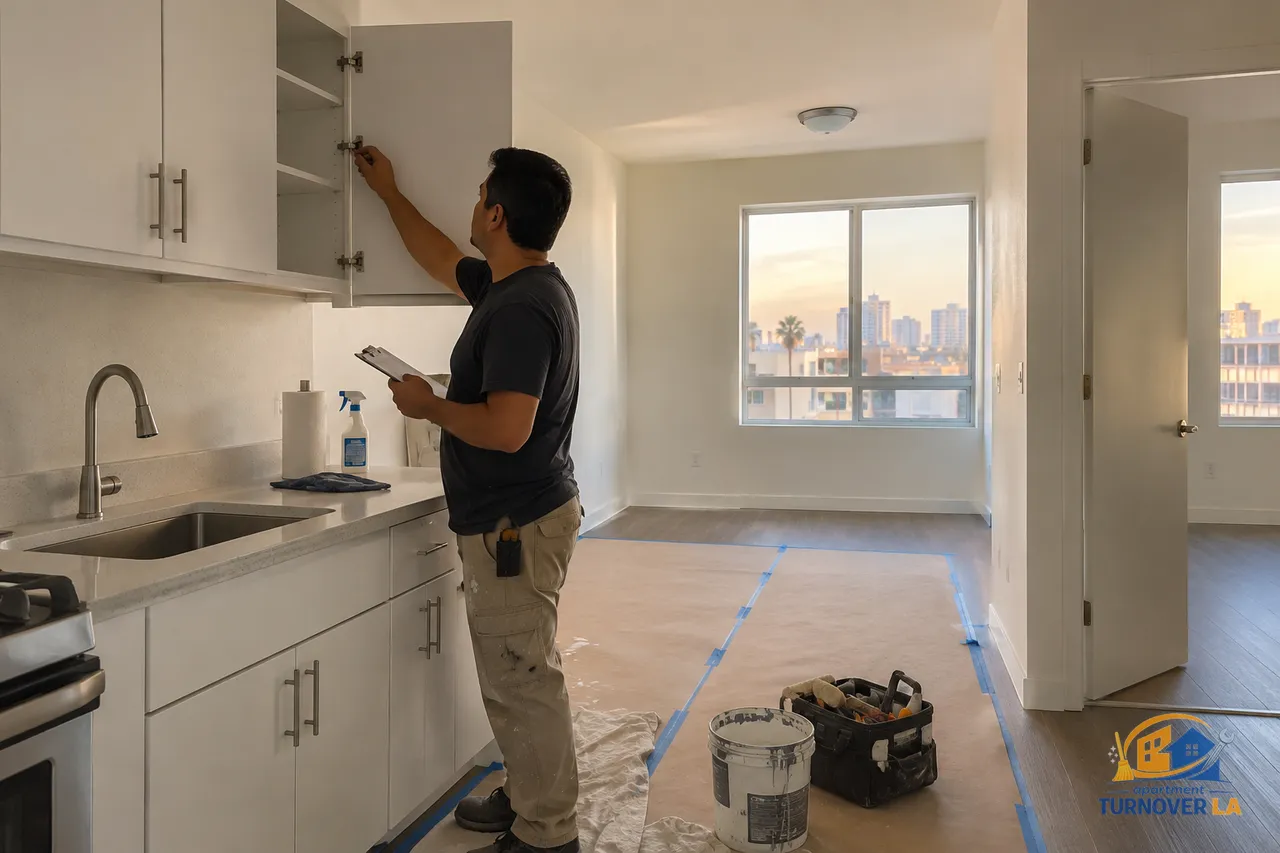
Quick answer: Reported pay for a make ready technician in Los Angeles averages $23.18 per hour, with a commonly reported range of $19.57 to $27.45 per hour. That wage pays a worker for preparing vacant units, not a flat tenant-turnover charge. A complete Make Ready scope combines cleaning, inspection documentation, and coordination of needed repairs.
A make ready technician salary in Los Angeles depends on whether the worker handles cleaning only, maintenance punch work, vendor coordination, or all three. The practical issue for an owner is not simply hourly pay, but whether the person can move a unit from returned keys to show-ready condition without missed items or repeat vendor trips. Get instant quote in 30 seconds
What does a make ready technician do in an apartment?
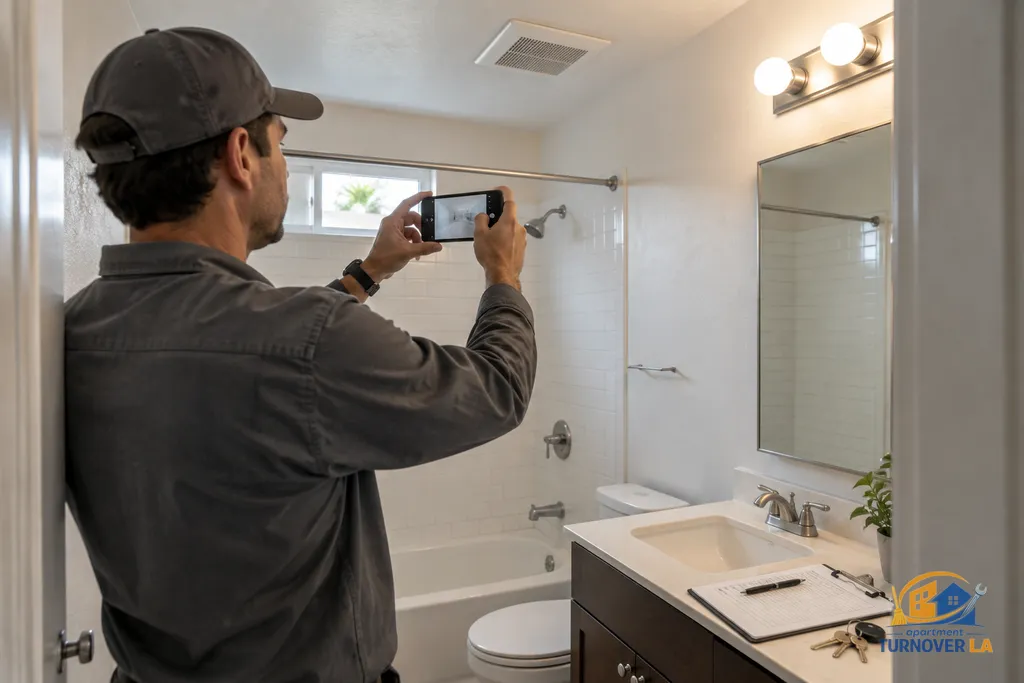
A make ready technician prepares a vacant apartment for the next resident. In a typical LA turnover, that means walking the unit after move-out, documenting visible conditions, cleaning or coordinating cleaning, identifying repair needs, checking basic safety items, and confirming the apartment is ready for leasing photos or showings. The job often crosses between housekeeping, maintenance, and quality control.
The exact scope changes by property. A small building may have one person replace filters, patch minor wall damage, remove abandoned items, and clean the refrigerator. At a larger community, the technician may only inspect, complete a limited punch list, and hand specialized work to painters, cleaners, or licensed trades. The useful definition is outcome based: the unit is returned to a consistent, rentable baseline. For a fuller breakdown of that baseline, see what make ready means for rentals.
This is different from a resident maintenance request. A request concerns an occupied unit and a specific reported problem. Make ready is a vacancy workflow, with a fixed sequence and a final readiness check.
What is the average make ready technician salary in Los Angeles?
The reported Los Angeles average is $23.18 per hour, with reported pay ranging from $19.57 to $27.45 per hour. That range is a useful hiring benchmark, but it is not a complete labor budget. Employers also carry payroll taxes, workers' compensation, travel time between properties, tools, supervision, and paid time spent sourcing parts or waiting for access.
A technician near the lower end may be assigned mostly cleaning support and simple inspections. Higher pay is more common when the role includes skilled patching, paint matching, appliance diagnostics, lock work, resident-facing coordination, or responsibility for a large portfolio. In Sherman Oaks, for example, reported technician pay can differ from central LA because a worker's route, parking time, building type, and maintenance expectations all affect the job.
For a manager comparing applicants, ask what work the hourly rate actually covers. A worker who can identify a medium drywall repair before a painter arrives may prevent a day of delay. A worker who only reports damage still has value, but the vendor coordination burden stays with the manager.
Why is technician pay different from a make ready charge?
An hourly wage pays for a person's time. A make ready charge pays for a defined result, often including crew labor, cleaning supplies, inspection documentation, dispatching, and completion coordination. Treating the two as interchangeable is how managers underprice turns or hire a technician for work that requires a separate trade.
For context, the LA labor market reports $19.57 to $27.45 per hour for make ready technicians. TurnOver LA instead uses fixed unit pricing for its Make Ready service: $225 for a studio, $255 for a 1 Bedroom, $335 for a 2 Bedroom, and $425 for a 3BR or larger. Each package includes a deep clean and 12-point photo report, with a 48-hour turnaround.
That distinction matters when budgeting. The package is not a promise that every damaged unit needs no other work. Paint, parts, fixtures, and repairs are identified at the on-site inspection, added to the final invoice only with approval. It gives the owner a defined clean-and-document baseline while leaving visible damage and replacement decisions separate.
How much should a landlord charge for apartment make ready?
A landlord should not automatically pass a full make ready invoice to the departing resident. The correct charge depends on documented tenant-caused damage, actual cleaning needed beyond ordinary use, the lease, and California deposit rules. The cost of returning a unit to normal rental condition is often an ownership expense, especially when the work addresses ordinary aging or a manager's preferred leasing standard.
Start with evidence, not a standard fee. Keep move-in photos, a signed condition record, move-out photos, invoices, and notes tying a specific charge to a specific condition. Review California Civil Code §1950.5 before making deductions. It governs permissible security-deposit uses and documentation requirements. Our guide to normal wear and tear in California is also useful when evaluating scuffs, worn finishes, and cleaning.
Do not use a technician's hourly wage as a shortcut for a deposit deduction. If a wall needs paint solely because of normal turnover, that does not become tenant damage because the technician spent time in the unit. California's deposit limits also changed under AB 12 (2023) security deposit cap, so keeping a precise, supportable file matters.
Need the walls done before you re-list?
Turnover painting, scuff removal and patching, with a photo record of the condition we left behind.
$395 per room · 48-hour turnaround
Get an instant quoteWhich tasks belong with the technician, and which need a vendor?
A good turnover workflow separates quick, repeatable tasks from work that needs a specialized scope or extra authorization. That keeps a technician's time focused on inspection, coordination, and small punch items instead of turning one vacancy into a collection of unfinished side jobs.
- Walk the vacant unit and photograph each room before work begins.
- Remove obvious trash, check appliances, test basic fixtures, and note access issues.
- Complete routine cleaning and identify damage that changes the scope.
- Assign wall repairs and paint work when the condition exceeds a small touch-up.
- Rekey or replace locks after possession is confirmed.
- Complete a final room-by-room inspection and retain photos for the property file.
For example, TurnOver LA lists a $125 general maintenance or safety visit, a $230 half-day handyman punch list, and a $425 full-day handyman punch list through its repair and maintenance team. Paint work is separately scoped through painting and drywall service, including a $150 small drywall patch plus texture or $200 paint touch-up only. Those line items help avoid asking one hourly employee to perform work outside their tools, training, or allotted time.
Get instant quote in 30 seconds
How do LA rent rules affect a make ready workflow?
Los Angeles turnover work is operationally simple only when the unit's rent rules have already been checked. The cleaning and repair sequence may look the same in a Hollywood duplex or a Koreatown fourplex, but the leasing decision after the work is complete can be subject to different local or state requirements. Make ready staff should not make rent or tenancy determinations from a maintenance checklist.
For units covered by local rules, managers should review the LAHD Rent Stabilization Ordinance and preserve records separately from the physical turnover file. The technician's job is to document condition, access, completed work, and safety concerns. The manager's job is to apply the correct rent, notice, deposit, and re-rental rules.
This separation prevents a common failure: a unit is spotless, keys are changed, and photos are ready, but the file lacks the invoices and move-out documentation needed for a deposit accounting. Use a repeatable process such as this apartment turnover checklist, then keep the accounting and regulatory review with the authorized manager or owner.
What makes a make ready technician more valuable to a property manager?
The strongest technicians reduce uncertainty. They do not merely say that a unit is “done.” They flag a failing smoke detector, photograph a stained carpet edge, identify a cabinet door that needs adjustment, and make clear which item needs owner approval. That documentation lets the manager decide quickly rather than discover problems during a showing.
Speed has a real value in Los Angeles. Vacancy loss commonly runs $80 to $200 per day depending on submarket, so a one-day delay can cost more than a small repair that was caught and approved early. The technician does not need to perform every trade task to protect that revenue. They need to produce reliable information and close the loop after work is finished.
For managers with multiple vendors, the best operational standard is one final report that shows the unit condition after cleaning and the status of each open item. A Make Ready package's 12-point photo report is useful because it gives leasing staff a shared record rather than relying on a verbal handoff. It also helps distinguish a completed turnover from a unit that only looks clean at first glance.
Should you hire an employee or use a make ready service?
An in-house technician makes sense when there is enough steady vacancy and maintenance volume to keep the role productive across the week. The employee can learn building quirks, maintain keys, and respond quickly to recurring issues. The tradeoff is that the manager must provide scheduling, supplies, insurance, supervision, backup coverage, and a plan for specialized repairs.
A service is often more practical for scattered units, small portfolios, or periods of concentrated move-outs. TurnOver LA's Make Ready scope pairs the deep clean with a 12-point photo report and a 48-hour turnaround. If a unit needs debris removal, lock work, painting, or repair beyond the package, those needs can be scoped after inspection and approved before materials are added.
The deciding question is not whether an employee's hourly wage appears lower than a service invoice. It is whether the workflow gets the apartment rent-ready with fewer handoffs, complete documentation, and no avoidable vacancy days. Compare the full operating cost, not just the first hourly number.
Get instant quote in 30 seconds
The practical takeaway for LA owners and managers
A make ready technician in Los Angeles earns about $23.18 per hour in reported local salary data, but that number is only one part of a turnover budget. The role is most useful when it combines a disciplined inspection process with clear boundaries around work that needs a cleaner, painter, handyman, locksmith, or owner approval.
Use employee wages to evaluate hiring. Use a defined vendor scope to budget a vacancy. Keep tenant deductions tied to documented damage and actual lawful charges, not a generic turnover fee. Then measure the process by its real outcome: how quickly a unit is clean, documented, safe, and ready for the next leasing step. Get instant quote in 30 seconds