Quick answer: You can paint your apartment without risking your deposit if you get written landlord approval, match the approved color and finish, protect the unit, and return altered walls to the agreed condition. In LA rentals, photograph the original condition before work and keep the approval, paint label, and final photos together. For professional touch-ups, TurnOver LA charges $200, with a 48-hour turnaround.
You can paint a rented apartment, but a verbal okay and a close-looking color are not enough when the lease ends. Treat the job as a reversible alteration: document the starting condition, get the scope in writing, and make the finish consistent before the final walk-through. Get instant quote in 30 seconds
Can I paint my apartment if I am a renter?
Usually, yes, if your lease and landlord allow it. Start with the lease's alteration, decorating, and move-out provisions. Some leases prohibit painting without consent, while others allow neutral colors but require the tenant to repaint before surrendering the unit. Ask for approval by email and include the room, proposed color, sheen, who will do the work, and whether repainting to the original color will be required.
Do not assume that a fresh coat automatically counts as an improvement the owner wants to keep. A dark feature wall, highly glossy finish, or color that does not match neighboring surfaces can create a restoration issue. Under California Civil Code §1950.5, a deposit deduction generally cannot cover ordinary wear and tear, but a tenant-caused alteration is a separate question. Keep before photos, written approval, and receipts in one folder. They are more useful at move-out than a memory of what was discussed.
What approval should I get before buying paint?
Get an email that answers four points: the approved color, the approved sheen, the rooms included, and the move-out expectation. If the owner supplies a paint name or partial can, photograph the manufacturer label, color code, sheen, and batch information. Ask whether the unit has flat, eggshell, satin, or another finish, because a correct color with the wrong sheen can flash under window light.
For LA rent-stabilized units, local rules do not replace the lease's painting terms. The LAHD Rent Stabilization Ordinance is important for many tenancy issues, but it is not blanket permission to alter walls. A useful operational rule is this: do not start work until the approval states whether the owner wants the walls returned to the original condition. That one sentence can prevent a repaint scramble after keys are due.
Which paint and finish should I use in a rental?
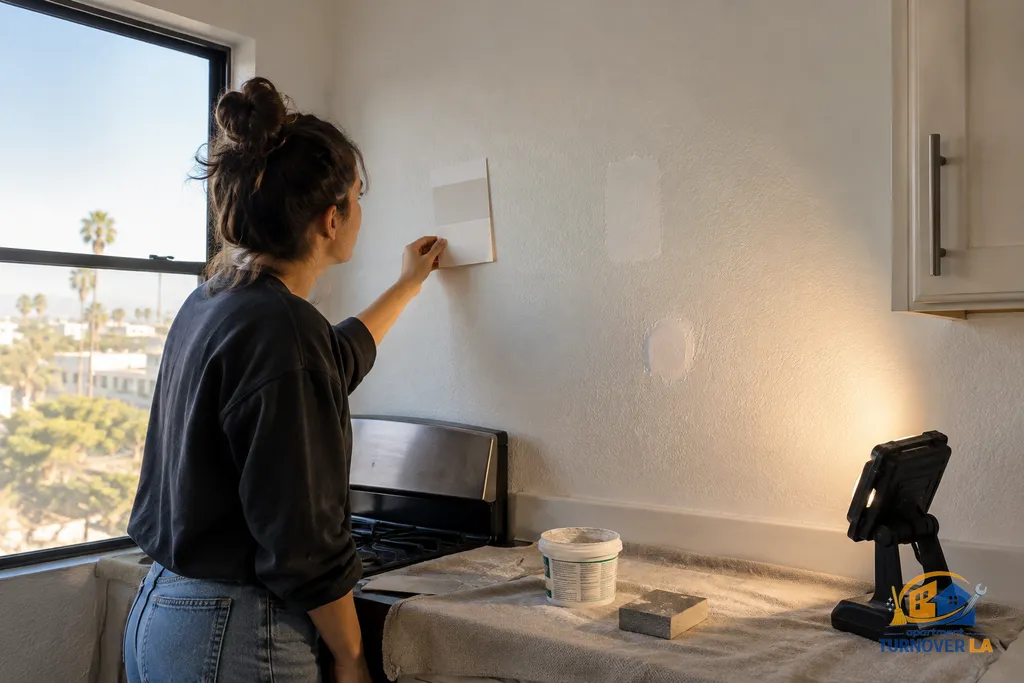
Use the exact existing paint when it is available. If it is not, take a small removable sample or ask the property manager for the prior turnover records, then have a paint store color match it. Test the match in a small, low-visibility area and let it dry fully. Wet paint nearly always looks different from cured paint, particularly on beige, gray, and off-white walls common in LA apartments.
For a practical match, consider these five checks before opening a full gallon:
- Compare the dried sample in daylight and at night with lights on.
- Match sheen before matching color, because sheen changes how a wall reflects light.
- Check wall texture, especially orange peel and older plaster repairs.
- Confirm whether the ceiling is a separate flat white.
- Save the label and a small sealed amount of leftover paint for touch-ups.
Paint one full wall from corner to corner if color matching is uncertain. A spot repair in the middle of a sunlit wall can show even when the color code is correct.
How do I prepare an apartment wall for paint?
Preparation determines whether the result looks like maintenance or a rushed move-out fix. First remove nails, anchors, and adhesive hardware. Clean the wall with a mild cleaner, especially around switches, cooking areas, and headboard locations. Let it dry. Then fill holes in thin applications, sand smooth, and wipe dust away before priming bare patches.
Protect more than the floor. Remove outlet covers after switching off power where appropriate, tape trim carefully, cover counters and appliances, and move furniture away from the work zone. Do not paint over greasy kitchen residue, smoke film, loose drywall paper, or crumbling caulk. Those conditions cause poor adhesion and leave a visibly different surface later.
Small damage is often the point where a paint job becomes a repair job. TurnOver LA lists a small drywall patch plus texture at $150 per patch and a medium drywall repair at $240 per patch. For the underlying sequence, see our guide to drywall patching in LA rental apartments before applying primer or finish paint.
Need the walls done before you re-list?
Turnover painting, scuff removal and patching, with a photo record of the condition we left behind.
$395 per room · 48-hour turnaround
Get an instant quoteWhat is the right order for painting an apartment?
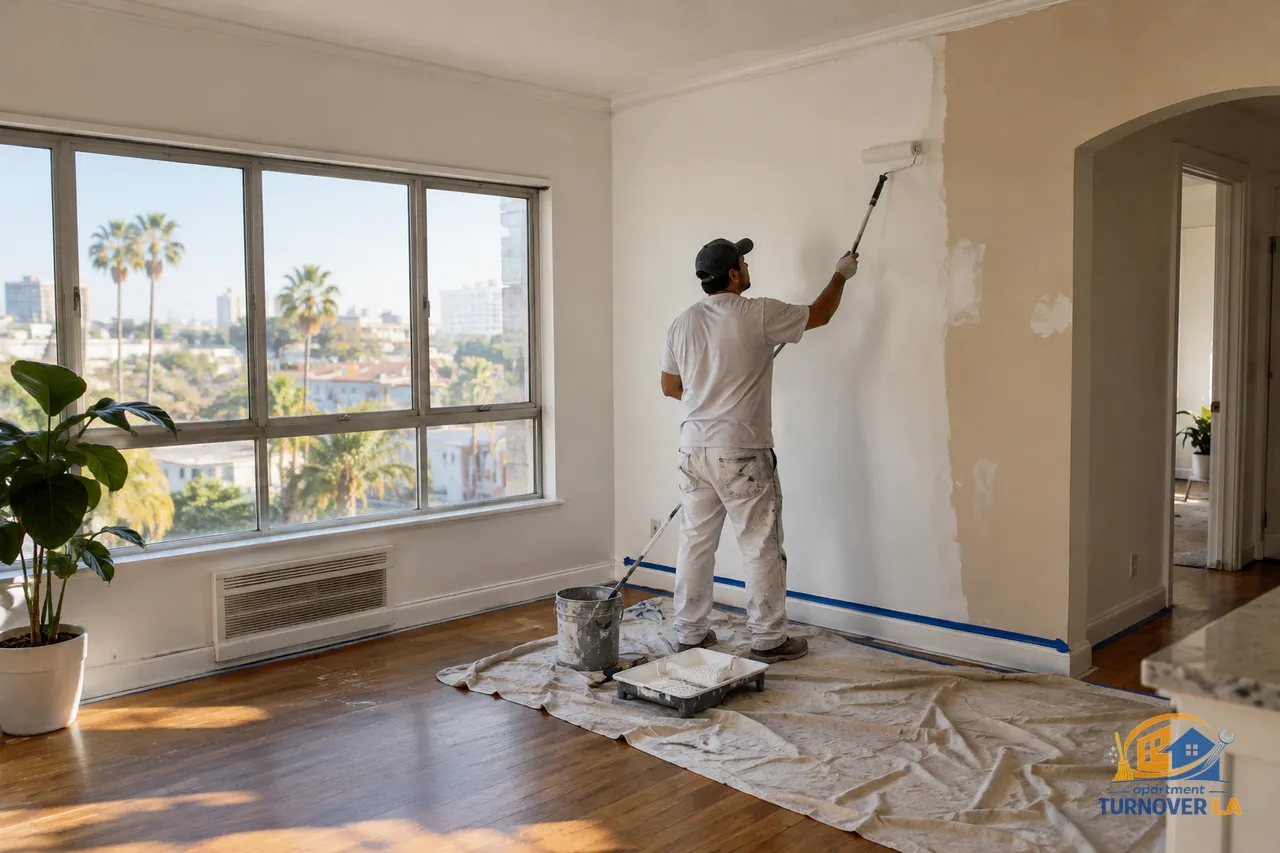
Work from the cleanest, highest surfaces toward the floor, and finish each wall while the edge remains wet. Cut in a narrow line at the ceiling, trim, corners, and outlets first, then roll the larger field in overlapping vertical passes. Keep enough paint on the roller to avoid dry bands, but do not overload it. Two thin coats usually look more even than one heavy coat.
Paint the ceiling before walls if both need work. Paint trim after walls when the trim color is distinct, allowing wall paint to cure as directed before taping it. Pull painter's tape slowly while the final coat is still slightly tacky, rather than waiting until it fully hardens and risks tearing.
Between coats, inspect from several angles. In a west-facing LA unit, late afternoon light exposes roller marks and missed repairs that are invisible under a ceiling fixture. Use that light as a quality check. The final pass should include door edges, switch plates, baseboards, window returns, and any area behind where furniture sat.
How much does it cost to paint a 500 sq ft apartment in LA?
Across LA, a painter's quote for limited wall work in a roughly 500 square foot apartment commonly falls around $300 to $800, depending on the number of rooms, wall condition, color change, ceiling height, and whether patching is needed. That is a general market reference, not a TurnOver LA price. With TurnOver LA, paint touch-up only is a flat $200, while repainting is $395 per room, each with a 48-hour turnaround.
Use the scope, not just square footage, to compare quotes. A 500 square foot studio with one scuffed wall is different from a 500 square foot one-bedroom needing a living room, bedroom, trim, and patched anchors. Here is the applicable TurnOver LA rate menu:
| Scope | TurnOver LA price | | | --- | | Paint touch-up only | $200 | | Repainting per room | $395 / room | | Ceilings and baseboard/trim | $125 | | Sand + repaint cabinets/shelving | $135 | | Small drywall patch + texture | $150 / patch |
The quote covers labor and the crew's own supplies. Paint, parts, and fixtures are priced during the on-site inspection and added to the final invoice only with your approval. Get instant quote in 30 seconds
When should I hire a painter instead of doing it myself?
Hire help when the job involves a whole-room color change, a visible texture match, water staining, many wall repairs, high ceilings, or a fixed move-out deadline. DIY can work for one clean, small wall when you have approval, a reliable color match, enough drying time, and a place to protect furniture. It becomes risky when a renter tries to cover damage with paint rather than repair the substrate.
A professional scope also helps when several turnover tasks are connected. A repaired anchor hole must be filled, textured, primed, and painted with a blended edge. That is why the painting crew and repair crew need to see the same wall. TurnOver LA can handle apartment painting and drywall work and related maintenance punch-list repairs under one turnover schedule.
If your concern is whether scuffs or faded paint should be charged to you at all, review normal wear and tear in California. Do not repaint simply because a unit looks lived in. First separate normal aging from actual tenant damage.
How do I finish the job and protect my deposit?
Before putting furniture back, walk the apartment slowly in daylight and with interior lights on. Look for missed cut lines, paint on hardware, roller marks, drips, and sheen changes around repairs. Remove tape, reinstall covers, clean every surface you touched, and save the paint information. Take wide room photos and close-ups of repaired areas after the work is complete.
At move-out, compare those images against your original move-in photos and the landlord's approval. California's deposit rules also set deadlines and documentation requirements for security-deposit accounting. The California DCA Landlord-Tenant Guide is a useful starting point, and our guide to the California 21-day deposit return rule covers the turnover timing in plain language.
A clean repaint is only one part of leaving a unit rent-ready. Finish with a documented clean, repair any remaining holes before the final photos, and avoid last-minute color guessing. Get instant quote in 30 seconds