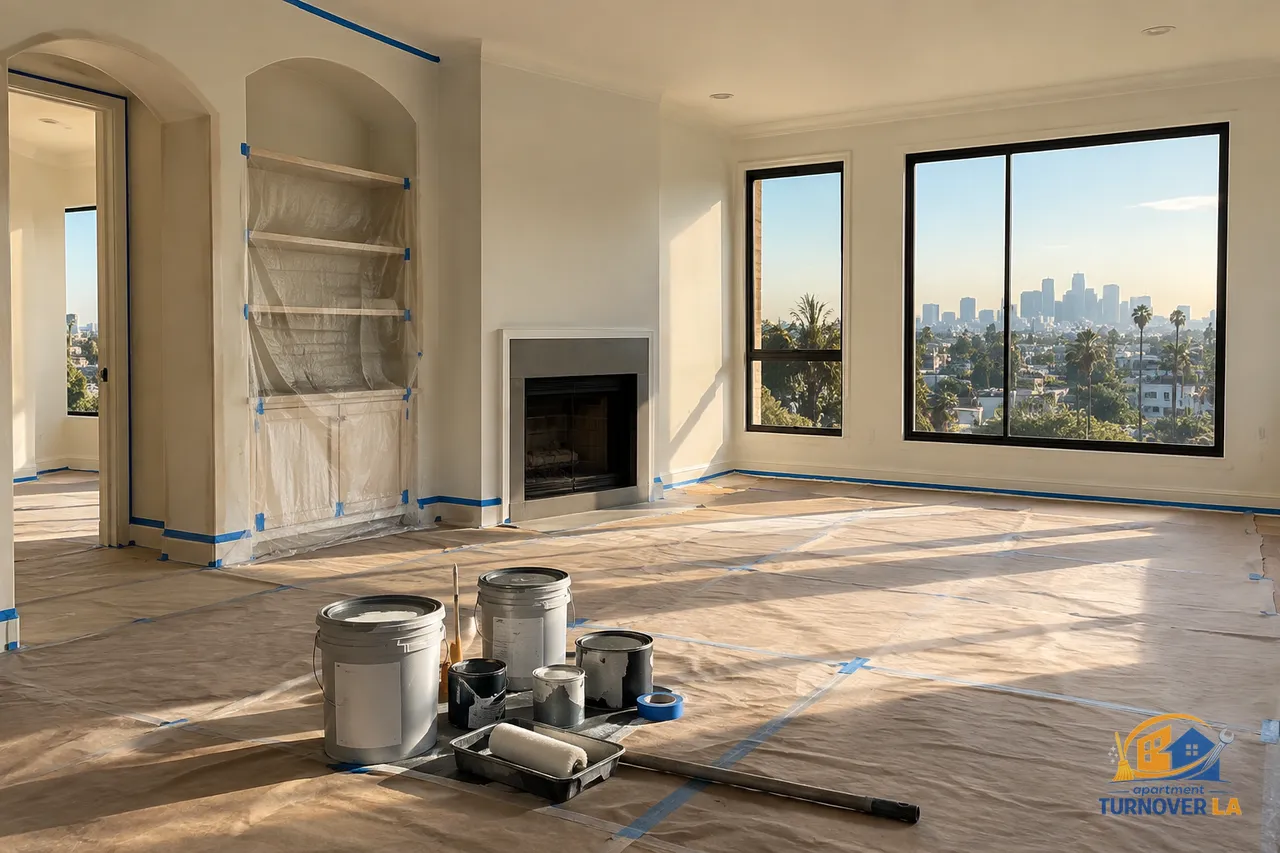
Quick answer: Luxury apartment painting in Los Angeles generally costs about $350 to $700 per room in the local market, depending on prep, ceiling height, trim, and paint specification. TurnOver LA charges $395 / room for repainting, or $200 for paint touch-up only, with a 48-hour turnaround. Paint, parts, and fixtures are inspected and approved before they are added to the final invoice.
Luxury apartment painting is a scope-control job, not just a color change. A clean repaint can protect the next showing, while a rushed coat over scuffs, anchors, and drywall damage can make an otherwise high-end unit look unfinished. Get instant quote in 30 seconds
What does luxury apartment painting cost in Los Angeles?
For planning purposes, the general LA market commonly lands around $350 to $700 per room for an interior repaint, with larger rooms, extensive prep, high ceilings, detailed trim, and occupied-unit constraints pushing the cost higher. TurnOver LA's rate is $395 / room for repainting per room, a useful fixed labor baseline for a turnover scope.
For a unit that only needs isolated scuff coverage and color matching, the broader market can range roughly from $150 to $350. TurnOver LA charges $200 for paint touch-up only. That distinction matters: touch-up work is not a substitute for repainting a room with broad fading, sheen differences, nicotine staining, or a patchwork of prior colors.
The quoted labor includes the crew's own supplies. Paint, replacement parts, and fixtures needed for the job are priced at the on-site inspection and added to the final invoice only with owner approval. A premium finish starts with approving the exact scope, sheen, and materials before work begins.
What makes a luxury-unit paint scope different?
Luxury is not a separate paint category under California law, but it changes the acceptable finish standard. In a well-positioned LA rental, renters notice roller marks at window light, flashing around repairs, paint on hardware, and mismatched white tones long before they notice the brand printed on the can.
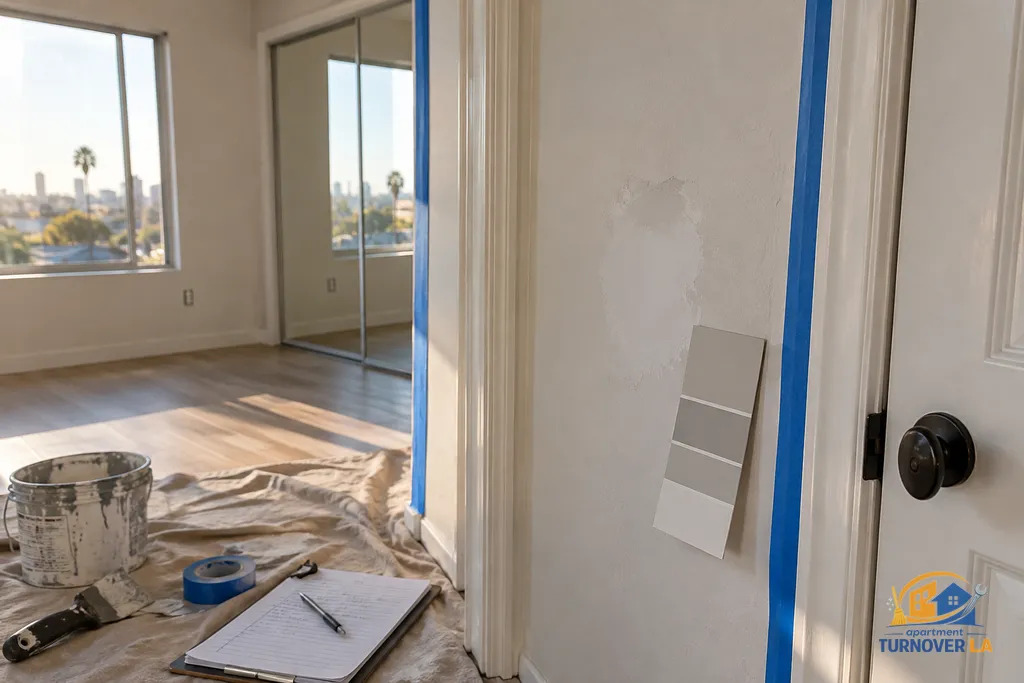
The operational difference is preparation. The crew should identify nail holes, door strikes, furniture rubs, loose caulk, wall anchors, pet scratches, cabinet wear, and prior patch repairs before deciding whether a room needs touch-up or a full repaint. Clean cut lines at ceiling, trim, tile, and built-ins matter most in bright rooms with large windows.
It also helps to record the paint name, sheen, and location of prior touch-up cans in the unit file. That simple record can prevent a near-match repair from drying darker than the surrounding wall. A luxury turnover should look consistent from the entry, not merely clean from six feet away.
Should you choose touch-up work or repaint the room?
Choose touch-up work when the existing coating is sound, the original paint can be accurately matched, and defects are limited to a few localized marks. TurnOver LA's $200 paint touch-up only option is built for that controlled situation. It is often the right call after a short tenancy with a documented paint record.
Repaint the full room when the wall has multiple repair zones, uneven sheen, visible sun fade, smoke residue, bold tenant colors, or extensive scuffing. TurnOver LA charges $395 / room for repainting per room. If ceilings or baseboard and trim need attention, the catalog rate is $125 for ceilings and baseboard/trim.
Do not ask a painter to hide a damaged substrate with another coat. A small drywall patch plus texture is $150 / patch, while a medium drywall repair is $240 / patch. Repair first, allow the work to set properly, then prime and paint for a result that holds up at the showing.
For a closer breakdown of repair decisions, see this guide to drywall patching in LA rental apartments and TurnOver LA's painting and drywall turnover service.
How should a landlord sequence painting during a turnover?
The correct sequence reduces repeat trips, keeps dust out of final cleaning, and avoids painting around work that should have happened first. A practical luxury turnover sequence is:
- Photograph the unit at possession and identify chargeable damage separately from normal wear.
- Remove remaining items and complete repairs that open walls, move appliances, or create dust.
- Confirm paint colors, sheen, rooms, trim, ceilings, and approved material allowance at the inspection.
- Patch, sand, prep, prime where needed, and paint before final cleaning.
- Deep clean the unit, complete the final photo report, and check every room in showing light.
This order is particularly important in units with newly repaired drywall. Painting before a handyman closes holes or adjusts hardware creates duplicate prep and can leave a visible mismatch. Pair painting with turnover repair support, then follow with a Make Ready deep clean and 12-point photo report.
A vacancy costs many LA owners about $80 to $200 per day, depending on the submarket. The 48-hour turnaround is designed to keep the paint scope moving without a rush or same-day upcharge. Get instant quote in 30 seconds
Need the walls done before you re-list?
Turnover painting, scuff removal and patching, with a photo record of the condition we left behind.
$395 per room · 48-hour turnaround
Get an instant quoteWhat should you document before charging a tenant for paint?
Document condition, not assumptions. California security-deposit deductions must be reasonably necessary, and the governing standard appears in California Civil Code §1950.5. Take dated, wide and close photos at move-out, retain the prior move-in condition record, and keep the paint invoice tied to the damaged area.
Ordinary aging, light scuffs, and gradual fading can be normal wear rather than tenant-caused damage. Large unauthorized paint changes, excessive holes, gouges, or damage beyond ordinary use may be different, but facts and documentation control the outcome. See normal wear and tear in California before treating a repaint as a tenant charge.
For California deposit accounting timelines and itemization requirements, use the California DCA Landlord-Tenant Guide alongside your records. A turnover vendor's before-and-after photos are useful operational evidence, but they do not replace a landlord's duty to apply the law correctly.
How often does a landlord need to repaint an apartment?
There is no simple statewide rule that requires a landlord to repaint every fixed number of years. The practical trigger is condition: repaint when the unit no longer presents as clean, habitable, or market-ready, or when damage and fading make spot work visibly inadequate. In a luxury rental, owners commonly evaluate paint at every vacancy because a few visible defects can affect leasing photos and tours.
For properties covered by the LAHD Rent Stabilization Ordinance, keep turnover records organized and separate maintenance work from any claimed tenant damage. Local rent rules can affect the broader tenancy relationship, while state deposit rules determine how deductions must be handled.
A useful operating rule is to retain paint records by room. Note color, sheen, last full repaint date, repairs, and tenant-caused damage. That creates a defensible maintenance history and prevents the leasing team from approving a full repaint simply because no one can identify the existing paint.
Is $25 an hour expensive for apartment painting?
An hourly number alone does not tell an owner whether painting is expensive. It leaves open how many workers are coming, what prep is included, whether ceilings and trim are included, how repairs are priced, and whether paint materials are included. A low hourly rate can cost more if the crew returns repeatedly or skips preparation.
For a vacancy, compare a defined room scope and completion standard instead. Across LA, a repaint commonly runs $350 to $700 per room in the general market. TurnOver LA lists $395 / room for repainting per room, with separate catalog pricing when the scope includes $125 for ceilings and baseboard/trim or drywall repairs.
That makes the approval conversation clearer: specify each room, the surfaces included, the repair count, and the selected paint. Labor and crew supplies are covered in the quote, while paint and other required materials are approved at inspection before they appear on the final invoice.
How do painting, cleaning, and listing photos work together?
Painting should be complete before final cleaning and before listing media. Freshly painted walls make the deep clean more visible, but only if floors, fixtures, switches, and cabinet faces are cleaned after paint work. For a standard unit reset, TurnOver LA's Make Ready package is $225 for a studio, $255 for a 1 Bedroom, $335 for a 2 Bedroom, and $425 for a 3BR or larger. Each includes a deep clean and 12-point photo report.
Do not schedule listing photos while patches are drying or painter's tape is still on the trim. Once the unit is clean and staged only with permanent fixtures, the TLA Launch Pad Media Package is $399. Good listing media is most effective when it records the finished unit, rather than trying to distract from an incomplete turn.
Use the apartment turnover checklist to coordinate the handoffs. If the apartment needs a refresh before it can be marketed, approve the paint scope first, then clean, inspect, and release it for media and showings.
Get a defined painting scope before the unit sits vacant
The fastest way to lose control of a luxury turnover is to approve vague work such as “touch up as needed.” Define rooms, repairs, ceilings, trim, sheen, materials, and the final condition expected at inspection. That keeps a $200 localized touch-up from being mistaken for a full-room repaint, and it makes the owner approval step straightforward.
TurnOver LA can coordinate paint, drywall, repairs, cleaning, and final documentation under a 48-hour turnaround. Start with the condition of the unit, select only the scopes it needs, and approve any paint or other materials after the on-site inspection. Get instant quote in 30 seconds