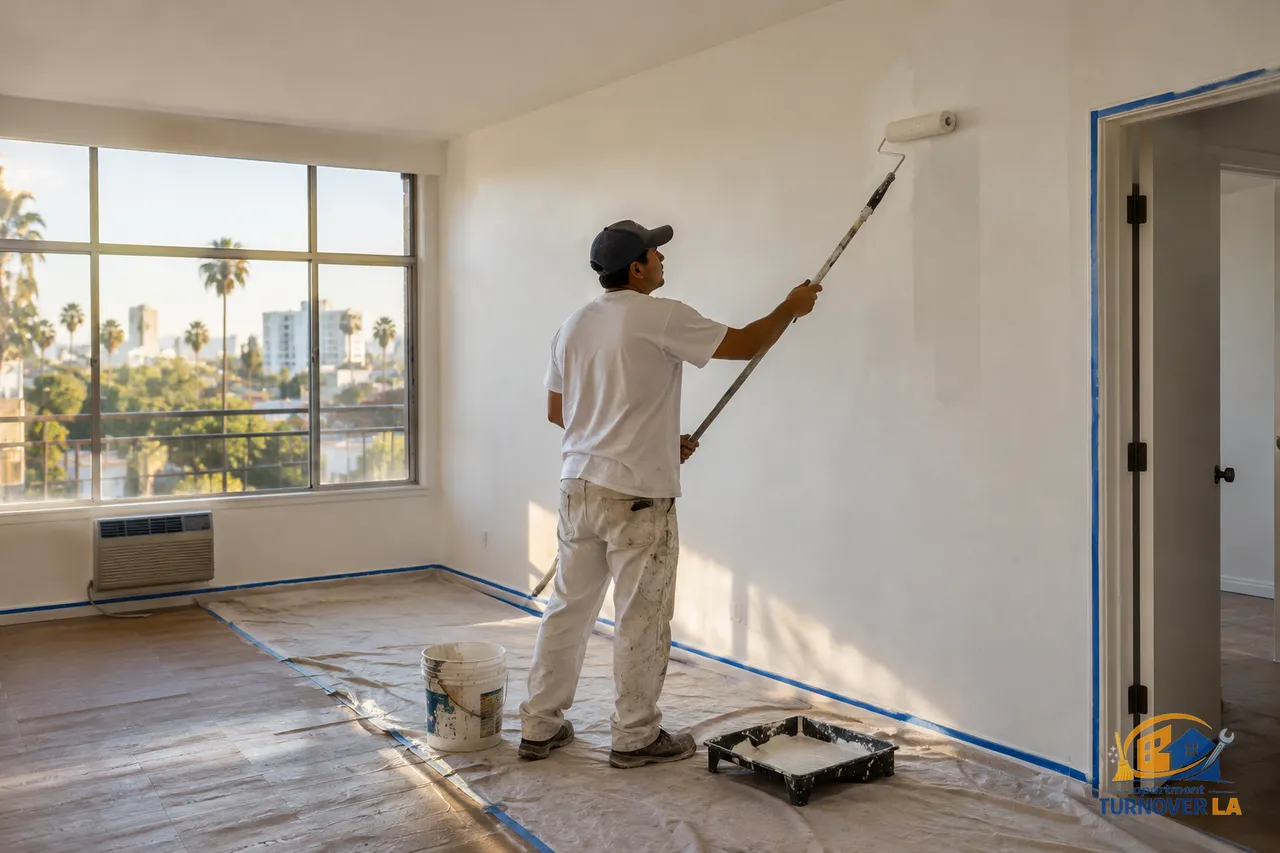
Quick answer: To paint an apartment properly, get written approval, document the starting condition, patch and sand defects, then paint ceilings, trim, and walls in that order. In LA, a standard room repaint commonly runs about $300 to $800 in the general market. TurnOver LA charges $395 / room for repainting, with labor and crew supplies included and a 48-hour turnaround.
Painting an apartment is mostly a preparation and permission job, not a rolling job. A clean finish depends on matching the lease requirements, protecting floors and fixtures, and catching flaws after the paint dries. Get instant quote in 30 seconds
Can you paint an apartment without asking the landlord?
Usually, no. A tenant should treat paint as an alteration unless the lease, building rules, or written owner approval says otherwise. Even when a landlord verbally says a color is fine, send a short email confirming the color, sheen, rooms, whether the work must be restored at move out, and who pays for restoration. That record matters if the security deposit is later disputed.
For a landlord or manager, give the resident an approved color name and finish rather than saying "neutral." Neutral is subjective, and mismatched sheen is one of the most visible failed touch-ups in a rental. Check whether the building has a stored paint formula or a prior turnover photo set. California deposit rules are governed by California Civil Code §1950.5, but a documented approval and condition record can prevent the disagreement in the first place. For a broader condition standard, review normal wear and tear in California.
What do you need before painting an apartment?
Start with an approval record, a room-by-room condition log, and enough time for cleaning, drying, painting, and inspection. The basic kit includes drop cloths, painter tape, a filler knife, patch compound, sanding sponges, caulk, angled sash brush, roller frame, roller covers, extension pole, tray, screwdriver, and a bright portable work light. Buy the paint only after verifying the required color and sheen.
Do not estimate paint from floor area alone. Wall height, closets, alcoves, patched areas, and dark-to-light color changes affect coverage. In occupied units, label every removed switch plate, vent cover, curtain bracket, and blind part in a cup or bag by room. That small hardware log avoids a common turnover delay: a freshly painted room with missing cover plates or mismatched screws.
If the walls have scuffs rather than broad color failure, first determine whether washing or a targeted repair will solve it. This guide to apartment wall scuff removal helps separate cleaning work from repainting work.
How do you prepare the walls for paint?
Clean first, patch second, sand third, and mask last. Paint locks in dust, grease, smoke residue, and adhesive shadows, so wipe walls where hands commonly touch, especially around switches, doors, kitchen edges, and thermostat areas. Let the wall dry before applying patch material or paint.
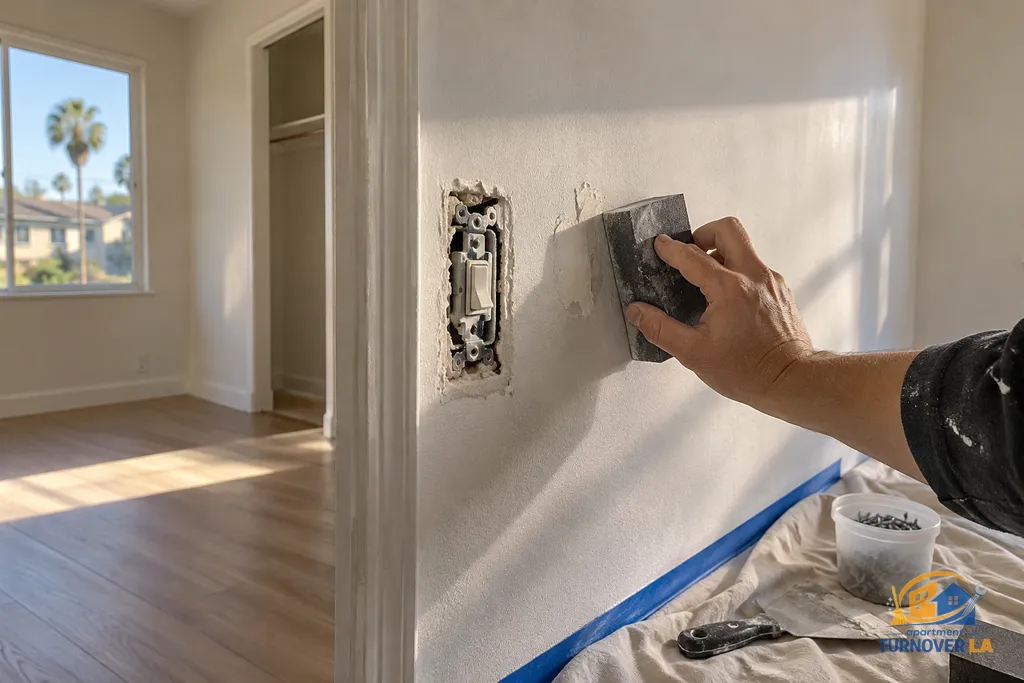
Scrape loose paint, fill nail holes and dents, and let patch compound dry completely. Sand the repair until its edge disappears into the surrounding wall, then remove the sanding dust with a vacuum or damp microfiber cloth. Prime bare drywall, water stains that have been properly corrected, and any repair that flashes differently from the surrounding paint. A patch that looks smooth before paint can still show as a dull circle after paint if it was not primed.
In rentals, inspect the wall under side light, not only overhead light. Place a work light low and aim it across the wall. It exposes ridges, missed sanding, roller lap marks, and texture mismatches before the final walkthrough. For larger holes, loose tape, or texture matching, use a painting and drywall service instead of applying more paint over the defect.
What is the correct order for painting a room?
Paint from the top down: ceiling first, then trim and baseboards, then walls. This sequence lets you correct drips without damaging a finished wall surface. Remove or protect outlet covers, mask the floor edge, and cut in a manageable section before rolling, keeping a wet edge so one band does not dry before the next overlaps.
A practical room sequence is:
- Cover floors and remove switch plates, vent covers, and movable hardware.
- Clean, patch, sand, dust, and prime repairs.
- Cut in and roll the ceiling, if it is being painted.
- Paint doors, trim, and baseboards, allowing adequate dry time.
- Cut in the wall edges with an angled brush.
- Roll the walls in sections, working from dry edge to wet edge.
- Apply a second coat where coverage, color change, or the label requires it.
- Reinstall hardware only after the paint is dry enough not to stick.
Do not load a roller until it drips. A properly loaded roller is coated evenly but not dripping, which reduces splatter on rental flooring and window tracks. Keep one person cutting in and one person rolling only when both can maintain the same wet edge.
Need the walls done before you re-list?
Turnover painting, scuff removal and patching, with a photo record of the condition we left behind.
$395 per room · 48-hour turnaround
Get an instant quoteHow do you avoid visible touch-ups and color mismatch?
Use the same paint product, color formula, finish, and application method across the repair area. Even a correct color can look wrong if the old wall is eggshell and the touch-up is satin, or if a brush stroke is applied in the middle of a roller texture. For a small repair, feather paint from the patched area outward and roll the final pass in the same direction as the original finish.
Before opening a new can, stir it thoroughly and test a small area in daylight. Do not trust a paint chip, a photo, or a tenant's memory of "off white." Sunlight in a west-facing LA unit can make a warm white look yellow, while a shaded hallway can make the same color look gray. If a unit has been repainted several times, a full wall or full room often looks more consistent than chasing a tiny touch-up.
Take photos before masking and again after the final dry inspection. A before-and-after set shows whether a mark was pre-existing, whether a repair was completed, and whether trim or flooring was protected. That is more useful at deposit accounting time than a vague note saying "walls painted."
What is a fair price to paint one apartment room?
Across LA, a standard room repaint often falls in the general market range of $300 to $800, depending on wall condition, ceiling height, color change, furniture, trim, and needed drywall work. TurnOver LA charges $395 / room for repainting, with a 48-hour turnaround. The quote covers labor and the crew's own supplies. Paint, parts, or fixtures needed for the job are priced at the on-site inspection and added to the final invoice only with your approval.
Ask any painter whether the quote includes patching, prep, primer, trim, ceiling work, furniture moving, and cleanup. A low room price can exclude the steps that determine whether the room actually looks rent-ready. Hourly handyman pricing is also difficult to compare because a painter may need multiple drying windows, not just active labor time.
For a small set of walls, it may be smarter to compare a paint touch-up with a full-room repaint after inspecting the sheen and color match. If patches are visible, texture is loose, or there are several repairs, a coordinated LA apartment painting crew reduces the chance that cleaning, patching, and painting become separate visits. Get instant quote in 30 seconds
When should a landlord repaint instead of charging a tenant?
Repaint at the owner's expense when the issue is ordinary aging or normal wear, such as faded paint, minor scuffs, settled hairline cracks, or a finish that has reached the end of its useful appearance. Consider a charge only when there is documented tenant-caused damage beyond normal use, such as unauthorized dark colors requiring restoration, large holes, extensive marker or adhesive damage, or smoke staining tied to a lease violation.
The distinction should be made with photos, move-in records, invoices, and a reasonable allowance for paint age. Do not charge a resident for a whole-room repaint merely because a few marks are present on an older painted surface. The California DCA Landlord-Tenant Guide is a useful starting point for owners handling deposits, and this explanation of tenant turnover costs can help separate operating turnover work from a defensible resident charge.
For LA rent-stabilized properties, turnover planning also intersects with local rental rules. Check the LAHD Rent Stabilization Ordinance before treating a vacancy repaint as a reason to alter lease terms or charges.
How do you finish the paint job and release the unit?
Do the final inspection after the paint has dried, in both daylight and artificial light. Walk each wall from several angles. Check the ceiling line, corners, behind doors, outlet edges, baseboards, and around patched areas. Look for roller holidays, where thin coverage leaves a dull or lighter strip, plus paint on flooring, hardware, windows, or cabinet pulls.
Remove tape carefully while the paint is not fully hardened, pulling it back over itself at a low angle. Reinstall labeled hardware, test outlets and switches, open and close windows, and make sure no paint bridges have sealed a window or closet door. Then photograph each finished room and note the paint color, sheen, manufacturer, and date in the unit file. That makes the next turnover faster and turns future touch-up decisions into a record check instead of a guess.
A paint job is complete when the unit presents consistently, not when the last roller is washed. If the room needs patching, repainting, and a documented turnover finish on a short schedule, Get instant quote in 30 seconds.