
Quick answer: Curb-painting ads sometimes claim $200-$300 a day, but that is an advertised earning claim, not a standard LA wage or a guaranteed paycheck. Most curb-number painters are paid per completed address, and travel, supplies, permission, and collections determine the real daily take-home. TurnOver LA does not offer curb painting, but it does price apartment paint touch-ups at $200 and room repainting at $395 / room.
For someone asking how much curb painters get paid, the honest answer is that there is no dependable citywide rate. A painter may earn money on a route of preapproved homes, but a day can also produce little if residents decline, addresses are scattered, or the work was not authorized. Get instant quote in 30 seconds
What do curb painters actually get paid in LA?
Curb painters generally earn job-based income, not an hourly wage with a guaranteed shift. The $200-$300 a day figure appears in classified-style curb-painting promotions, but it should be treated as a marketing claim until the hiring party explains the pay structure in writing. Ask whether payment is per curb, per completed route, per door knocked, or per address that pays after the paint is applied.
The difference matters. A route with 25 confirmed customers is a production job. A route where the painter must solicit each homeowner is a sales job plus a paint job. Those produce very different results, even if both are described as "painting curbs." In LA, drive time between blocks, parking, and getting access to a curb can erode a short job quickly. Do not count gross payments as daily earnings until you subtract paint, stencils, transportation, callbacks, and unpaid collection time.
Is curb painting a job, a contractor gig, or a scam risk?
It can be any of the three, which is why the payment source matters more than the headline pay number. A legitimate local operator may have written customer requests, a mapped route, a defined design, and a clear process for handling resident complaints. A vague offer that promises cash but cannot identify the customer, property owner, or scope is a warning sign.
Curb painting also creates a common consumer dispute: a resident may believe the work was done by a government department when it was actually done by a private person. Do not represent private work as city work, and do not imply that a homeowner owes payment for an unrequested address number. Before accepting any assignment, get the client name, the agreed price, the number of addresses, the payment timing, and who authorized the work. That paperwork protects both the painter and the resident.
What should you verify before taking a curb-number route?
Verify the property authorization and the exact curb location before opening a paint can. Curbs can carry parking, fire-lane, loading, accessibility, and traffic-control markings, so a decorative address number cannot cover or alter an official marking. If the curb is adjacent to an apartment building, confirm whether the owner, manager, HOA, or tenant actually has authority to approve the work.
Use this five-step screen before you agree to a route:
- Get a written list of approved addresses and the agreed price for each one.
- Confirm who owns or manages each property and who will pay.
- Photograph the curb before starting, including existing official paint or markings.
- Define the approved number style, color, and placement before the visit.
- Set a payment deadline and a process for correcting a customer-approved mistake.
This is operationally different from apartment turnover work, where a manager can authorize a unit scope in one place. For owners managing regulated units, the LAHD Rent Stabilization Ordinance is also a reminder that documented maintenance practices matter beyond one small exterior task.
How does the daily math work after supplies and travel?
The real curb-painting number is the amount collected per completed address multiplied by the number of confirmed addresses, less the cost of producing them. A painter who is paid for completed work but spends half the day driving, knocking doors, waiting for approval, or returning for payment has not completed a high-output route. That is why a daily ad cannot tell you what a beginner will actually take home.
| Work model | What drives earnings | Main risk |
|---|---|---|
| Prebooked curb route | Completed, approved addresses | Cancellations or access problems |
| Door-to-door curb offers | Sales plus completed addresses | Low conversion and collection disputes |
| Apartment turnover painting | Defined unit scope and approval | Hidden repairs or materials needed |
For a painter considering rental work, apartment tasks are usually easier to scope by room or repair type. TurnOver LA's labor pricing is transparent: Paint touch-up only: $200, Repainting per room: $395 / room, and Small drywall patch + texture: $150 / patch. Those are unit-turnover services, not curb-painting wages. Get instant quote in 30 seconds
Need the walls done before you re-list?
Turnover painting, scuff removal and patching, with a photo record of the condition we left behind.
$395 per room · 48-hour turnaround
Get an instant quoteIs apartment turnover painting a more predictable alternative?
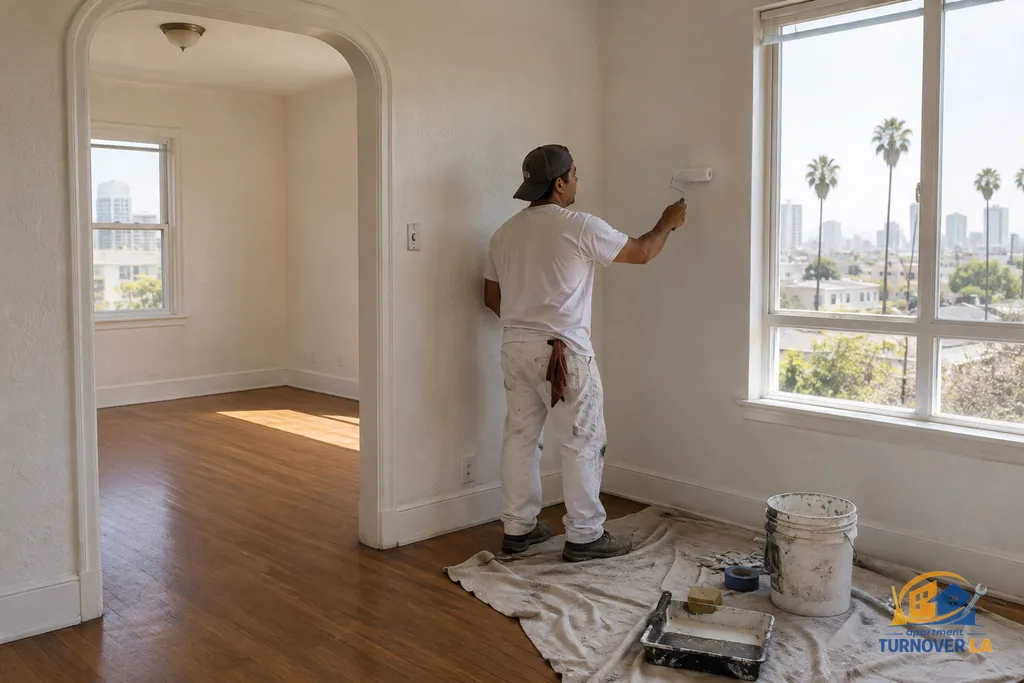
Yes, when the painter is working from an approved unit scope rather than chasing individual curb jobs. Apartment turnover painting begins with a vacant-unit condition review: wall scuffs, holes, touch-up mismatch, smoke residue, damaged trim, and whether the prior color can be blended. The manager then decides what needs to be completed before photos, showings, or move-in.
Across LA, vacancy can cost roughly $80-$200 per day depending on the submarket, so the useful question for a landlord is not simply what a painter earns. It is whether the work clears the unit for leasing without a second trip. TurnOver LA offers apartment painting and drywall work, with a flat 48-hour turnaround on every job and no rush or same-day upcharge. Materials such as paint, parts, and fixtures are identified at the on-site inspection and added only with the owner's approval.
A defined turnover scope also creates a cleaner record for deposit discussions. California owners should understand the itemization rules in California Civil Code §1950.5, rather than treating ordinary repainting as an automatic tenant charge.
What does paint work look like during an LA apartment turnover?
A good turnover paint decision starts after cleaning, not before. Grease, dust, adhesive residue, and smoke film can make a wall look like it needs repainting when the first step is actually cleaning. Once the surfaces are clean, the crew can see whether a scuff will blend, whether nail holes need patching, or whether an entire wall or room needs a consistent finish.
For a vacant one-bedroom, the sequence is typically: photograph condition, clean surfaces, patch damage, sand and texture as needed, paint, inspect under natural and artificial light, then document the completed unit. TurnOver LA's Make Ready service combines a deep clean with a 12-point photo report, which helps managers decide what paint work is actually necessary. The base Make Ready price is 1 Bedroom $255. For a broader scope, see what a make-ready service includes before treating paint as a standalone line item.
When should a landlord choose touch-up instead of repainting a room?
Choose a touch-up when the existing paint is known, the wall is clean, the damage is limited, and the repaired area can blend under normal lighting. It is usually the practical choice for a few scuffs, minor marks, or small tenant-caused spots after the unit has been cleaned. TurnOver LA lists Paint touch-up only: $200 for that defined task.
Repaint the room when paint sheen has changed, there are multiple repair points, smoke or odor staining remains, the old color cannot be matched, or the wall reads patchy from the doorway. TurnOver LA lists Repainting per room: $395 / room. Ceilings and baseboard/trim are a separate $125 line item, which prevents a vague "full paint" assumption from becoming a scope dispute. For more on separating chargeable damage from expected use, review normal wear and tear in California.
That distinction is especially useful in older rental stock, where repeated spot repairs can become more visible than a room repaint. The fastest choice is not always the cheapest first pass if it causes a delayed listing or a callback.
Why does a 48-hour turnover schedule matter more than a curb route?
A curb route is only productive when confirmed customers are close together and payment is reliable. A vacancy turnover has a fixed business deadline: return the unit to rentable condition before the next showing or lease start. In neighborhoods with frequent tenant turnover, including Hollywood, a missed paint or repair handoff can cost more than the narrow labor savings from postponing the work.
TurnOver LA completes every job on a flat 48-hour turnaround, without a rush or same-day upcharge. That lets a manager coordinate cleaning, repairs, locks, and listing preparation around one known window. If the unit also needs maintenance beyond paint, a Half-day handyman punch list: $230 can address the smaller fixes that otherwise keep a clean unit off market. Managers comparing vendors can also review why one vendor for cleaning, painting, and repairs reduces handoff gaps.
For someone seeking curb-painting income, the practical lesson is simple: verify the route and pay model first. For a landlord, use a documented interior scope that gets the unit ready to show. Get instant quote in 30 seconds