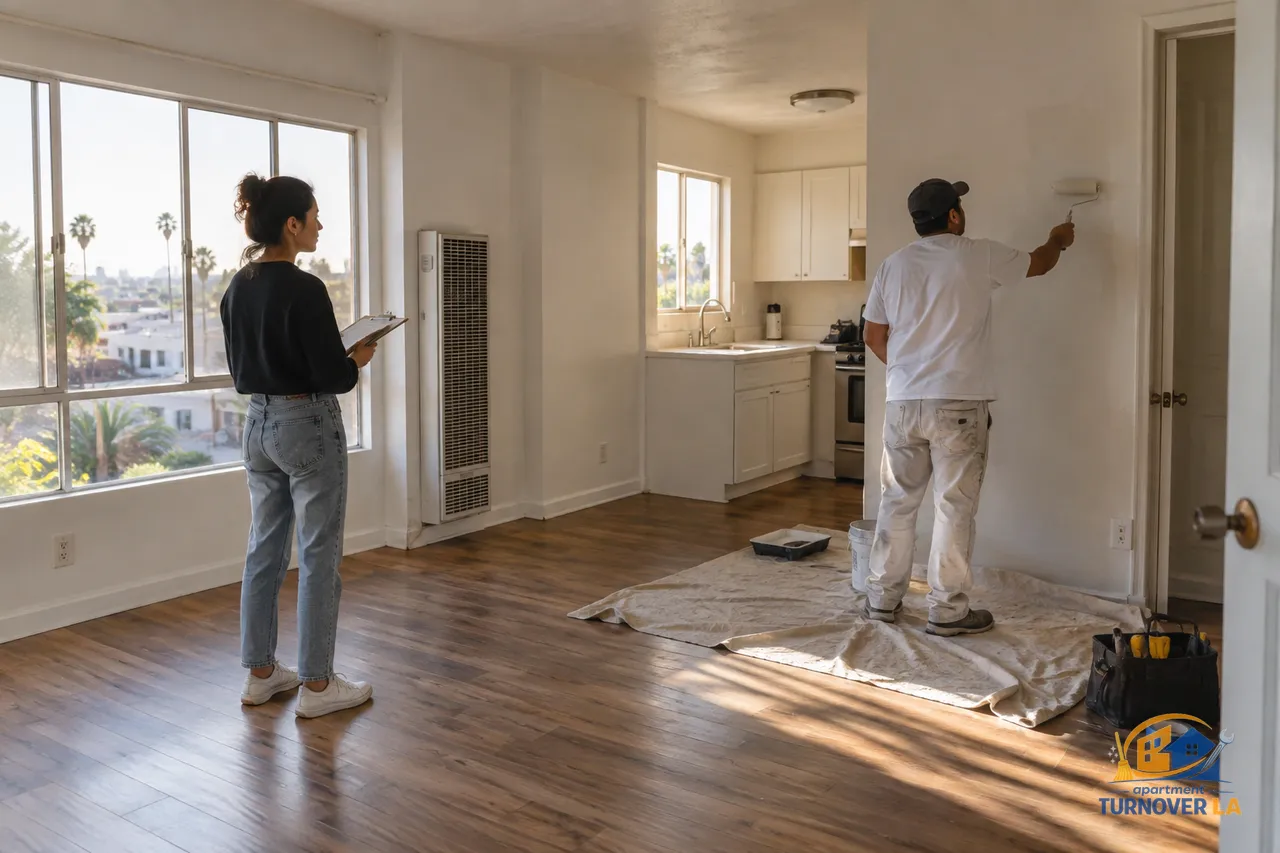
Quick answer: A make ready maintenance request is a work order to prepare a vacant apartment for its next resident. It combines the condition review, cleaning, repair coordination, final security checks, and documented handoff that happen between move out and move in. In Los Angeles, TurnOver LA's Make Ready package starts at $225 for a studio and includes a deep clean and 12 point photo report.
For a maintenance team, “make ready” is not one repair such as a leaking faucet or a broken blind. It is the unit level workflow that gets a vacant home back to rentable condition, with open items organized in the right sequence and closed with evidence. Get instant quote in 30 seconds
What does make ready mean on a maintenance request?
A make ready request means the apartment is vacant or about to become vacant, and the team needs to return it to a showable, safe, clean, functional condition for the next tenancy. The request should identify the unit, the vacancy date, target ready date, access status, known damage, and who approves added work. It is a workflow label, not automatic permission to replace everything found inside.
That distinction matters in a busy LA building. A resident repair ticket may close when a technician restores one item. A make ready stays open until cleaning, condition work, security, and documentation are complete. At TurnOver LA, the base Make Ready service pairs a deep clean with a 12 point photo report, so a manager has a clear record of the completed unit condition rather than only a verbal confirmation.
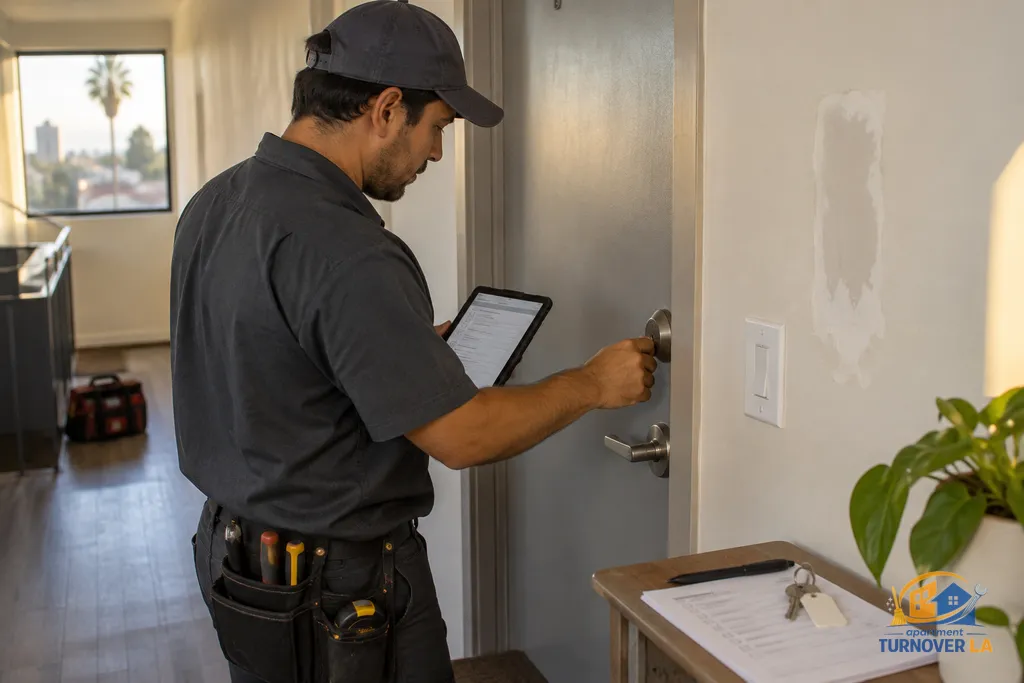
Is a make ready request the same as a resident repair ticket?
No. A resident repair ticket addresses an active occupancy issue, while a make ready request coordinates work across an empty unit. The two can contain similar tasks, such as a drywall patch or lock issue, but their deadlines, access rules, approval path, and proof of completion differ.
A good request also separates preexisting issues from damage found after move out. That protects the maintenance team from guessing later why a repair was ordered. For example, “vacant, move out inspection complete, patch nail holes in bedroom, test GFCI, clean refrigerator, rekey after final access” gives the crew a usable scope. “Unit needs make ready” does not. For a broader task list, use this apartment turnover checklist alongside the property’s own inspection form.
In LA RSO properties, keep the work record especially clear. The LAHD Rent Stabilization Ordinance is separate from the physical turnover workflow, but vague records can create avoidable disputes about condition, access, and charges.
What work belongs in an apartment make ready scope?
The scope should start with condition and safety, then move through dusty repairs, cleaning, security, and the final visual check. Cleaning first can waste time if drywall sanding, cabinet work, or repairs will create new dust afterward. That sequencing is one practical reason a make ready is more than booking a cleaner.
- Inspect each room, appliance, fixture, window, and life safety item.
- Flag repairs, paint touch ups, and damage that needs owner approval.
- Complete dusty or invasive work, including drywall patches and hardware repairs.
- Deep clean the unit, including kitchen grease, bathroom buildup, floors, and interior surfaces.
- Rekey or confirm locks after all vendor access is finished.
- Photograph the finished condition and release the unit for leasing or move in.
The popular 20/10 and 80/20 cleaning rules can help a person pace housekeeping, but they are not make ready standards. A turnover needs room by room completion criteria. For the cleaning component alone, see move out cleaning in Los Angeles. For wall damage, a drywall and repair visit is a separate, defined scope.
How much does apartment make ready work cost in Los Angeles?
Across LA, basic one bedroom turnover quotes commonly run about $200 to $500 before substantial repairs, paint, junk removal, or lock work. With TurnOver LA, Make Ready is a flat $255 for a 1 Bedroom, including the deep clean and 12 point photo report, with a 48 hour turnaround. That base price is not a promise that every vacant unit needs only base work.
| Unit size | General LA market context | TurnOver LA Make Ready |
|---|---|---|
| Studio | Basic turnover quotes often begin around $200 | Studio $225 |
| 1 Bedroom | Basic turnover quotes often run $200 to $500 | 1 Bedroom $255 |
| 2 Bedroom | Scope rises with rooms, surfaces, and condition | 2 Bedroom $335 |
| 3BR or larger | Larger units need a condition based scope | 3BR or larger $425 |
The quote covers labor and the crew's own supplies. Paint, parts, and fixtures are priced at the on site inspection and added to the final invoice only with approval first. This is why a request should identify whether the unit needs only base preparation or also paint, patches, maintenance, a cleanout, or a rekey. Get instant quote in 30 seconds
Need the unit turned before the next tenant?
We do the move-out clean and send you a photo report you can attach to the deposit itemization.
From $225 · 48-hour turnaround
Get an instant quoteWho should approve added work during a make ready?
The owner, asset manager, or designated property manager should approve nonroutine materials and added scopes before they proceed. The maintenance request needs one named decision maker, especially where a technician finds concealed damage after the first walkthrough. Without that, a small repair can sit while a vacant unit loses another day.
Use the photo report to make the decision specific: identify the room, the item, the condition, and the recommended correction. A clear example is better than “bedroom needs attention.” Write “north bedroom, two inch drywall hole behind door, patch and texture recommended.” Then the approver can decide promptly whether the work is resident chargeable, owner maintenance, or normal turnover preparation.
California deposit rules also require discipline around documentation. Review California Civil Code §1950.5 and this guide to the California 21 day deposit return process before treating an outgoing resident's deposit as a repair budget.
When should a make ready request be scheduled?
Schedule the request as soon as a move out date is known, then confirm access when the unit is actually surrendered. The most useful operational timeline has two checkpoints: an early condition review to identify likely work and a final possession check after keys are returned. This reduces the chance that a crew arrives while the resident still has possession or that necessary materials are discovered too late.
For a standard vacancy, book cleaning and inspection work first, hold a repair window for approved findings, then make locks the final access related task. TurnOver LA provides a flat 48 hour turnaround on every job, with no rush or same day upcharge. That does not mean every repair decision should wait until day two. Fast approvals are what keep a manageable turnover from becoming a week of disconnected vendor visits.
Vacancy loss in Los Angeles commonly falls in the $80 to $200 per day range depending on submarket. The work order should therefore show a ready date, not merely a list of chores. That makes delay visible to leasing and ownership.
Can a make ready request be charged to the former tenant?
Sometimes, but the request itself does not decide who pays. A make ready is a condition and operations label. Charges to a former tenant depend on documentation, ordinary wear and tear, actual damage, cleaning needs, and the applicable lease and California requirements.
Do not use a blanket “make ready fee” as a shortcut. Separate routine owner turnover work from supported damage claims, and retain move in and move out records. The California DCA Landlord-Tenant Guide is a useful starting point for security deposit handling. Managers should also distinguish cleaning that restores a unit after ordinary use from cleaning supported by the documented move out condition.
A practical request has separate fields for “resident charge review” and “approved owner work.” That small administrative step keeps a maintenance technician from being asked to make a legal or accounting judgment in the field.
What should close a make ready maintenance request?
Close the request only when the unit is physically ready and the record is complete. The final closeout should confirm that approved work is done, the deep clean is complete, locks or access controls have been addressed, photos are uploaded, and unresolved items are clearly assigned rather than hidden in a closed ticket.
The 12 point photo report is useful as a handoff between maintenance and leasing because it documents the unit at the moment it becomes available. It is not a substitute for a lease inspection, but it prevents the common problem of leasing hearing “ready” without knowing whether the oven, bathroom, floors, entry, and visible walls were checked. Learn more about what make ready includes, then use the same closeout standard for every vacancy. Get instant quote in 30 seconds