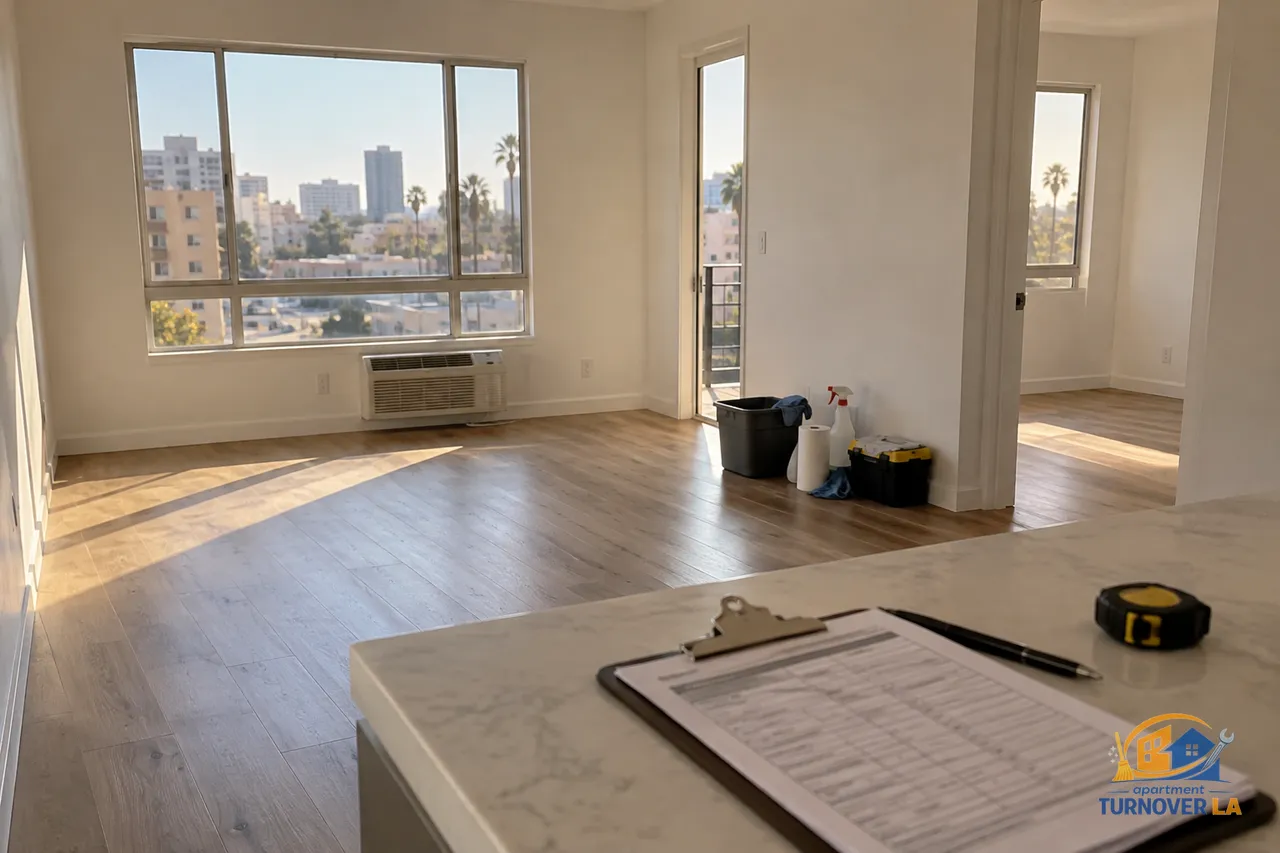
Quick answer: In Los Angeles, a basic apartment turnover commonly begins around $200 to $500 for cleaning alone, before repairs, paint, locks, haul-away, and vacancy time. TurnOver LA's Make Ready package is $225 for a studio, $255 for a 1 Bedroom, $335 for a 2 Bedroom, and $425 for a 3BR or larger, with a deep clean, 12-point photo report, and a 48-hour turnaround.
The average cost of an apartment turnover is not one number because the condition of the unit, not its bedroom count alone, drives the final scope. Start with a documented clean, then authorize paint, repairs, locks, or cleanout only where the move-out inspection shows they are needed. Get instant quote in 30 seconds
What is included in the average apartment turnover cost?
A useful turnover budget separates work that gets every vacant unit ready from work caused by the specific condition of that unit. The base scope usually includes a deep cleaning, kitchen and bath reset, floor detailing, trash removal within the normal cleaning scope, and a visual condition record. It does not automatically include repainting, drywall repair, rekeying, fixture replacement, or a full junk haul.
Across LA, basic turnover cleaning commonly runs about $200 to $500, depending on unit size, soil level, access, and whether the vendor is actually coordinating the work. With TurnOver LA, Make Ready service is a flat $225 for a studio, $255 for a 1 Bedroom, $335 for a 2 Bedroom, and $425 for a 3BR or larger. It includes the deep clean and a 12-point photo report. Labor and crew supplies are covered. Paint, parts, and fixtures are inspected on site, priced separately, and require approval before being added to the invoice.
For a more detailed cleaning scope, see our apartment turnover checklist.
Why can two similar apartments have very different turnover costs?
Two one bedroom units in the same building can have very different invoices because the base clean is only the starting point. A tenant who left ordinary dust, light kitchen residue, and intact walls needs a short reset. A unit with nicotine film, grease buildup, abandoned furniture, damaged drywall, missing blinds, or unreturned keys needs separate trades and potentially several approvals.
The practical mistake is treating every visible issue as one large “turnover” line item. Break it into decisions. Is the wall mark normal wear, or chargeable damage? Does the cabinet need a wipe-down, hardware adjustment, or replacement part? Is the lock change part of building policy? California deposit rules matter here. California Civil Code §1950.5 limits what may be withheld and requires landlords to account for deductions appropriately.
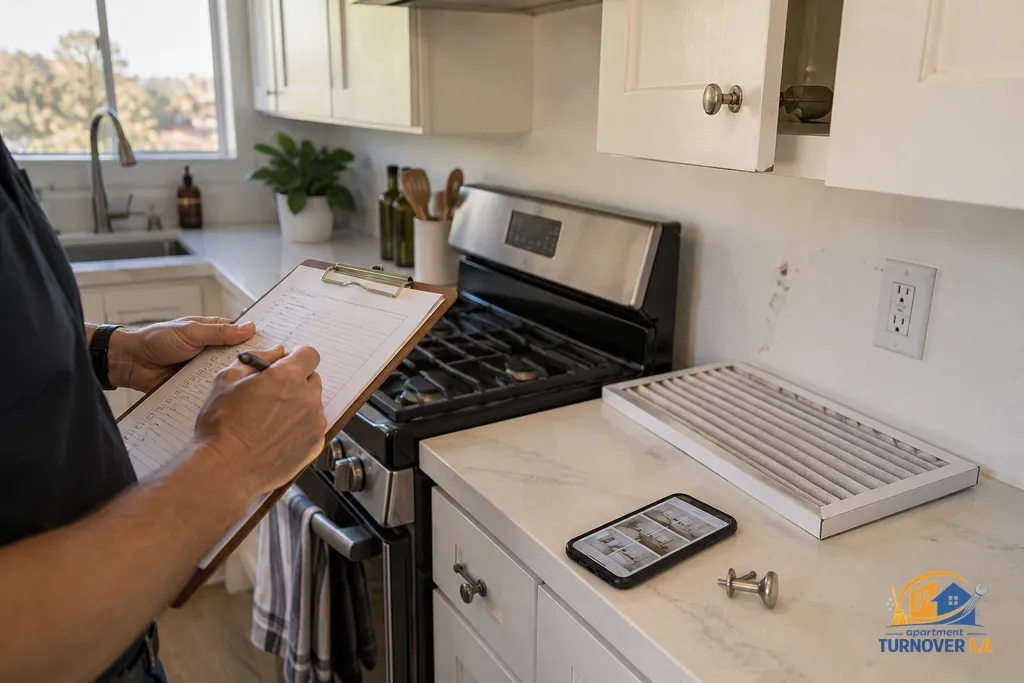
A photo report helps separate cleaning needs from repair decisions before a manager sends a blanket approval. That is especially useful when the owner is off site and the next showing is already scheduled.
How should an LA landlord calculate a realistic turnover budget?
Use a unit-by-unit formula instead of a portfolio average: base Make Ready, approved condition work, materials, and vacancy loss. For a 1 Bedroom, the cleaning line is $255 with TurnOver LA. Then add only the approved scope, such as a paint touch-up, repair visit, or lock work. Do not bury materials in a labor allowance. Paint, parts, and fixtures should be identified at the on-site inspection and approved before purchase.
Use this five-step workflow:
- Document the move-out condition before work begins.
- Assign the base cleaning package by bedroom count.
- Sort defects into cleaning, normal wear, tenant damage, and owner maintenance.
- Approve repair and material items separately from the base scope.
- Add the cost of each vacant day until the unit is actually show-ready.
In many LA submarkets, vacancy costs roughly $80 to $200 per day. A delayed approval can therefore cost more than a modest punch-list item. Get instant quote in 30 seconds
What do paint, repairs, and locks add to a turnover?
They add only when needed, which is why a condition report should come before authorization. Across LA, paint touch-ups and small repair work are often quoted as variable add-ons, with the total changing by wall condition, access, matching paint, and the number of items. TurnOver LA charges $200 for paint touch-up only, $150 / patch for a small drywall patch + texture, and $125 for a general maintenance / safety visit. These are separate catalog line items, not assumptions built into Make Ready.
For a unit requiring a broader maintenance reset, the relevant choice may be a handyman punch list, rather than sending cleaners back after each repair. Across LA, lock changes also vary by keyway, number of doors, and hardware condition. TurnOver LA lists $150 for a full apartment rekey (up to 2 locks). Materials remain separate when a job requires new hardware or fixtures.
That separation protects the budget. It also prevents a manager from paying for repainting when a documented touch-up will make the unit rental-ready.
Need the unit turned before the next tenant?
We do the move-out clean and send you a photo report you can attach to the deposit itemization.
From $225 · 48-hour turnaround
Get an instant quoteHow much does vacancy change the real cost of turnover?
Vacancy is the line item landlords most often fail to put on the turnover worksheet. A unit that is technically clean but waiting three days for a repair approval is still unavailable to show or lease. At an LA vacancy-loss baseline of $80 to $200 per day, a three-day delay can represent $240 to $600 in lost rent opportunity, before utilities and staff time.
The operating goal is not to approve every add-on quickly. It is to get complete information quickly, make clear approvals, and avoid repeat visits. A deep clean with a 12-point photo report is useful because it creates a decision point: the manager can see whether paint, repairs, or a cleanout are actually needed while the unit is still in the turnover window.
TurnOver LA uses a flat 48-hour turnaround on every job, without a rush or same-day upcharge. For background on how empty days affect operations, review property managers' vacancy loss in Los Angeles.
How do you calculate annual turnover rate for apartments?
Annual turnover rate measures how often units change residents, not what each turn costs. Calculate it by dividing the number of move-outs during the year by the average number of occupied units, then multiply by 100. For example, a 20-unit building with six move-outs and an average of 20 occupied units has a 30% annual turnover rate.
Use that rate to forecast a turnover reserve, but do not multiply it by a guessed all-in invoice. Build a budget from your actual mix of unit types and historical condition. A building with frequent studio moves may need more base cleans but fewer large repair projects. A small older building may have fewer move-outs but more maintenance decisions per turn.
Track at least these fields for every vacancy: move-out date, work authorization date, cleaning complete date, repair complete date, show-ready date, lease date, base package, add-ons, materials, and days vacant. Over two or three quarters, that record shows whether the problem is resident turnover, approval lag, vendor handoffs, or leasing follow-up.
Does the 7% rule tell you what to spend on turnover?
No. The 7% rule is a rough investing shorthand, not a California turnover budget or a legal standard. Investors sometimes use it to compare potential annual operating costs against gross rental income, but it cannot tell you whether a particular wall repair is deductible, whether a unit needs repainting, or how quickly it can be listed.
For Los Angeles rentals, the better practice is to use actual property data and apply the rules that govern the unit. LA's local requirements may apply to rent-stabilized properties, so review the LAHD Rent Stabilization Ordinance when evaluating a unit covered by RSO. Statewide deposit rules and local rent rules are separate from a vendor's turnover quote.
A workable reserve is based on recurring base work, the age and condition of the building, expected repair frequency, and vacancy exposure. It should also distinguish normal wear from chargeable damage. Our guide to normal wear and tear in California covers that distinction.
A controlled turnover costs less than a fast-looking one
The average apartment turnover cost becomes manageable when the scope is visible. Start with the base clean, get photos before authorizing extras, approve materials separately, and measure vacancy from keys returned to show-ready. That process is more useful than a generic percentage rule because it tells you where each dollar and day went.
For a studio through a 3BR or larger, TurnOver LA's Make Ready package gives the manager a known cleaning price and a photo record within 48 hours. It does not force a repair package onto a unit that does not need one. Get instant quote in 30 seconds