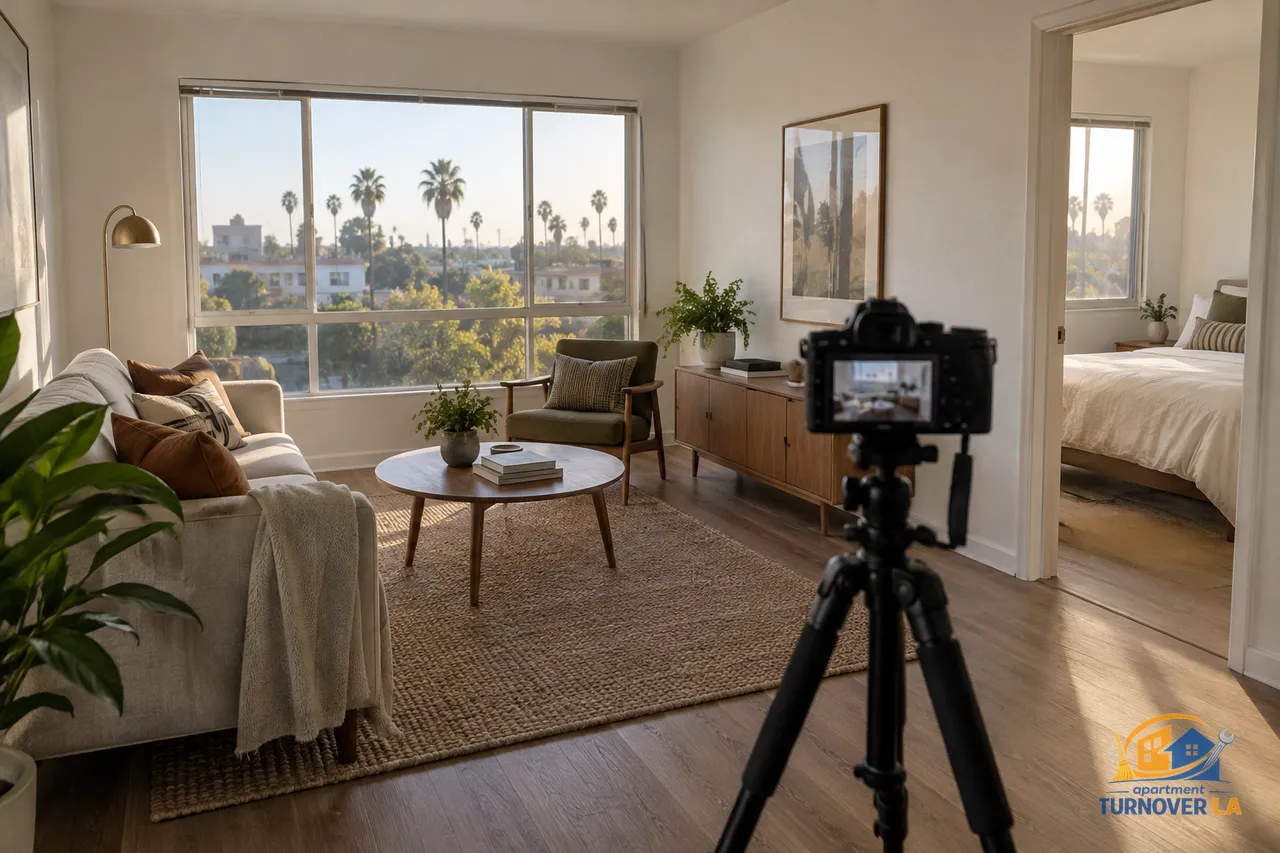
What Does LA Real Estate Photography Cost for Rentals?Quick answer: Across LA, real estate photography packages commonly run from $1,000 to $5,000+ per listing, depending on property size and the media included. For a rental listing, TurnOver LA offers the TLA Launch Pad Media Package for $399, with a 48-hour turnaround. The practical savings come from scheduling media after cleaning and repairs are complete, so the unit is photographed once, in rentable condition.
LA real estate photography is often priced for agents marketing homes, not managers turning a vacant apartment between leases. That is why a general market package can run $1,000 to $5,000+, while TurnOver LA's TLA Launch Pad Media Package is $399 for a rental-focused listing media option. Get instant quote in 30 seconds
What does LA real estate photography cost for a rental?
In the general LA market, published real estate photography pricing commonly starts around $1,000 and can exceed $5,000 for a listing, especially when a package grows to include multiple media formats, large-home coverage, or specialized architectural work. That range is useful context, but it is not a TurnOver LA rate and it is often more production than a standard apartment vacancy needs.
TurnOver LA's exact listing-media price is the TLA Launch Pad Media Package: $399. It is built around the operational moment a manager cares about: the unit is clean, access is confirmed, the punch list is closed, and the listing needs to go live. Every job has a 48-hour turnaround, with no rush or same-day upcharge. Ask for the deliverables and scheduling requirements in the quote so the media plan matches the unit and listing channel.
A $399 media package also should not be confused with unit preparation. Cleaning, repairs, paint, and junk removal are separate scopes when needed. Keeping those scopes visible makes the final invoice easier to review and avoids photographing a unit before it is actually ready to show.
Why is agent-style photography often the wrong comparison?
A single-family sales listing and an apartment turnover answer different questions. A sales agent may be marketing architecture, views, lot size, outdoor spaces, and lifestyle features over a longer listing cycle. A rental manager generally needs accurate, current media that helps a qualified prospect decide whether to tour a vacant unit this week.
In neighborhoods with steady rental demand, such as Koreatown, a slow handoff between turnover work and listing publication can cost more than the media itself. Vacancy loss in LA commonly falls in the $80 to $200 per day range, depending on submarket. The useful calculation is not just the media invoice. It is whether the unit can be marketed promptly after work is completed.
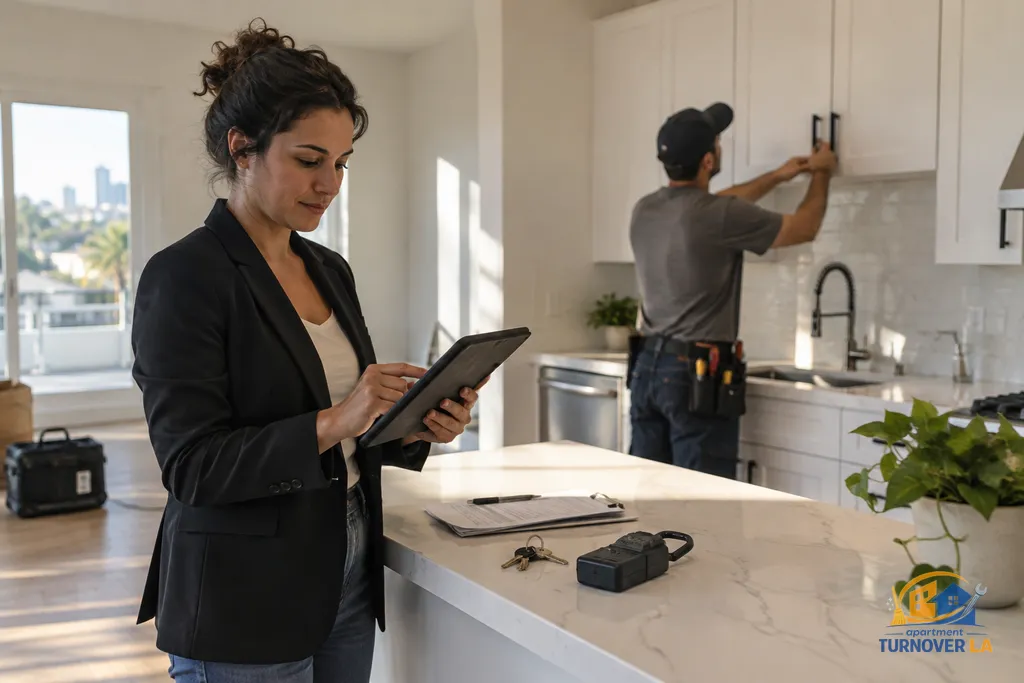
This is where a rental-specific workflow changes the decision. Confirm the unit number, access method, parking or loading restrictions, and the expected completion time for the turnover crew before booking. Do not treat photography as a separate project that starts after several days of email coordination. It should be the final scheduled step in the rent-ready sequence.
What should be finished before the photographer arrives?
Finish the work that will be visible in every frame. That normally means removing abandoned belongings, cleaning kitchens and baths, correcting obvious wall damage, clearing maintenance issues, and making sure lights, blinds, appliances, and doors operate normally. A camera records small misses that are easy to overlook during a fast walk through, such as a cabinet door sitting crooked or a patch that has not been painted.
For many units, the base starting point is Make Ready service, which includes a deep clean and a 12-point photo report. TurnOver LA lists it at $225 for a studio, $255 for a 1 Bedroom, $335 for a 2 Bedroom, and $425 for a 3BR or larger. Those are separate from the $399 TLA Launch Pad Media Package, so a manager can approve each scope based on the unit's actual condition.
The 12-point report has a practical use beyond cleaning verification. It gives the person ordering media a last visual check before the listing shoot. If a report shows wall marks, debris, or a fixture problem, resolve it before media is captured instead of paying for a second visit or publishing photos that invite questions.
How should managers sequence cleaning, repairs, and media?
The most reliable sequence is simple, but the handoffs matter:
- Document the unit after possession and identify cleaning, damage, maintenance, and cleanout needs.
- Remove remaining tenant property and trash before cleaners and repair crews begin.
- Complete repair and paint work before the final clean, so dust and touch-up residue do not show in photos.
- Perform the deep clean and review the 12-point condition report.
- Confirm access, working lights, window coverings, and an empty unit before scheduling listing media.
- Publish the completed media as soon as the files are delivered and begin showing the apartment.
If the unit has wall damage, use a separate drywall repair scope before the final clean. TurnOver LA lists a small drywall patch plus texture at $150 per patch and a medium drywall repair at $240 per patch. Materials such as paint, parts, or fixtures are identified at the on-site inspection, added to the final invoice only with approval, and are not hidden inside a media price.
Get instant quote in 30 seconds
Need the unit turned before the next tenant?
We do the move-out clean and send you a photo report you can attach to the deposit itemization.
From $225 · 48-hour turnaround
Get an instant quoteCan listing photos also serve as move-out documentation?
Listing photos and move-out documentation have different jobs. Listing media is meant to market the next tenancy. A move-out condition record is meant to support the manager's internal file, maintenance planning, and, where applicable, security-deposit accounting. Do not rely on attractive listing images to prove a chargeable condition issue, because they may not show the needed detail, date context, or before-and-after sequence.
For deposit handling, review California Civil Code §1950.5 and keep itemized records, receipts, and condition documentation appropriate to the work performed. Our guide to the California 21-day deposit return explains the timing framework. For the turnover itself, the apartment turnover checklist helps separate marketing readiness from documentation and deposit tasks.
This distinction matters in practice. A bright kitchen photo may make a listing work, while a close condition photo of a damaged drawer, plus an invoice and notes, is what belongs in the maintenance and deposit file. Build both records during turnover, but do not substitute one for the other.
What access and occupancy issues should be resolved first?
Vacant units are easiest to schedule because the manager can control access and confirm the unit is clean before the appointment. Occupied units require more care. Confirm lawful notice, resident communication, pet arrangements, and whether personal belongings will materially obstruct the rooms. Do not promise a listing-ready result if the apartment is still occupied and not prepared for marketing.
Los Angeles properties can also have local rental rules that affect how managers handle tenancies and turnover planning. Review the LAHD Rent Stabilization Ordinance for applicable city rules, and use the California DCA Landlord-Tenant Guide as a general tenancy reference. Neither source turns a photo appointment into a substitute for proper access practices.
Operationally, a lockbox code, a named onsite contact, a confirmed parking plan, and a vacant, powered unit prevent the most common failed appointment. In older LA buildings, also check whether hallway lighting, elevator access, or a narrow stairwell affects the crew's arrival window. Those details sound small, but they determine whether the listing media step stays inside the turnover schedule.
When does the $399 package make the most sense?
The TLA Launch Pad Media Package at $399 makes the most sense when a unit is genuinely ready to list and the manager needs one clear media line item rather than a custom sales-production package. It is especially practical for standard apartments where speed, accurate condition, and a clean handoff to leasing matter more than extensive production features.
Use the package after the final condition check, not as a way to cover up unfinished work. If the unit still needs a cleanout, TurnOver LA lists a unit cleanout or junk haul at $500, with an additional junk load at $500 per load. If it needs maintenance attention, a general maintenance or safety visit is $125. Approve the needed scopes first, then capture the finished unit.
The operational advantage is not that $399 replaces every possible listing service. It is that the rate is clear, the scheduling can sit inside the turnover plan, and the result can move directly into marketing once the apartment is presentable. That reduces the gap between a crew leaving and leasing beginning.
How can listing media help reduce avoidable vacancy days?
Good listing media cannot fix an unrealistic rent, an unresponsive leasing process, or an unresolved maintenance issue. It can remove one avoidable delay: waiting to market a unit until someone eventually has time to take usable photos. Schedule the listing-media step while the turnover is being scoped, then release it only after the unit passes its final walk.
That approach is more disciplined than taking informal phone photos before cleaning and hoping to replace them later. It also limits duplicate work. One completed turnover, one condition review, one media appointment, then publication is a cleaner sequence for a small manager with several units moving at once.
For a standard LA rental, compare the general market range of $1,000 to $5,000+ with TurnOver LA's TLA Launch Pad Media Package at $399, then weigh that against the $80 to $200 daily vacancy-loss baseline. The right decision is usually the one that gets an accurately represented, rent-ready apartment in front of prospects without adding a second round of access, cleaning, or repair coordination.