
Quick answer: Los Angeles landlords have the right to collect lawful rent, enforce a valid lease, inspect or enter for lawful reasons with proper notice, and use the court process to recover possession. Those rights come with firm limits: security deposits generally require an itemized accounting and return within 21 days, and self help lockouts are not lawful.
Los Angeles landlords have meaningful property rights, but the day to day risk is usually in how those rights are carried out. A valid lease, dated documentation, proper notices, and a disciplined turnover process protect an owner far better than an argument after a tenant leaves. Get instant quote in 30 seconds
Can a landlord collect rent and enforce lease rules?
Yes. A landlord can set and collect lawful rent, require performance of written lease terms, screen applicants using lawful criteria, and pursue remedies when rent is unpaid or a material lease term is breached. The lease matters, but it cannot waive rights California law gives a tenant or authorize conduct the law prohibits. House rules about smoking, pets, parking, noise, keys, and maintenance access are most useful when they are written clearly, applied consistently, and retained with the signed lease.
In Los Angeles, the rent and eviction rules may depend on the unit. A property may be subject to the city RSO, statewide AB 1482, a local exemption, or separate Santa Monica rules. The LAHD Rent Stabilization Ordinance is the starting point for determining whether a City of Los Angeles unit is covered. Do not assume a rent increase, termination notice, or lease clause works the same way across an LA portfolio. Verify the address, unit type, and tenancy before acting.
When may a landlord enter an occupied rental?
A landlord may enter for lawful reasons, including necessary or agreed repairs, services, inspections, showing the unit to prospective renters or buyers, and emergencies. For routine entry, California generally requires reasonable written notice, commonly at least 24 hours, and entry during normal business hours. An emergency, a tenant's consent at the time, or a court order can change the notice requirement.
Operationally, entry disputes often begin with vague notice rather than bad intent. State the date, time window, purpose, and who is coming. Keep a copy of the notice and record whether entry occurred. Repeated entry without a legitimate reason, or using repairs as a way to pressure a tenant, creates avoidable exposure. The California DCA Landlord-Tenant Guide is a useful reference for the baseline rules, but local ordinances and the lease may add obligations. For a turnover, schedule the final work only after possession is clearly returned, not merely because the tenant says they are moving.
What can a landlord deduct from a security deposit?
A landlord may use a security deposit for unpaid rent, cleaning needed to return the unit to the level of cleanliness at move in, repair of tenant caused damage beyond ordinary wear, and restoration of personal property if the rental agreement allows it. The key distinction is condition, not frustration. Faded paint, worn traffic paths, and ordinary aging are not automatically chargeable just because the unit needs work before reletting.
Under California Civil Code §1950.5, the landlord generally must provide the accounting and any remaining deposit within 21 calendar days after the tenant vacates. The file should connect each deduction to evidence: move in photos, move out photos, inspection notes, invoices, receipts, and any required estimates. Review the exact process in our guide to California's 21 day deposit return rule. A fresh turnover photo report can document post possession condition, but it does not replace the move in evidence needed to support a deduction.
How should an LA landlord separate damage from normal wear?
Start with the condition at move in, then compare the same area after possession returns. A nail hole from ordinary hanging may be normal wear in context. A large unauthorized wall opening, broken cabinet hardware, missing keys, or a pet damaged door is easier to document as tenant caused damage. Age and useful life also matter. Charging a departing tenant for the full replacement cost of an old item can be difficult to support when the item was already near the end of its life.
This is where a line item turnover scope should stay separate from the deposit statement. A unit may need repainting to show well, while only a limited portion of that work is chargeable to the former tenant. Review normal wear and tear in California before assigning charges. Take wide room photos first, then close photos of each claimed defect with a ruler, key, or other scale reference when useful. That small detail makes a disputed patch, damaged blind, or missing fixture much easier to explain later.
Need a turnover quote?
Send the unit address and your target date. We quote in 15 minutes.
From $225 · 48-hour turnaround
Get an instant quoteCan a landlord change locks or remove a tenant without court process?
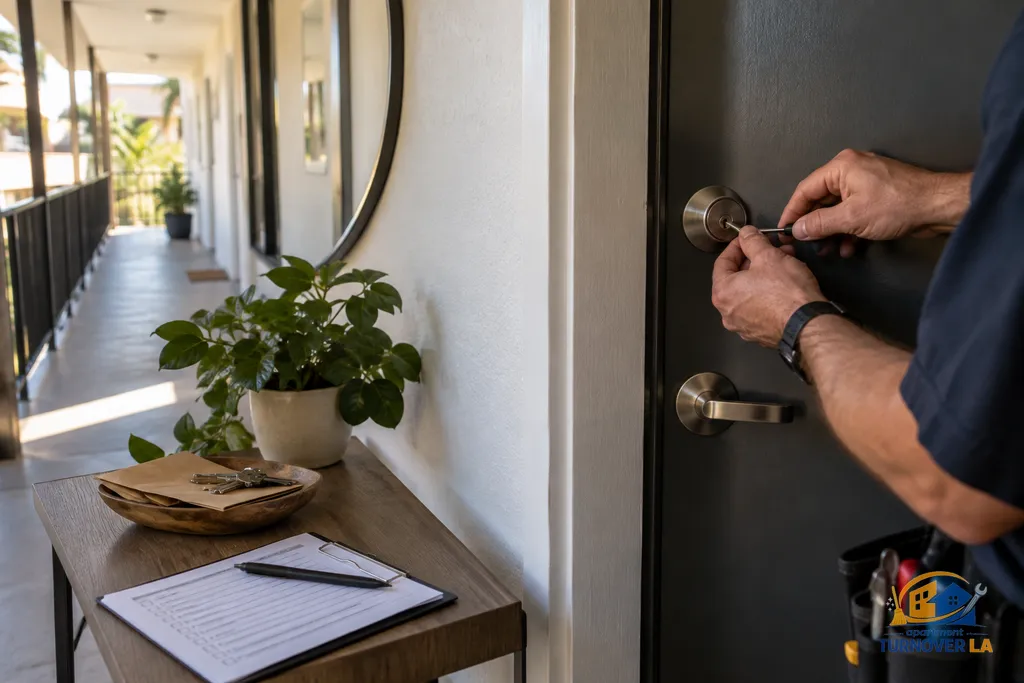
No. A landlord cannot use a lockout, utility shutoff, removal of belongings, or intimidation to force a tenant out. Even where rent is overdue or the lease has been seriously violated, possession must be recovered through the required notice and court process unless the tenant has voluntarily surrendered possession. Changing locks is appropriate after a confirmed vacancy, lawful surrender, or other clear right to possession, not as leverage during a tenancy.
Key control is one of the most practical protections after a move out. Record when possession was returned, who received the keys, how many keys and remotes came back, and when rekeying was completed. If the unit is vacant and possession is settled, apartment lock rekey service can reset access before vendors, showings, and a new tenancy. A rekey record also helps distinguish an ordinary turnover security step from an unlawful exclusion. Keep the documentation in the unit file, not only in a vendor text thread.
How long can a guest stay before becoming a tenant?
California does not have one statewide number of days that automatically turns every guest into a tenant. The answer depends on the facts: whether the person pays rent, receives mail there, keeps belongings there, has a key, uses the address as a residence, and has an agreement with the tenant or owner. A lease can set guest limits, but a written guest policy does not eliminate the need to follow lawful procedures if a person has established occupancy rights.
Do not rely on a casual label such as "friend" or "visitor" when the facts show long term residence. Address possible unauthorized occupants early, in writing, and under the lease's occupancy clause. If the issue affects a planned vacancy, do not book a cleanout or change locks until possession is legally clear. Once possession is returned, property manager turnover support can coordinate condition reporting, vendors, and readiness work without blurring the legal question of who is entitled to occupy the unit.
What is the 2% rule, and does it create a landlord right?
The 2% rule is an investor screening shortcut, not a California landlord tenant law. It generally means an investor looks for monthly rent equal to roughly 2% of a property's purchase price. It does not set legal rent, authorize an increase, determine a security deposit, or establish whether a tenancy may be ended. In much of Los Angeles, it is also a difficult benchmark to meet because acquisition prices and regulated rent limits do not move together.
Tenant retention is similarly a business measure, not a legal entitlement. It means reducing avoidable vacancy by keeping reliable renters through responsive maintenance, clear communication, fair renewal practices, and a property that remains habitable. Retention does not mean overlooking lease breaches, and turnover does not mean charging every refresh item to the departing tenant. When a unit does turn, use a documented apartment turnover checklist to separate legal closeout tasks from make ready work. Get instant quote in 30 seconds
What should a landlord document before and after a turnover?
Document the tenancy before a dispute exists. Keep the signed lease and addenda, move in condition report, dated photos, repair requests, notices, payment ledger, communications, inspection records, key log, and deposit accounting in one unit file. At move out, photograph every room before cleaning or repairs, note meter and key status, preserve invoices, and identify which work is ordinary turnover versus a claimed tenant charge.
This sequence matters in LA buildings where a vacancy can cost roughly $80 to $200 per day depending on submarket, yet rushing the closeout can create a much more expensive deposit dispute. In West Hollywood, for example, confirm the tenancy and local rules before scheduling access dependent work. Use vendors for clearly defined post possession scopes, such as repairs, cleaning, and security reset, but keep the legal decision making with the owner or qualified counsel. Get instant quote in 30 seconds