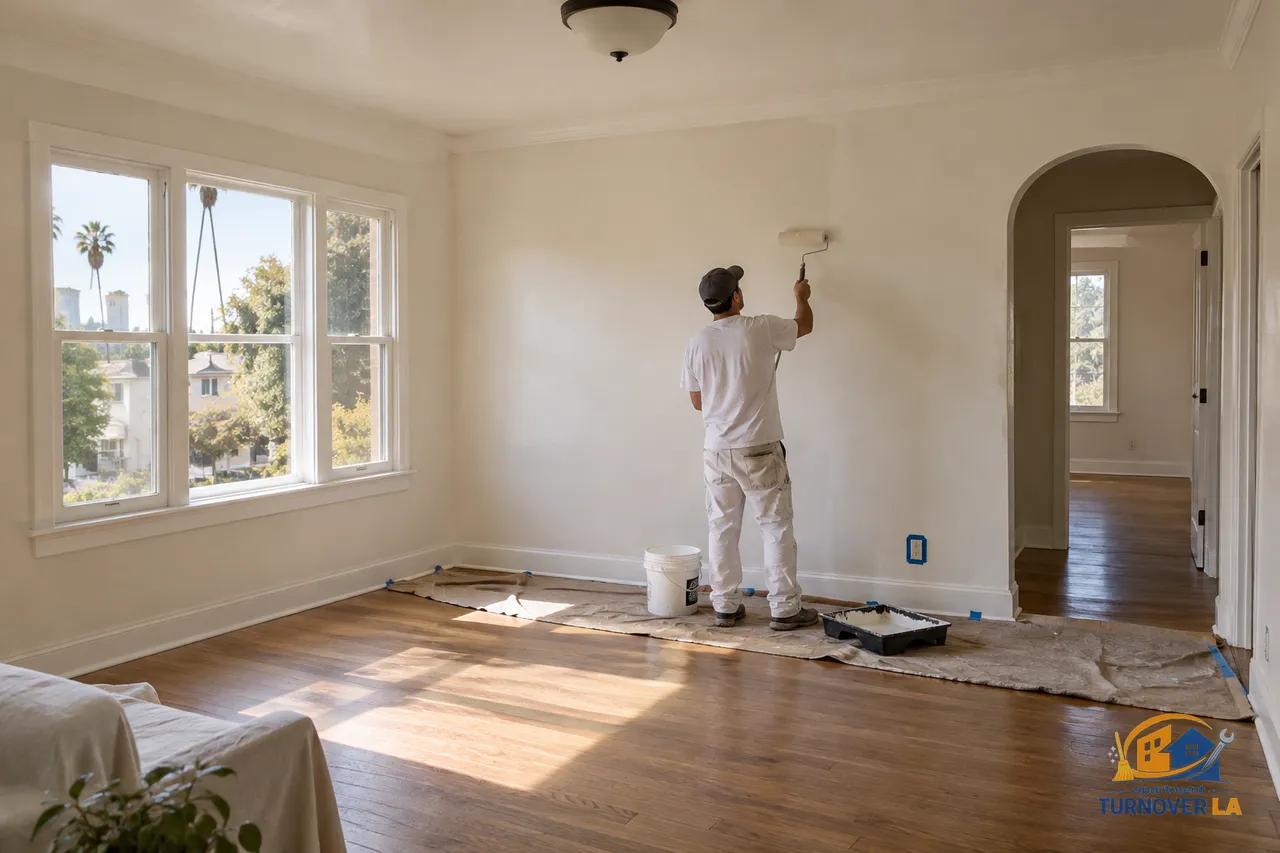
Quick answer: Most LA apartments use water-based acrylic latex paint because it dries quickly, has lower odor, and holds up to routine cleaning. Walls are usually eggshell or satin, ceilings are flat, and baseboards, doors, kitchens, and baths often use semi-gloss. For a turnover, match the existing sheen before selecting a neutral color, since a good color match with the wrong sheen will still show.
Most rental units are not painted with one finish from floor to ceiling. The practical apartment system is washable wall paint, flatter ceilings that hide imperfections, and harder-wearing trim paint where hands, carts, and mop heads hit. Before authorizing a repaint, identify whether the unit needs a touch-up, a single-room repaint, or work connected to a broader apartment make-ready scope.
Get instant quote in 30 seconds
What paint base do most apartment walls use?
Most apartment walls use interior acrylic latex paint, usually called water-based latex. It is the standard turnover choice because it dries faster than oil-based paint, has a more manageable odor in an occupied building, and can be cleaned after it cures. A quality washable formulation is more useful in a rental than a decorative specialty finish, particularly in entries, halls, kitchens, and units with frequent tenant turnover.
Oil-based paint still appears in older buildings, often on original wood trim, metal railings, or doors, but it is not the normal choice for repainting apartment walls. A crew should not apply latex paint over a glossy older surface without proper cleaning, scuff sanding, and bonding preparation. That is where peeling starts, usually around door frames and baseboards.
For turnover work, the important question is not only the product base. It is whether the existing coating is sound, washable, and compatible with the repair work below it. If a wall has nicotine staining, grease, marker bleed, or water marks, a stain-blocking primer may be necessary before the finish coats go on.
Which paint sheen belongs on walls, ceilings, and trim?
Use eggshell or satin on most apartment walls, flat on ceilings, and semi-gloss on trim, doors, and other high-contact areas. That combination gives a landlord reasonable cleanability without making every drywall repair visible. Satin is the tougher choice for kitchens, bathrooms, hallways, and family-heavy units. Eggshell is a common choice for living rooms and bedrooms where a softer appearance matters.
Flat ceiling paint is standard because ceilings collect fewer hand marks and flat sheen disguises uneven texture, old patching, and light raking across the surface. Semi-gloss handles cleaning on baseboards and doors, but it also highlights roller marks, drips, dents, and poor drywall preparation. It should not be used across ordinary walls simply because it is durable.
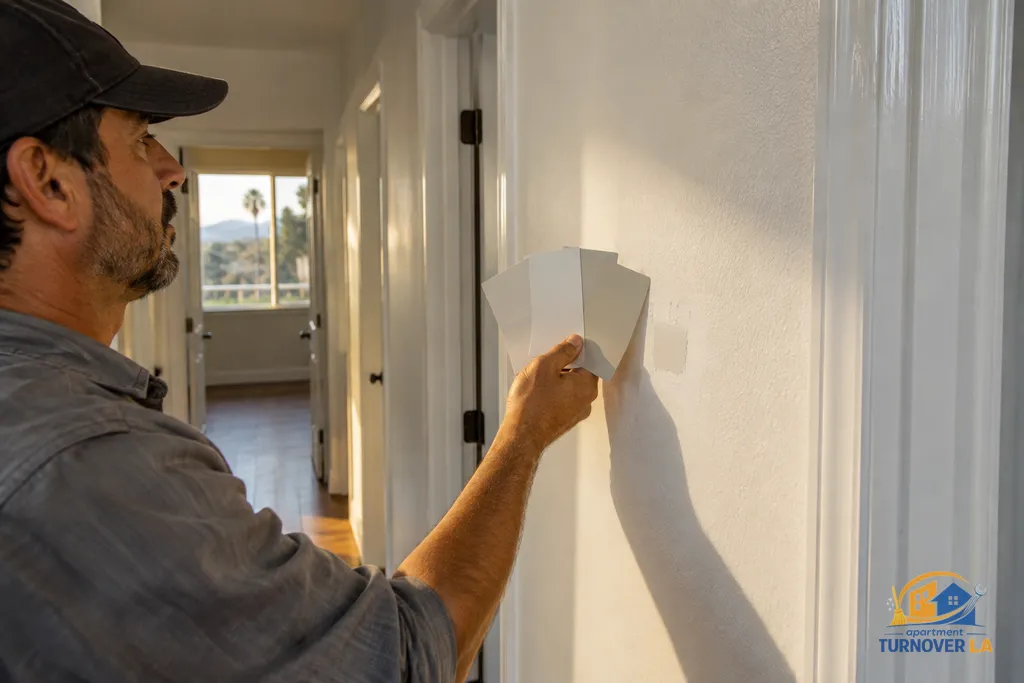
A useful field check is to shine a work light sideways across the wall. That angled light reveals whether the existing wall is flat, eggshell, or satin and exposes old patches that a straight-on inspection misses. Matching sheen is often more important than matching a paint-chip color under store lighting.
Why does matching the existing paint matter so much?
A paint touch-up only disappears when the color, sheen, product family, wall condition, and application method are close enough. Even the correct color code can flash differently if fresh paint is rolled over a faded wall or if a small brush patch is applied to a roller-textured surface. Sun exposure is especially uneven in LA units with large west-facing windows.
Start by checking the owner file for paint brand, color name, sheen, and prior work date. If there is no record, test a discreet wall area and compare it in daylight and under the unit's installed lighting. A clean wall around a repair may be brighter than the rest of the room, so the right solution can be to repaint from corner to corner rather than chase several isolated touch-ups.
This is also why scuffs need a condition check before painting. Many scuffs lift with proper cleaning, while gouges, torn drywall paper, and raised patches need repair and paint. See how to remove apartment wall scuffs before treating every mark as a repaint. For holes or failed patches, a dedicated drywall repair service creates a more stable surface for the final coat.
What colors do landlords usually choose for rental apartments?
Landlords usually choose a light neutral with a warm or balanced undertone, not stark bright white and not a color selected from a single online swatch. Soft off-white, light greige, pale beige, and restrained warm gray remain practical because they work with varied flooring, cabinets, tile, and tenant furniture. The best neutral is the one that fits the fixed finishes already in the unit.
Check the undertone in the flooring and kitchen counters before approving a color. A cool gray against creamy tile can make the entire apartment look mismatched. In older Los Angeles buildings, beige travertine, honey oak cabinets, and warm laminate floors often need a warmer wall neutral than a newer concrete-and-white-cabinet unit.
Keep a written paint schedule for every building: wall color and sheen, ceiling color, trim color and sheen, manufacturer, and any primer used. That small record prevents a superintendent from guessing at the next move-out. It also makes a unit-by-unit photo report more useful when deciding whether a mark is new damage or pre-existing wear.
Get instant quote in 30 seconds
Need the walls done before you re-list?
Turnover painting, scuff removal and patching, with a photo record of the condition we left behind.
$395 per room · 48-hour turnaround
Get an instant quoteWhen is a touch-up enough, and when should you repaint a room?
A touch-up is enough when the wall has a few localized marks, the existing paint is in good condition, and the original product can be matched. Repaint the full wall or room when there are multiple repairs, color fade, smoke residue, uneven cleaning, pet damage, or a sheen mismatch that will flash under normal light. The decision should be based on visibility after the unit is lit and cleaned, not on the number of marks alone.
Across LA, a basic professional room repaint commonly runs about $350 to $800 per room, depending on prep, ceiling height, furniture, and stain coverage. TurnOver LA charges $395 / room for repainting per room, with a 48-hour turnaround. Across LA, limited touch-up work often falls around $150 to $300. TurnOver LA's Paint touch-up only: $200 rate is for the defined touch-up scope.
The quote covers labor and the crew's own supplies. Paint, primer, replacement parts, and fixtures needed for the job are reviewed at the on-site inspection, then added to the final invoice only with owner approval. Do not approve a cheap touch-up simply to avoid repainting if it will leave visible rectangles on listing photos.
Can a landlord charge a departing tenant for repainting?
A landlord can generally deduct for tenant-caused damage beyond ordinary wear, but routine aging of paint is not automatically chargeable to a departing tenant. Fading, minor scuffs, and normal wear from ordinary use are different from unauthorized dark-color repainting, extensive holes, crayon across multiple walls, or unusual staining. The distinction matters when preparing the itemized security-deposit statement.
California's baseline rule is in California Civil Code §1950.5, which addresses permissible deposit deductions and documentation. Keep dated move-in and move-out photos, invoices, paint records, and notes explaining the condition and repair. The California DCA Landlord-Tenant Guide is also a useful reference for the broader deposit process.
For Los Angeles rent-stabilized units, review local requirements separately. The LAHD Rent Stabilization Ordinance governs rent-stabilization issues, but it does not turn ordinary paint aging into tenant damage. For the operational side of the decision, compare the unit condition against this guide to normal wear and tear in California.
How should paint work fit into an apartment turnover schedule?
Paint work should happen after cleanout, repair identification, and drywall patching, but before the final clean and listing photos. Painting before wall repairs creates duplicate work. Cleaning before sanding and painting dust means the cleaner returns to remove debris from floors, window tracks, counters, and fixtures. A clear sequence avoids both problems.
A practical turnover sequence is:
- Document the vacant unit with condition photos.
- Remove left-behind items and identify repairs.
- Patch, texture, sand, and prime damaged drywall.
- Complete touch-ups or repaint rooms after the primer cures.
- Install or repair hardware and safety items.
- Perform the final deep clean, including paint dust and floor edges.
- Take final listing and condition photos after the unit is dry and staged only as needed.
TurnOver LA can coordinate rental painting work with a Make Ready service, which includes a deep clean and 12-point photo report. That lets the owner see the finished wall condition after cleaning rather than approving paint from a dusty mid-job snapshot.
What should be written into the paint scope before work begins?
A usable paint scope names the room, surfaces, color, sheen, prep level, number of coats, repair locations, and exclusions. “Paint bedroom” is not enough. It leaves open whether the ceiling is included, whether baseboards are included, whether a closet is included, and whether the crew is covering a water stain without primer.
For a small scope, identify each wall by direction or feature: “repaint north bedroom wall and closet return, eggshell finish, after two patched anchor holes are sanded.” For a full room, state whether doors, ceilings, trim, cabinets, and baseboards are separate items. This prevents the common turnover surprise where a freshly painted wall makes yellowed trim look worse.
Photograph the walls before prep and after the final coat in the same room lighting. The before set supports deposit records; the after set supports leasing. A defined scope also helps decide whether the unit is ready for photos or whether an additional clean is needed to remove sanding dust, tape fragments, and paint specks.
What is the practical paint choice for a rent-ready apartment?
For most LA apartments, use washable acrylic latex in a neutral color, eggshell or satin on walls, flat on ceilings, and semi-gloss on doors and trim. Then adjust only for the unit's actual condition: satin in a hard-use kitchen, stain-blocking primer over smoke marks, or a whole-wall repaint where a touch-up would flash. Consistency across the building saves time on every later turnover.
The goal is not to use the shiniest or most expensive finish. It is to produce walls that clean well, repairs that do not telegraph through the paint, and a unit that photographs honestly after the final clean. Keep the paint schedule with the turnover file, document damage separately from normal aging, and approve materials before they are purchased.