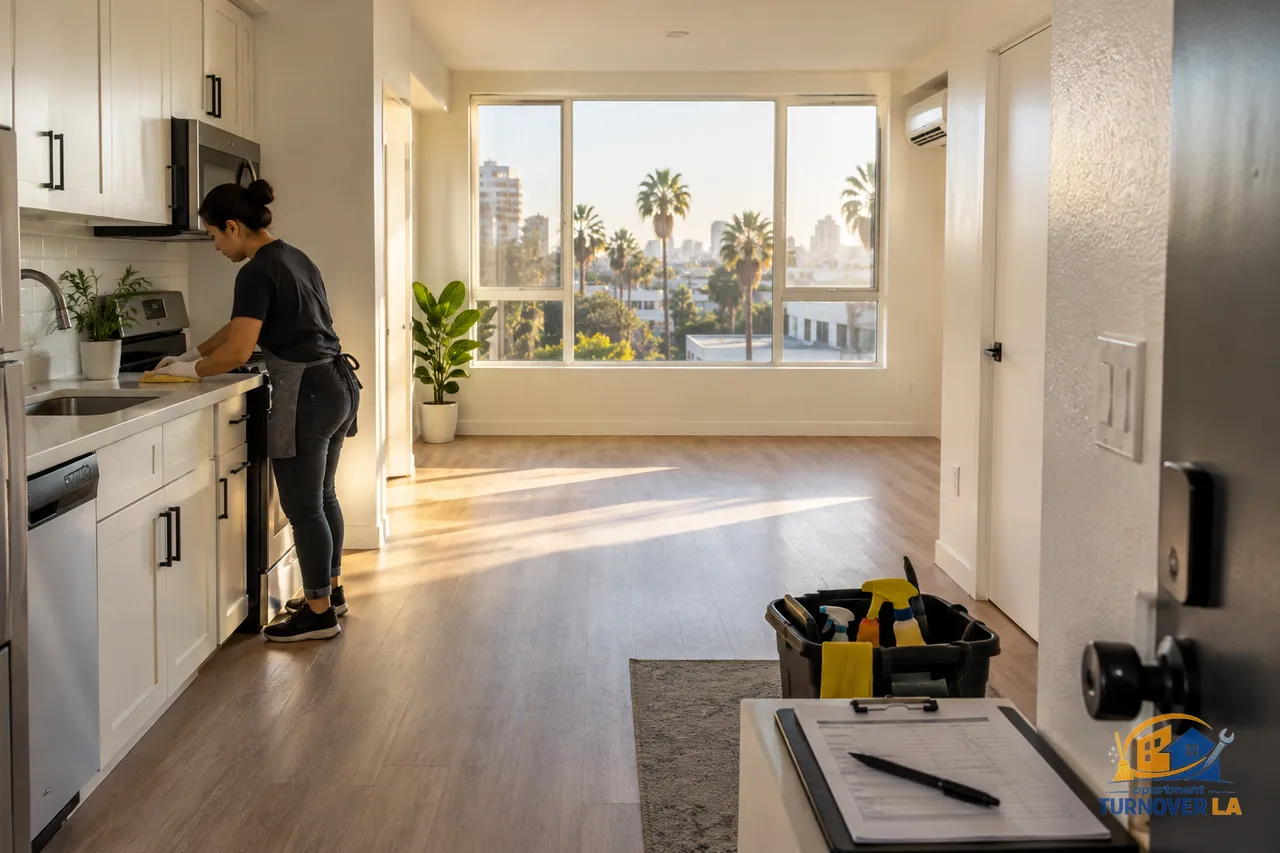
Quick answer: A three-hour apartment clean in Los Angeles usually costs about $75 to $165 when priced at the common hourly market range of $25 to $55 per hour. TurnOver LA does not sell an hourly cleaning block for vacant rentals: its documented Make Ready package is $225 for a studio, $255 for a 1 Bedroom, $335 for a 2 Bedroom, and $425 for a 3BR or larger, all with a 48-hour turnaround.
For a landlord, the useful question is not only how many hours a cleaner spends inside. It is whether the unit is clean enough to inspect, photograph, show, and hand to the next resident without a second crew visit. A three-hour hourly clean can work for a lightly used occupied apartment, but a vacant turnover often needs a defined scope and proof of completion. Get instant quote in 30 seconds
What does a three-hour clean typically cost in Los Angeles?
Across LA, independent and app-based cleaners commonly charge $25 to $55 per hour, putting three hours at a general market cost of $75 to $165. That range usually reflects labor time, may carry a two or three-hour minimum, and does not necessarily include a turnover inspection record. For a vacant rental, TurnOver LA's flat Make Ready prices are $225 for a studio, $255 for a 1 Bedroom, $335 for a 2 Bedroom, and $425 for a 3BR or larger.
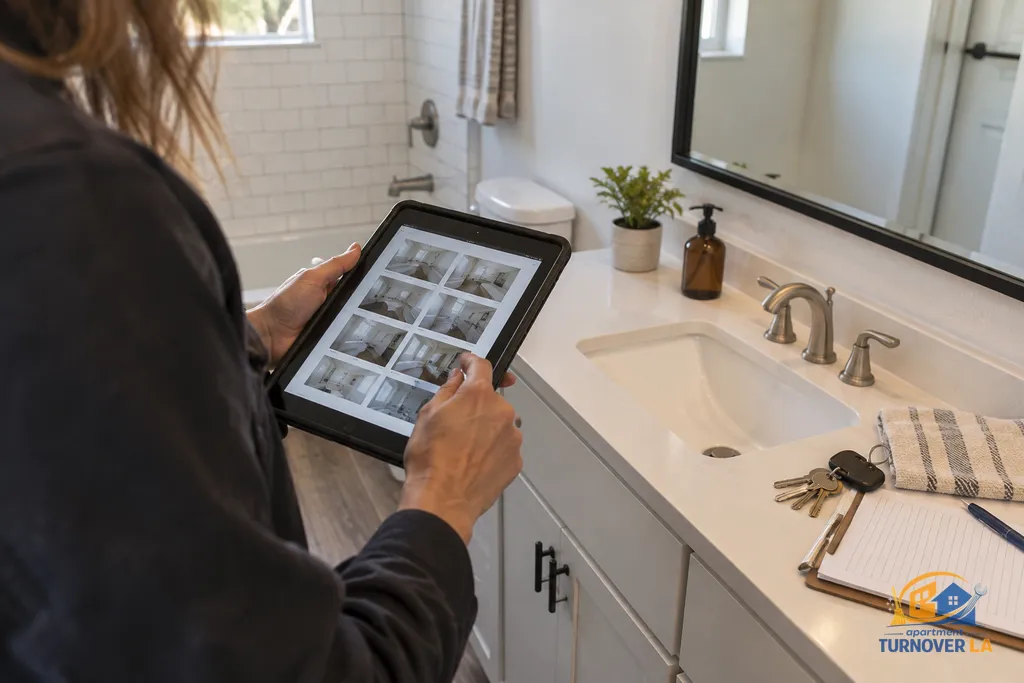
The difference is scope. The Make Ready service pairs a base deep clean with a 12-point photo report, so the owner or manager can review unit condition without guessing what was done. Labor and the crew's own supplies are included. Paint, replacement parts, and fixtures are evaluated on site, then added only with approval before they are invoiced. That matters when a routine cleaning exposes a failed vanity light, damaged blind, or wall patch that needs a separate decision.
Is three hours enough to clean a vacant apartment?
Three hours can be enough for a small, already-maintained studio or one-bedroom where the prior resident left on good terms and there are no odor, grease, or heavy-bathroom issues. It is often not enough when the cleaner must degrease kitchen cabinets, remove pet hair, detail a shower, clean inside appliances, or deal with move-out debris. Time is also lost when keys, parking, water access, or an elevator reservation are not ready when the crew arrives.
For turnover work, schedule by condition rather than the clock. A clean-looking unit may still fail a showing if fingerprints remain on the refrigerator, dust collects on window tracks, or bathroom grout photographs poorly. The first pass should identify work that cleaning cannot solve, including wall damage, failed hardware, and worn caulk. For room-by-room standards, use this apartment turnover checklist before authorizing work. It gives the cleaner and the manager the same finish line.
Why is an hourly clean different from an apartment Make Ready?
An hourly cleaner is generally working until the booked time ends. That model is sensible when a resident needs help with recurring housekeeping or wants a few specific rooms addressed. A vacant-unit Make Ready is an operations handoff. The job has to account for access, unit condition, a complete cleaning scope, inspection evidence, and the next action if the apartment has a repair issue.
TurnOver LA's Make Ready is built for that handoff, not as a promise that any unit will take a particular number of labor hours. The 12-point photo report is useful when the leasing agent, owner, and onsite manager are in different places. It also catches issues while the unit is open, rather than after the cleaner has left and the showing is scheduled. If the unit only needs intensive cleaning and no report-driven turnover workflow, compare the scope of deep cleaning for rentals. Do not book hourly time simply because the unit is small.
What should be included in a three-hour cleaning scope?
Before approving a three-hour visit, put the priority list in writing. A cleaner cannot reliably deep-clean every surface in a neglected apartment, clean inside appliances, and correct maintenance defects in one short appointment. Start with the spaces that affect health, odor, and first impressions, then identify anything that must be deferred.
- Kitchen counters, sink, stovetop, cabinet fronts, and visible grease.
- Bathroom toilet, shower or tub, vanity, mirror, and floor edges.
- Vacuuming and mopping of accessible flooring.
- Trash removal and wipe-down of high-touch switches, handles, and doors.
- A final walk-through for damage, missing items, leaks, and access problems.
This is where owners avoid a common turnover mistake: treating cleaning as a substitute for repairs. A cleaner can remove a scuff, but not patch a hole or stop a dripping angle valve. Send repair items through a defined apartment repair request, and document the issue before the next resident takes possession. Get instant quote in 30 seconds
Need the unit turned before the next tenant?
We do the move-out clean and send you a photo report you can attach to the deposit itemization.
From $225 · 48-hour turnaround
Get an instant quoteIs $50 an hour too much for cleaning in LA?
No, $50 an hour sits inside the general LA market range of $25 to $55 per hour for hourly cleaning. Whether it is a good value depends on who is working, the condition of the unit, whether supplies are included, and whether the cleaner can complete the critical areas before the booked time ends. A $50 hourly rate produces a $150 three-hour visit, but it does not automatically provide a rent-ready result.
For a vacant apartment, compare that market $150 example with TurnOver LA's $225 studio Make Ready price, which includes a deep clean and 12-point photo report with a 48-hour turnaround. The higher flat amount is not an hourly conversion. It covers a defined turnover deliverable and reporting process. In neighborhoods with fast leasing cycles, such as Hollywood, an incomplete clean that delays photos or a showing can cost more than the apparent savings from a shorter hourly booking. Vacancy loss in LA can run $80 to $200 per day, depending on the submarket.
How do you avoid paying for cleaning twice?
The best way to avoid duplicate cleaning is to inspect before the cleaning crew leaves, not after marketing begins. Confirm utilities are on, keys work, the refrigerator is empty, and all personal property is removed. If a unit needs a cleanout, do that first. Asking a cleaning crew to work around bags, furniture, or abandoned food wastes paid labor and makes the finished result harder to evaluate.
Next, separate cleaning work from damage and normal wear. California security-deposit rules govern what may be deducted and what documentation matters. Review California Civil Code §1950.5 and keep condition photos from move-in and move-out. The practical sequence is cleanout, inspection, repairs or paint approval, cleaning, then final photos. For a closer look at what a cleaning visit can cost versus a turnover scope, see move-out cleaning costs in Los Angeles. That sequence reduces return trips and creates a usable record if charges are challenged.
What is the 80/20 rule for apartment cleaning?
In apartment turnover work, the 80/20 rule is a practical prioritization tool, not a legal standard. It means a small set of visible and high-impact areas drives most of the impression that a unit is clean: the kitchen, bathroom, floors, odor, entry, and major surfaces. Start there when time is limited. Do not use the rule to skip sanitation, safety checks, or issues hidden behind a closed cabinet door.
For example, a clean bathroom mirror does not offset a dirty toilet base, and a vacuumed living room does not offset food residue in the refrigerator. The rule helps a manager tell a three-hour cleaner where to begin, but it is not a substitute for a full move-out standard. California landlords should also distinguish tenant-caused cleaning needs from ordinary aging. The California DCA Landlord-Tenant Guide provides useful statewide context, while this guide on normal wear and tear in California addresses the turnover distinction more directly.
When should a landlord use flat-rate turnover cleaning instead?
Use a flat, documented turnover scope when the apartment is vacant, the next showing date matters, or several people need to confirm readiness remotely. It is especially useful after a full move-out, when condition is uncertain and cleaning may uncover maintenance work. The operational benefit is not merely a clean apartment. It is one vendor workflow with a 48-hour turnaround and photo evidence that tells the manager what is complete and what still needs approval.
An hourly three-hour booking remains reasonable for a light refresh, such as cleaning an occupied unit before a visit or addressing a small, defined area. For a vacancy, choose the scope that supports the next step in leasing. Review the Make Ready process if you need to decide which path fits the unit. Then set access, parking, utility, and key details before the crew arrives. Get instant quote in 30 seconds
A three-hour clean is a time budget, not a turnover plan
A three-hour clean costs $75 to $165 in the general LA hourly market, and it can be useful for a short, tightly prioritized job. It is not a reliable description of what a vacant apartment needs after move-out. Unit condition, access, repairs, odors, and inspection requirements all change the real scope.
For landlords and small property managers, the better decision is to define the finish line before work starts. If the unit needs to be cleaned, inspected, and documented for the next leasing step, TurnOver LA's flat Make Ready package gives you a price by bedroom count rather than an uncertain countdown on the clock. Confirm the unit's condition, approve any needed materials after the onsite inspection, and keep the turnover moving.