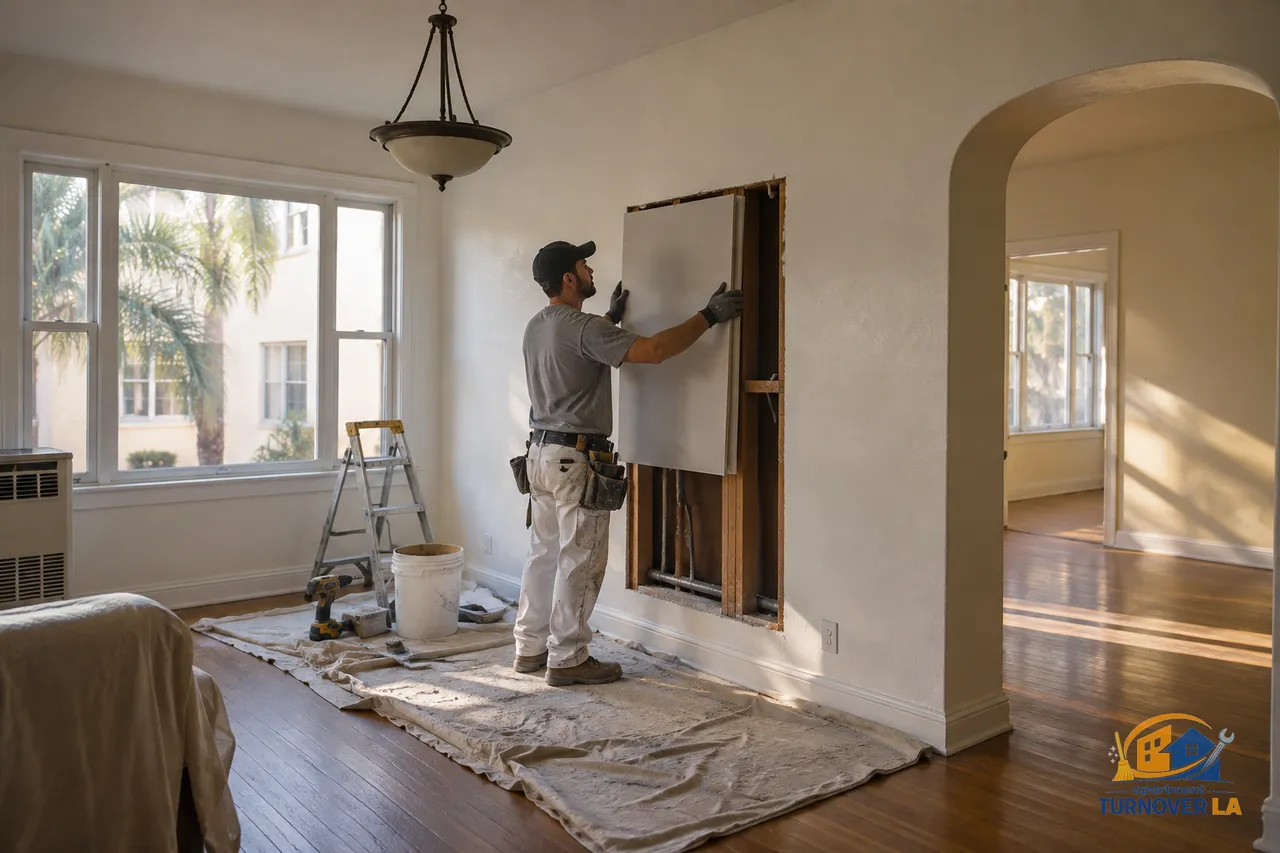
Quick answer: To repair a large area of drywall, cut the damaged section back to solid material and stud centers, inspect the wall cavity, install a matching drywall panel, tape and finish the seams, then match texture and paint. For an LA rental, plan on several drying stages, not one filler application. A large opening is usually a replacement-and-finish job, not a spackle job.
Large drywall damage should be repaired as a wall system: backing, board, joints, texture, and paint all need to work together. A patch that looks flat when wet can telegraph through paint or crack at the seam after the next tenant moves in.
Get instant quote in 30 seconds
What makes a drywall repair a large repair?
A repair becomes large when the missing or weakened area cannot be supported by the existing drywall alone. A fist-sized hole can sometimes take a small backing patch. Once damage reaches across a stud bay, follows a long crack, includes crushed gypsum, or sits near a door, outlet, plumbing access, or ceiling line, the practical repair is usually to remove a larger rectangle and install new board.
The important measurement is not just the visible hole. Check for soft paper, crumbling gypsum, water staining, loose fasteners, and an edge that ends between studs. A patch boundary that floats between framing has more movement and is more likely to crack along the finished seam. In many older LA units, the surrounding wall also has several paint layers or a texture that makes a narrow repair more visible than a deliberately squared, properly finished cutout.
How do you repair a large drywall area step by step?
First, protect floors and isolate the work area. Mark a rectangular cut that extends to sound drywall and, where possible, lands on the centerline of studs. Before cutting, identify electrical boxes, plumbing, low voltage wiring, and anything mounted on the opposite wall. Remove the damaged board cleanly, inspect the cavity for moisture or pest evidence, and correct the cause before closing the wall.
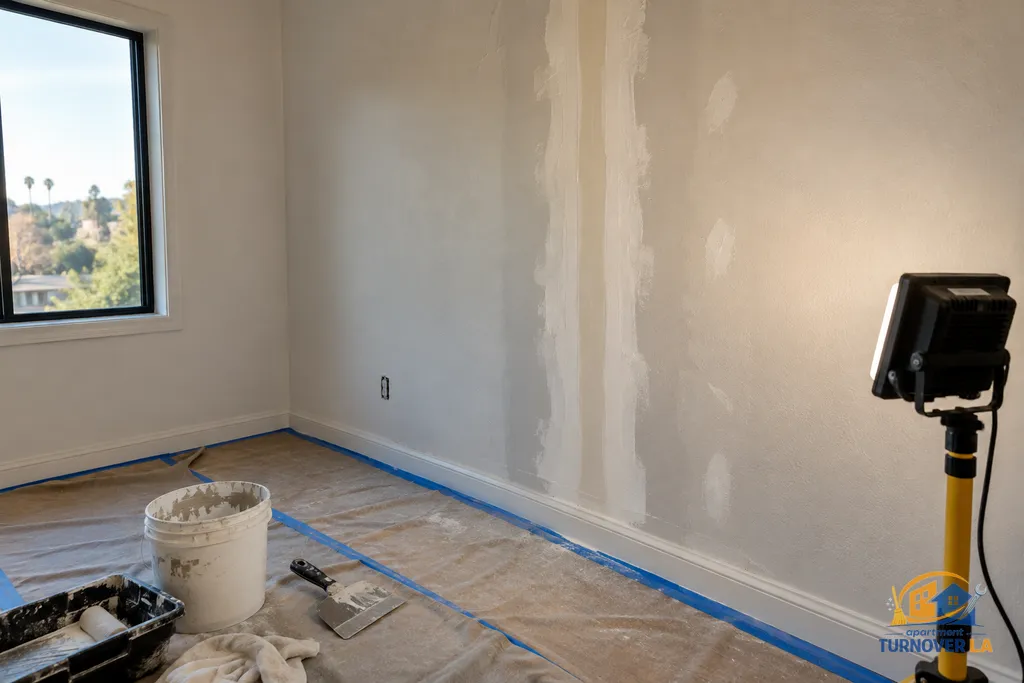
Measure and cut a replacement panel of the same thickness. Fasten it to framing without breaking the paper face. Then apply paper tape and joint compound over every seam, building the finish in thin coats rather than trying to fill the joint in one pass. Sand only after each coat is dry, using a work light held across the wall to find ridges. Prime the repair, reproduce the existing texture, and paint enough area to avoid a visible sheen change. For a related smaller-scale method, see our guide to drywall patching in LA rental apartments.
What should you inspect before closing the wall?
The wall cavity is the one part of this job you cannot inspect after the new panel goes up. Look for an active leak, damp insulation, mold-like staining, damaged framing, loose electrical boxes, or a missing nail plate where plumbing or wiring passes through a stud. If the damage began after a leak, replacing drywall without resolving the source simply creates a second repair.
Also check whether the wall is drywall at all. Some prewar and older Los Angeles buildings have plaster assemblies or prior repairs layered over lath. Their edges, thickness, and texture need a different approach. In a rental turnover, photograph the opened cavity before work continues. That record helps establish what was found and what was repaired. It also separates actual damage from normal wear and tear in California, which matters if a deposit accounting decision is still pending.
Why should drywall repair happen before the final clean?
Drywall work creates fine dust even when the crew uses containment and careful sanding. It settles on window tracks, baseboards, cabinet faces, floors, and HVAC returns. That is why the efficient turnover sequence is repair, primer and paint, then the final detailed clean. Sending cleaners in first often means paying for a second pass after sanding dust lands on surfaces that were already finished.
The same order protects the result. Paint is easier to blend after the repaired surface has been primed and checked under angled light. Once the wall work is complete, a Make Ready service can handle the final deep clean and 12-point photo report before showings. For repairs that include a door adjustment, loose cabinet hardware, or safety item, a combined handyman repair visit can keep the punch list in one workflow. Every TurnOver LA job has a 48-hour turnaround, with no rush or same-day upcharge.
Get instant quote in 30 seconds
Need the walls done before you re-list?
Turnover painting, scuff removal and patching, with a photo record of the condition we left behind.
$395 per room · 48-hour turnaround
Get an instant quoteCan painters do drywall repair before repainting?
Many painters can handle minor surface preparation, and some can complete a competent patch. The deciding question is whether the painter will open the wall, add backing or use framing correctly, tape the seams, allow separate drying cycles, match texture, prime, and repaint the affected area. A painter who only fills the hole and rolls color over it may leave a shadow line, a raised seam, or a texture mismatch.
For a small repair, TurnOver LA lists a Small drywall patch + texture at $150 / patch. A Medium drywall repair is $240 / patch. Those menu items are for defined patch work, not a promise that every large opening has the same scope. Larger damaged areas should be inspected before pricing because the board thickness, framing access, texture, and paint blending determine the labor. If repainting is needed beyond the repair zone, Repainting per room is $395 / room. Labor and crew supplies are included, while paint, parts, or fixtures are approved before they are added to the final invoice.
What is the best filler for large drywall holes?
Joint compound is the finishing material, not the structure that replaces missing drywall. For a large opening, the best repair uses a new piece of drywall supported by studs or solid backing, with paper tape embedded in setting or drying compound at the seams. The panel carries the wall plane. The compound feathers the transition so it disappears after primer and paint.
Mesh tape can work in limited situations, but paper tape is often the safer choice for broad flat seams because it beds tightly and resists cracking when installed correctly. Lightweight spackle is useful for pinholes and shallow finish corrections, not for rebuilding a section of wall. Expanding foam, cardboard backing, and oversized blobs of filler may look acceptable at first, but they do not create a durable, paint-ready plane. On textured LA walls, save a small section of the removed board or take close photos before sanding so the orange peel, knockdown, or hand-applied pattern can be matched.
How much does large drywall repair cost in Los Angeles?
Across LA, a large cutout-and-replace drywall repair commonly receives a general contractor quote of about $300 to $1,000, depending on framing, wall texture, access, moisture investigation, and the amount of paint blending required. That is a general market range, not a TurnOver LA price. A large repair needs an on-site scope because a 2 by 2 foot opening on a clear wall is different from damage beside a shower valve, electrical panel, or heavily textured ceiling.
With TurnOver LA, the published starting reference points are $150 / patch for a small drywall patch with texture and $240 / patch for a medium drywall repair. A larger area is assessed on site rather than forced into a misleading flat rate. If the repair also needs finish painting, the catalog rate is $395 / room for repainting per room. Paint and other job materials are priced at inspection and added only with your approval. For broader turnover budgeting, see apartment turnover costs in Los Angeles.
How do landlords document a large wall repair for the deposit file?
Take dated photos before any work, during the opened-wall inspection, after the patch is finished, and after paint is complete. Keep the move-in condition report, the repair scope, labor invoice, material receipts, and notes showing why the work was needed. If you charge a former tenant, the evidence should distinguish unusual damage from age, previous wear, or a building condition such as a leak.
California deposit rules impose deadlines and documentation requirements, so do not wait for final paint touchups before organizing the file. Review California Civil Code §1950.5 and the California DCA Landlord-Tenant Guide for the applicable rules. For operational guidance on the timing and paperwork, see our California 21-day deposit return guide. A repair record is most useful when it states what was damaged, what work restored it, and what was actually spent.
What is the practical turnover sequence after a large repair?
Use a sequence that allows the wall to dry and prevents rework:
- Document the damage and inspect for the underlying cause.
- Cut back to sound drywall and framing, then install matching board.
- Tape, apply thin finish coats, dry, sand, prime, and match texture.
- Paint the repair area or the full room as needed for a consistent finish.
- Complete the final clean, replace filters or hardware, and photograph the rent-ready unit.
This order matters because the final inspection should happen after the wall surface is stable, dry, and painted under normal room lighting. A repaired wall can look fine under a work light but show a raised seam in afternoon sun or after a prospective tenant turns on a ceiling fixture. Build in enough time for drying rather than covering wet compound with primer.