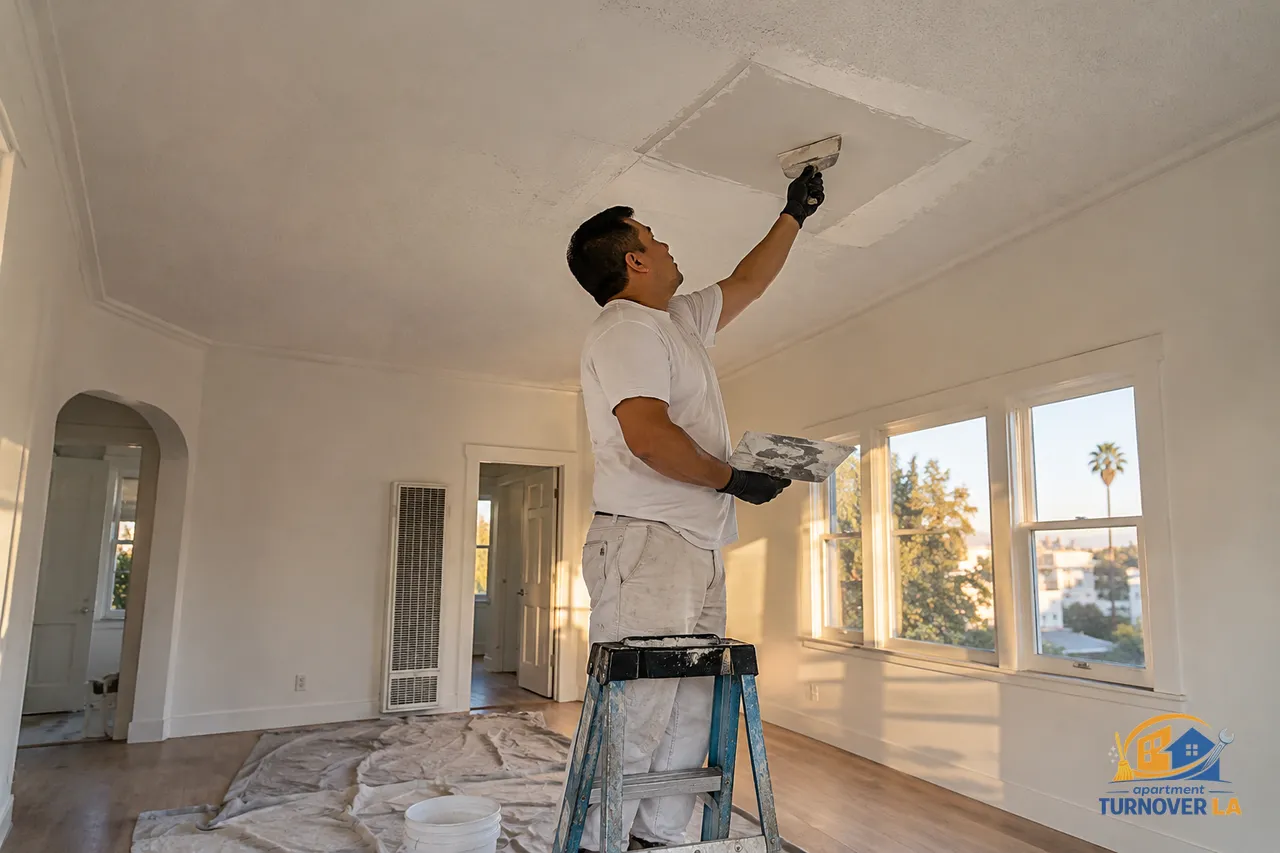
Quick answer: Repair a small, dry drywall ceiling hole by removing loose board, adding solid backing, fastening a matching patch, then taping, feathering compound, sanding, priming, and painting. Across LA, professional ceiling patch quotes commonly run $150 to $400. TurnOver LA charges $150 / patch for a small drywall patch + texture or $240 / patch for a medium drywall repair, with a 48-hour turnaround.
A sound, dry ceiling with a small puncture or isolated crack can usually be patched without replacing the whole sheet. Before applying any compound, find out whether the damage came from a leak, a loose fastener, or movement above the ceiling, because a cosmetic patch will fail if the cause is still active.
Get instant quote in 30 seconds
What should you check before repairing a drywall ceiling?
Start with the source of the damage, not the visible hole. In LA apartments, ceiling damage often follows a slow supply-line leak from the unit above, a failed toilet wax ring, an overflowing tub, or condensation around an older bathroom exhaust fan. Touch the area only after confirming that nearby electrical fixtures are safe. Look for staining that spreads beyond the hole, soft paper facing, sagging, a musty odor, rust at fasteners, or a crack that follows a seam for several feet.
Press gently around the damaged area. Drywall that feels firm and stays flat is a candidate for a localized repair. If it flexes, crumbles, or bows downward, remove enough material to reach solid board before deciding on the patch size. Photograph the condition before work begins. For a rental turnover, those photos help separate pre-existing building damage from resident-caused damage and support a clear repair record.
What tools and materials are needed for a small ceiling patch?
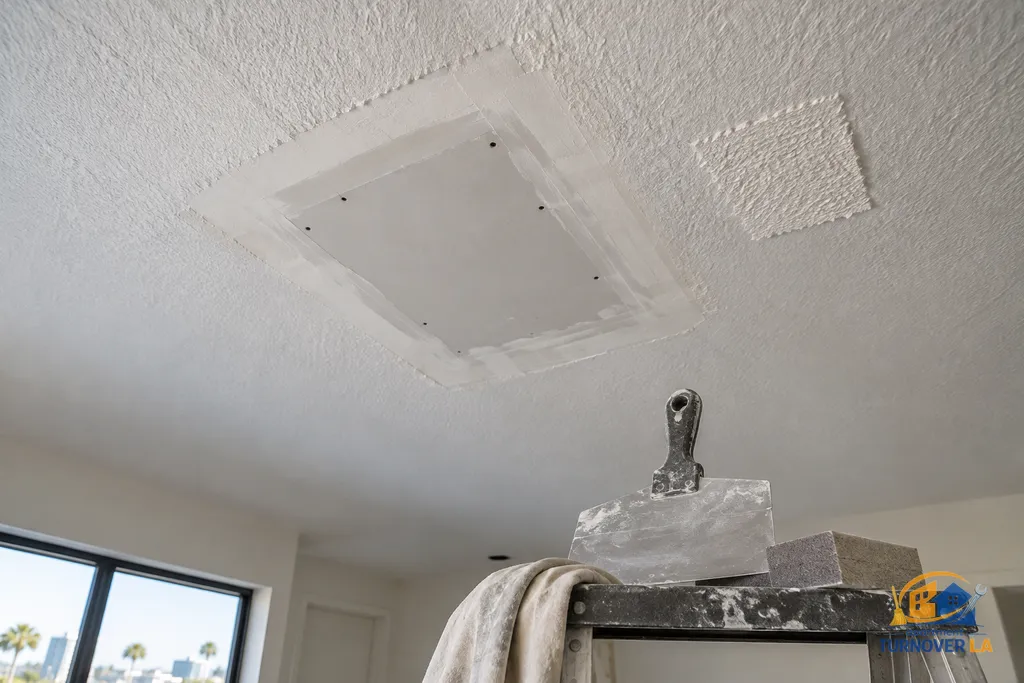
A durable ceiling patch needs more than a mesh square and a tub of compound. Gather a utility knife, drywall saw, measuring tape, straightedge, 1-by-2 or 1-by-3 wood backing, drywall screws, a drywall patch matching the existing board thickness, paper tape or fiberglass tape, setting-type compound, finishing compound, a six-inch and a 10-inch or 12-inch knife, sanding sponge, primer, and ceiling paint. Use eye protection and a dust mask, especially in older units where ceiling texture may create a large amount of fine dust.
For texture matching, test your spray or stipple technique on cardboard first. LA rentals commonly have smooth ceilings, light orange peel, or acoustic texture, and the repair can look obvious even when the patch itself is structurally sound. If the ceiling is painted flat white, prime the patched area before final paint. Skipping primer is a frequent reason patches flash or show through under side lighting.
How do you repair a small drywall ceiling hole step by step?
For a hole that is dry, stable, and not part of a failed seam, use this sequence. Do not work overhead alone on a large opening or beneath a ceiling that is sagging.
- Cut away loose paper and weak gypsum until the opening has firm, clean edges. A square or rectangle is easier to back and patch than a ragged circle.
- Slide wood backing through the opening and hold it tight against the back of the ceiling. Drive drywall screws through the existing ceiling into the backing on both sides of the opening.
- Cut a patch to fit with a narrow, even gap. Fasten it to the backing without breaking the paper face.
- Apply tape over the seams. Paper tape works well on flat seams when embedded fully in compound, while fiberglass tape can help bridge a small repair.
- Apply a thin first coat of compound, then two wider feathered coats after each coat dries. Keep the edges progressively wider so the repair disappears across the ceiling plane.
- Sand lightly, check the area with light from the side, then repeat a skim coat if ridges or screw heads remain visible.
- Match the texture, prime the repair, and repaint enough of the ceiling to avoid a visible paint halo.
If the opening is larger than a simple patch or the finish needs to match a tenant-ready standard, book a drywall repair service rather than relying on a surface patch kit.
Should ceiling drywall be replaced if it gets wet?
Sometimes. Drywall should generally be cut out and replaced if it is sagging, soft, swollen at the edges, stained through the paper, moldy, or still damp after the leak has been stopped and the cavity has been dried. The front face can look dry while the paper backing and gypsum core remain compromised, especially after water pooled on top of the board. A patch over wet material can trap damage and produce a recurring stain or crack.
A small water mark on a firm, fully dry ceiling may only need stain-blocking primer and paint after the plumbing issue is fixed. Do not make that call based on appearance alone. Open a controlled inspection area when there is a continuing odor, a broad yellow stain, or any downward bowing. In a multifamily building, document where the water originated before closing the ceiling. That matters for maintenance follow-up and for allocating repair responsibility between units.
Need the unit turned before the next tenant?
We do the move-out clean and send you a photo report you can attach to the deposit itemization.
From $225 · 48-hour turnaround
Get an instant quoteWhat are two common mistakes made during ceiling drywall repair?
The first common mistake is repairing the finish before correcting the cause. Taping over a crack caused by a leaking pipe, loose drywall fasteners, or movement at a seam only creates a short-lived repair. The second is applying joint compound too thickly. Heavy coats take longer to dry, shrink more, and leave a hump that catches light across a ceiling.
Another frequent problem is using mesh tape without enough embedded compound, then sanding through the surface. On a ceiling, tape needs a continuous bed and wide feathering because overhead light makes every ridge visible. Rushing the paint stage also causes trouble. Compound can feel dry at the surface while still holding moisture underneath. Let each coat cure, sand under good lighting, then prime. For scuff and surface issues outside the ceiling repair itself, this guide on apartment wall scuff removal covers the different prep needed before touch-up paint.
Get instant quote in 30 seconds
How much is professional drywall ceiling repair in Los Angeles?
Across LA, a professional small ceiling patch commonly costs about $150 to $400, depending on the opening size, texture, access, repainting scope, and whether water damage has spread beyond the visible area. That is a general market range, not a TurnOver LA rate. With TurnOver LA, a small drywall patch + texture is $150 / patch, and a medium drywall repair is $240 / patch. Both are scheduled with a flat 48-hour turnaround, with no rush or same-day upcharge.
A repair can require separate paint work when a patch must blend into a larger ceiling area. TurnOver LA lists ceilings and baseboard/trim at $125 and paint touch-up only at $200. Labor and the crew's own supplies are included in the quote. If the job needs materials such as paint, parts, or fixtures, they are priced at the on-site inspection and added to the final invoice only with approval first. For broader unit fixes, a handyman punch list can be a better fit than scheduling separate vendors.
When should a landlord call a professional instead of patching it?
Call a professional when water damage is involved, the opening is larger than a small isolated puncture, the ceiling is cracked along a joint, texture must match, electrical wiring is nearby, or the building has an active leak between units. These conditions turn a simple patch into an inspection, drying, and finish-coordination job. A turnover crew also helps avoid the common delay where cleaning is completed before a ceiling repair creates new dust and paint touch-up work.
For California rental owners, repair documentation also affects the security-deposit process. Damage beyond ordinary use may be itemized, but deductions need to follow the rules in California Civil Code §1950.5. Review the distinction between normal wear and tear in California and chargeable damage before assessing a former resident. The California DCA Landlord-Tenant Guide is also a useful reference for owner responsibilities and deposit handling.
How can you keep a ceiling repair from delaying the next showing?
Sequence the work in the right order: stop the source, dry and inspect, repair the board, sand and paint, then complete the final clean. Doing it backward leaves dust on finished surfaces and can add another visit. For a vacant unit, keep the repair area isolated with a drop cloth, remove sanding debris before cleaners arrive, and photograph the completed ceiling in natural and switched-on light. Those two lighting conditions reveal different patch flaws.
If the unit needs a complete turnover after the ceiling is fixed, pair the repair with a Make Ready service, which includes a base deep clean and a 12-pt photo report. That gives the owner a condition record after repairs rather than relying on a verbal completion note. It also keeps cleaning, patching, and final presentation on one 48-hour workflow instead of waiting on separate vendors.