Quick answer: The two most common mistakes made during drywalling are applying joint compound too thickly and sanding the repair too aggressively. Thick mud leaves a raised patch that shows after paint, while over-sanding cuts paper, exposes tape, or creates a low spot. In an LA rental turnover, both errors can delay painting and make a small repair visible at the final walk-through.
For landlords, the issue is not whether a patch looks passable while it is dusty and unpainted. It is whether the wall still disappears after primer, sheen-matched paint, daylight, and a tenant's furniture are in the room. A sound repair sequence protects the turnover schedule and creates a record that is easier to distinguish from ordinary wear later. Get instant quote in 30 seconds
What are the two most common mistakes made during drywalling?
The first mistake is building the repair with too much joint compound in one pass. Compound shrinks as it dries, and a thick application often leaves a hump, edge, or shallow crater after sanding. The second is over-sanding, especially at the edge of paper tape or the face paper of the drywall. Once that paper is fuzzy, torn, or thinned, paint can flash differently and the repair may need another skim coat or a sealing primer.
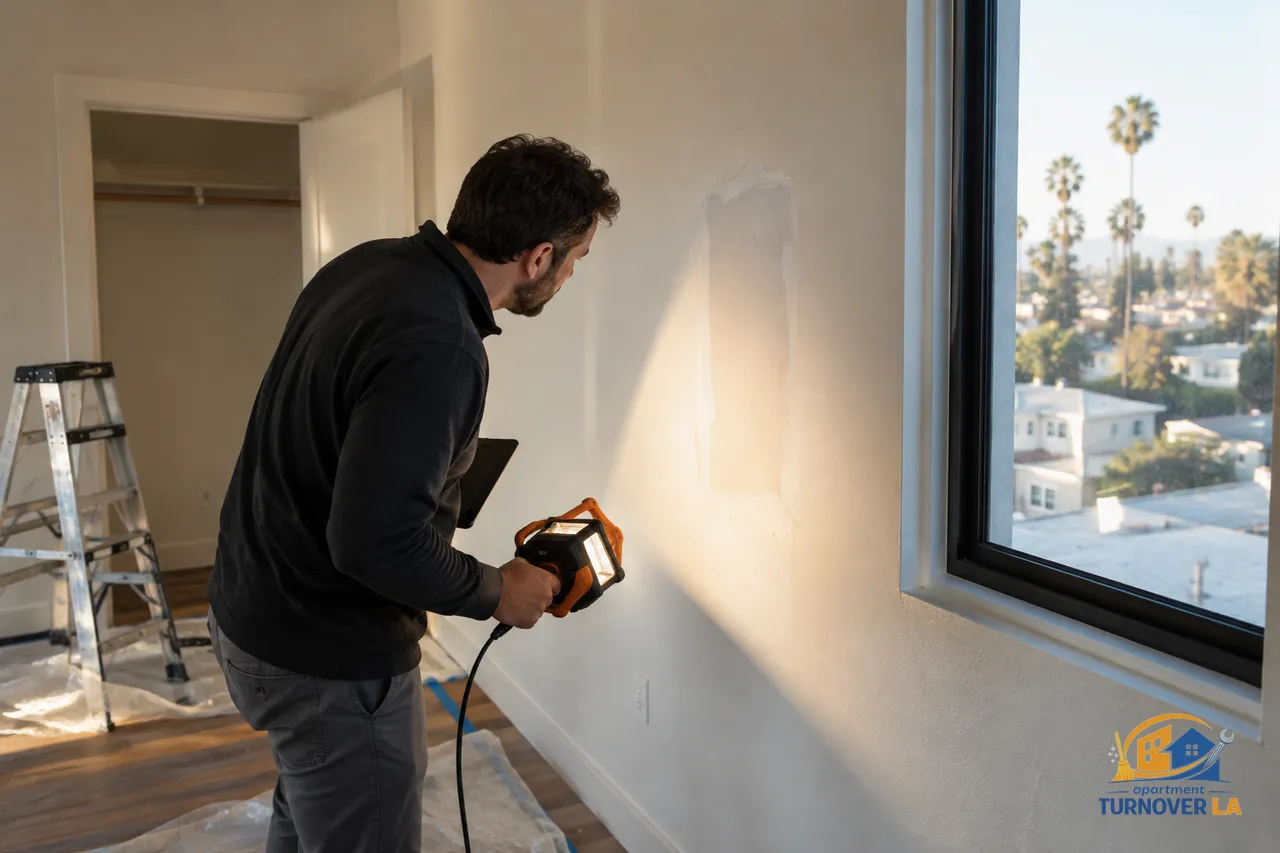
These are not just cosmetic errors in a rental. A tenant may not notice a dry patch during move-out, but a raised oval becomes obvious when a painter rolls low-sheen paint across it. The practical standard is a wide, gradual feathered edge, not simply a smooth-looking white spot. Use a straightedge across the repair and inspect it with light cast across the wall, rather than looking directly at it. That check catches profile problems before paint makes them more expensive to correct.
Why does thick joint compound show through paint?
Joint compound needs thin coats because each coat has a different job. The first fills the void and embeds tape where needed. The next coat widens the repair. The final skim blends the patch into the surrounding wall. Trying to do all three at once usually creates a dense center with a tight edge. It may feel smooth after sanding, but it still sits proud of the wall plane.
In vacant units, the failure often appears after a paint touch-up rather than immediately. Fresh paint can reflect light differently over a patch, especially on eggshell walls common in kitchens, hallways, and living rooms. A repair also needs adequate dry time before the next coat. Rushing from wet compound to sanding can pull material off the surface, then tempt the worker to refill the same area too heavily.
For a turnover, use a wider knife on each successive coat and keep the final feathered edge broad. A wall repair should be judged from several feet away under both window light and switched-on fixtures. This is why a small wall ding can require more care than its size suggests.
How does over-sanding turn a small patch into a repaint problem?
Over-sanding creates two separate problems. First, it can cut through the tape or damage the drywall face paper. Second, it can hollow out the center of a patch while leaving a hard ridge around it. Both defects become more apparent after paint because the changed surface absorbs primer and finish paint differently from the original wall.
A good sanding pass removes tool lines, not the repair itself. Start with a light hand, use a sanding block or pole sander to keep pressure even, and stop periodically to check the surface by touch and with side lighting. If a repair has a pinhole, a knife line, or a low spot, it usually needs a thin skim coat, not more aggressive sanding.
The rental-specific risk is a mismatch between the repaired spot and an otherwise clean wall. In a Hollywood or Koreatown unit with strong afternoon sun, a shallow depression near a window can be more visible than a larger patch in a dim closet. After a tenant move-out, coordinate patching with paint decisions rather than treating them as unrelated tasks. TurnOver LA can handle a standalone drywall repair service or coordinate the repair with painting work when the wall needs a broader reset.
How should a landlord inspect drywall before approving paint?
Inspect drywall after the final skim and again after primer. Do not rely only on a contractor's close-up view of the patch. The following five checks make the approval process faster and more consistent across units:
- Stand at least six feet back and look along the wall plane, not straight at the repair.
- Turn on a bright lamp or use daylight from a side window to reveal ridges and depressions.
- Run a clean hand lightly over the edge to feel for a hump, sharp line, or soft paper.
- Check corners, outlet cutouts, and door-jamb areas for cracks that may signal movement rather than a simple impact hole.
- Photograph the completed surface before paint if the repair relates to a move-out charge or recurring building issue.
This inspection also helps separate a repair from a cleaning problem. Scuffs, small nail holes, and ordinary wall marks are not automatically tenant damage. Review normal wear and tear in California before allocating any cost. For a vacant unit with multiple small defects, a coordinated handyman punch-list visit can prevent separate trade visits from extending downtime. Get instant quote in 30 seconds
Need a turnover quote?
Send the unit address and your target date. We quote in 15 minutes.
From $225 · 48-hour turnaround
Get an instant quoteShould a wet drywall ceiling be repaired or replaced?
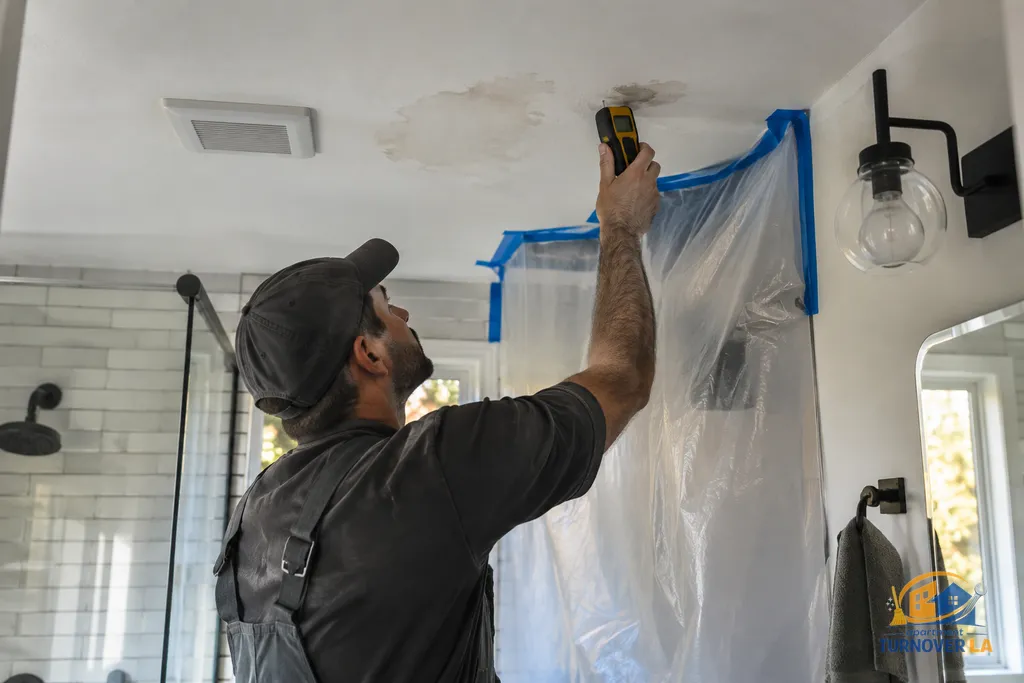
A wet ceiling should not be treated like a routine patch until the source of water is stopped and the material is dry. Drywall is gypsum covered in paper. Once water has soaked the core, softened the paper, caused sagging, or produced a persistent stain or odor, patching over the surface can hide a continuing failure. A ceiling also carries its own safety concern because saturated material can loosen and fall.
Start by documenting the location, checking the unit above or roof condition where relevant, and testing the area around the visible stain. If the board is firm, dry, and not distorted after the source is fixed, a stain-blocking primer and finish repair may be appropriate. If it is soft, bowed, crumbly, mold-affected, or wet beyond the visible edge, remove the damaged section and inspect the cavity before closing it.
This is a useful turnover distinction: a clean circular ceiling patch may be a repair issue, but a fresh ring after rain or an upstairs leak is a building-maintenance issue. Do not let a rushed paint schedule close the ceiling before the moisture condition is understood. California's California DCA Landlord-Tenant Guide is a useful starting point for habitability responsibilities when water intrusion affects a rental.
Can a landlord charge a former tenant for drywall damage?
A landlord can generally deduct for repair of damage beyond ordinary wear, but the documentation and the cause matter. A small number of minor nail holes, light scuffs, and age-related hairline cracking may fall under normal wear. A punched hole, unauthorized wall opening, repeated anchor damage, or a door-handle impact with a clear cause is different. Take move-in and move-out photos from the same general angle, preserve invoices, and avoid treating repainting an entire aged wall as a charge for one small mark.
For California deposits, the timing and itemization requirements are as important as the repair itself. Review California Civil Code §1950.5 and the practical timing steps in this guide to the California 21-day deposit return rule. The point is not to make a tenant pay for every wall imperfection. It is to maintain a defensible record when damage requires actual restoration.
A useful operational habit is a repair map. Mark each patch by room, note its likely cause, photograph it before work, and note whether it was repaired, primed, or painted as part of a wider wall refresh. That record is more useful than a single after-the-fact invoice when questions arise.
When is professional drywall repair the better choice?
Professional help makes sense when the repair involves a crack that returns, a hole larger than a simple surface ding, damaged corner bead, loose tape, ceiling material, water exposure, or a wall that needs texture matching. It is also sensible when a vacancy has multiple minor repairs spread across rooms. A single coordinated scope avoids the common turnover problem of cleaning first, finding wall damage later, and then scheduling painters after the unit was thought to be ready.
For straightforward work, the scope should identify labor, access, prep, patching, texture, primer, and whether painting is limited to the repair or extends to a larger wall. TurnOver LA quotes labor and crew supplies, while paint, parts, and fixtures needed for a job are reviewed at the on-site inspection and added only with approval. That distinction matters when an apparently simple patch reveals a leak, failed corner bead, or a color mismatch that requires more than local touch-up.
A finished patch is ready only when it is dry, flat under side light, stable at its edges, and compatible with the planned paint finish. Treat those as turnover acceptance criteria, not optional cosmetic details. Get instant quote in 30 seconds
What is the practical drywall sequence for a faster turnover?
The fastest reliable sequence is diagnose, protect, repair, inspect, prime, then paint. Diagnose the cause before closing a hole or stain. Protect floors and nearby fixtures before sanding. Repair with thin, dry coats rather than one heavy fill. Inspect with side lighting before primer, then use primer to expose remaining surface differences before the finish coat.
This sequence prevents a frequent vacancy delay: completing a deep clean, then creating fresh sanding dust or paint splatter because wall work was scheduled too late. If the apartment needs broader move-out coordination, use the apartment turnover checklist to place drywall and paint work before final cleaning and listing photos. The goal is not perfect new-construction walls in every unit. It is a durable, clean, consistent finish that will pass a realistic move-in inspection without creating avoidable rework.